Assemblymember Phil Ting Reintroduces Bill to Decriminalize Jaywalking

Note: GJEL Accident Attorneys regularly sponsors coverage on Streetsblog San Francisco and Streetsblog California. Unless noted in the story, GJEL Accident Attorneys is not consulted for the content or editorial direction of the sponsored content.
Citing statistics that show that jaywalking laws in California are mostly used to cite Black and brown people in California, Assemblymember Phil Ting introduced a new bill, A.B. 2147, to end the practice of stopping and citing pedestrians that pose no danger to themselves or others when they cross a street.
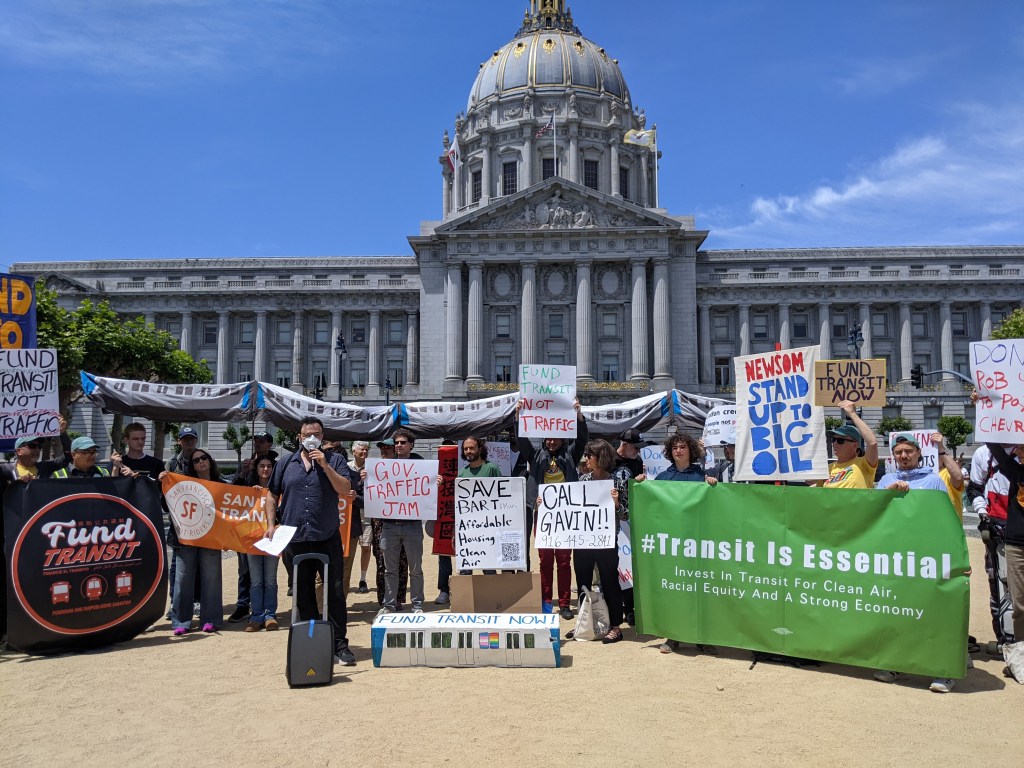
At a press conference on a busy San Francisco street this morning, Assemblymember Ting stated that the “Freedom to Walk” bill, A.B. 2147, would not mean that dangerous behavior is suddenly legal.
“Law enforcement still has every ability to stop and cite anyone who is crossing unsafely,” he said. A.B. 2147 simply clarifies that any reasonable person crossing a street in a safe manner has the right to do so.
A similar bill from the same author last year, A.B. 1238, made it all the way through both legislative houses, only to be vetoed by Governor Newsom.
Ting cited data from the city of Beverly Hills, where almost every jaywalking citation issued in the city was handed out to Black people. “Clearly jaywalking laws are being used to dissuade certain people from being in, and walking in, that city,” he said.
Ting also mentioned cases in San Clemente and Millbrae in which Kurt Reinhold and Chinedu Okobi were killed by police after what began as a stop for jaywalking, and another case in Sacramento where police beat Nandi Cain for a similar offense. All three of them are Black men, and all three incidents were captured on video.
Rio Scharf, an attorney with the Lawyer’s Committee for Civil Rights, which is sponsoring the bill, said at the press conference that while a citation for jaywalking “might seem minor, it could have a profound impact” on someone’s life. In addition to the stark racial disparities in who is usually cited, he said, “current jaywalk laws give law enforcement an excuse to stop anyone they want for engaging in everyday behavior. This can lead to dangerous and even fatal interactions between police and pedestrians, and it can saddle people with debt.”
A.B. 2147 “is a safety bill, a justice bill, and an economic justice bill,” he said.
Scharf also pointed to data from around the country and globally where jaywalking is not a crime. In many of those places, “pedestrians are safer” than they are in California. “All that jaywalking does is criminalize people; it does not increase safety,” he said.
Assemblymember Ting made some changes in response to Newsom’s veto of A.B. 1238. “We spent the fall working with the governor’s office and the CHP” to resolve their concerns, he told Streetsblog. In contrast to last year’s bill, A.B. 2147 “doesn’t repeal the jaywalking law,” he said. “Instead, it defines when an officer can stop someone.” That is, police can still stop a pedestrian for unsafe crossing but only in a situation when “a reasonably careful person would realize there’s an immediate danger of collision.”
“We don’t want anybody to cross the street in a dangerous way,” said Ting, but “we also know that when people are in their right mind no one crosses in front of a vehicle. People don’t want to get hit by cars.”
And, as Ting pointed out, the state is trying to encourage more people to walk, and encourage people to walk more. In areas that lack crosswalks, where a person can legally walk is tightly circumscribed if it is illegal to safely cross a street outside of a crosswalk.
“People shouldn’t be cited for reasonable behavior,” he said.
Streetsblog has migrated to a new comment system. New commenters can register directly in the comments section of any article. Returning commenters: your previous comments and display name have been preserved, but you'll need to reclaim your account by clicking "Forgot your password?" on the sign-in form, entering your email, and following the verification link to set a new password — this is required because passwords could not be carried over during the migration. For questions, contact tips@streetsblog.org.