App-Based “Microtransit” Provider Bridj Closes Shop

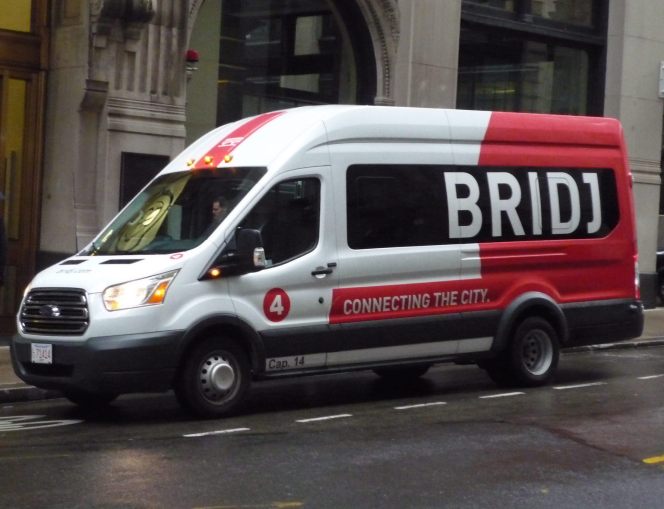
Bridj, the premium app-based “microtransit” service that tailored routes and prices based on customer demand, has folded after exhausting its funds.
“We made the strategic choice to pursue a deal with a major car company,” CEO Matt George wrote in a post on Medium. “Despite assurances, and all parties acting in the best of faith, that didn’t happen. With this in mind, we have made the difficult decision to begin winding down.”
The company, founded in 2014, had launched in Boston, Austin, and Washington, DC, before beginning a partnership with the Kansas City Area Transportation Authority. That program, which cost the authority $1.3 million, served just 1,480 people in a year before ending in March. Most of its users were younger and wealthier than the typical Kansas City area resident, and many potential riders indicated that the service wasn’t robust enough to be useful to them.
The company’s largest market was its hometown of Boston, where it operated up to 50 vehicles at a time, according to the Boston Globe. Bridj had proposed offering late-night bus service in partnership with the Massachusetts Bay Transportation Authority, but never reached an agreement with the T.
Former Massachusetts transportation secretary Jim Aloisi, who had been hopeful about the prospect of app-based van services as a complement to traditional transit, said Bridj’s demise is an opportunity to reflect on what people are looking for from transportation providers.
“It never fulfilled the promise that some people thought it might have fulfilled, because when you think about Bridj, at the end of the day it’s a fancy bus that’s stuck in traffic with everyone else,” Aloisi told Streetsblog. “This only underscores the need for Boston to invest in Bus Rapid Transit.” Just a few weeks ago, the Barr Foundation announced up to $100,000 in funding for Boston-area municipalities and transit agencies investing in upgrades to improve bus speeds.
Bridj isn’t the first app-based private transit service to shut down. Leap Transit, which raised $2.5 million from big-name Silicon Valley venture capitalists to offer $6 luxury bus rides across San Francisco, folded in 2015.
One of Bridj’s competitors, Chariot, remains very much in business, with plans to expand to eight cities this year, thanks to the sort of backing that Bridj never secured. The company was purchased by Ford last September for more than $65 million. Ford CEO Mark Fields has positioned Chariot at the heart of its move to “smart mobility” — i.e. transportation as a service, not a private vehicle.
Having access to a deep pool of capital seems necessary for companies like Bridj to survive long enough to develop a viable model and scale up. Even then it might not be enough. “This is expensive stuff,” Aloisi said of transit services. “It’s not clear that even companies like Uber are going to be able exist for any long period of time if they keep losing substantial amounts of money.”
Streetsblog has migrated to a new comment system. New commenters can register directly in the comments section of any article. Returning commenters: your previous comments and display name have been preserved, but you'll need to reclaim your account by clicking "Forgot your password?" on the sign-in form, entering your email, and following the verification link to set a new password — this is required because passwords could not be carried over during the migration. For questions, contact tips@streetsblog.org.