Legislators Announce a California Green New Deal
A group of legislators today announced the introduction of a new bill–one of the first of the 2020 session–that they say will address climate change and equity in California.
The bill would work in a manner similar to the way A.B. 32 and S.B. 32 addressed climate change: by creating targets, with deadlines, on a variety of issues related to climate change, the environment, and social equity. The details have yet to be worked out, but the targets will address emissions, the environment, public health, housing, and systemic racial injustice, “to ensure all California residents enjoy a 21st century standard of living without regard to their wealth or income,” according to the bill’s draft language.
The bill’s authors say A.B. 1839 recognizes that all Californians have the right to clean air and water, and healthy food–and that access has not been experienced equally throughout the state’s communities.
The bill was written, said Assemblymember Rob Bonta (D-Oakland), its principle author, after a similar attempt last year didn’t get off the ground. In the intervening months, a coalition of legislators covering a broad swath of the state–north and south, inland and coastal–came together to discuss issues connected to climate change and to formulate a plan to fix them.
“This is a big bill. It’s a paradigm-shifting bill,” said Bonta. “It will have obstacles. But this is not something we just decided to do; it’s something that science is telling us we have to do.”
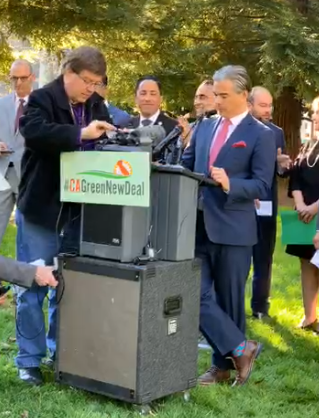
The bill’s co-authors took turns reminding people that time is of the essence, and that help is not coming from outside the state. Meanwhile, “homelessness, poverty, and income inequality have risen,” said Bonta. “Historically marginalized communities have been experiencing the worst of the pollution, and have been denied access to clean air and water. Those who have suffered most from the effects of climate change and pollution must be first in line to benefit from a cleaner, greener society,” he added.
To address climate change and inequity, he said, the bill will call for doubling affordable housing, accelerating emissions reductions, and creating high-quality jobs in clean-emission industries. The authors called it a “new California compact for a better, greener life for all.”
“With this bill we could put our state on the path to a sustainable future,” said Robert Rivas (D-Hollister), one of the co-authors. “Climate change costs lives, but it also costs billions of dollars of damage. Having lived in rural California my entire life, I can tell you our rural areas are on the forefront when it comes to suffering the effects of climate change.” Heat waves and changing growing cycles, for example, have immediate negative effects on farmworkers, he said.
“Addressing climate change also means we must address poverty and economic disadvantage,” added Eloise Gomez-Reyes (D-San Bernardino). She pointed out that the areas of the state that need economic opportunity the most are the ones that end up hosting some of the most polluting, environment- and climate-damaging industries.
“The solutions are known, and the science is abundantly clear,” said Todd Gloria (D-San Diego). “The question is how soon will we act. It will only get harder the longer we wait to have these conversations.”
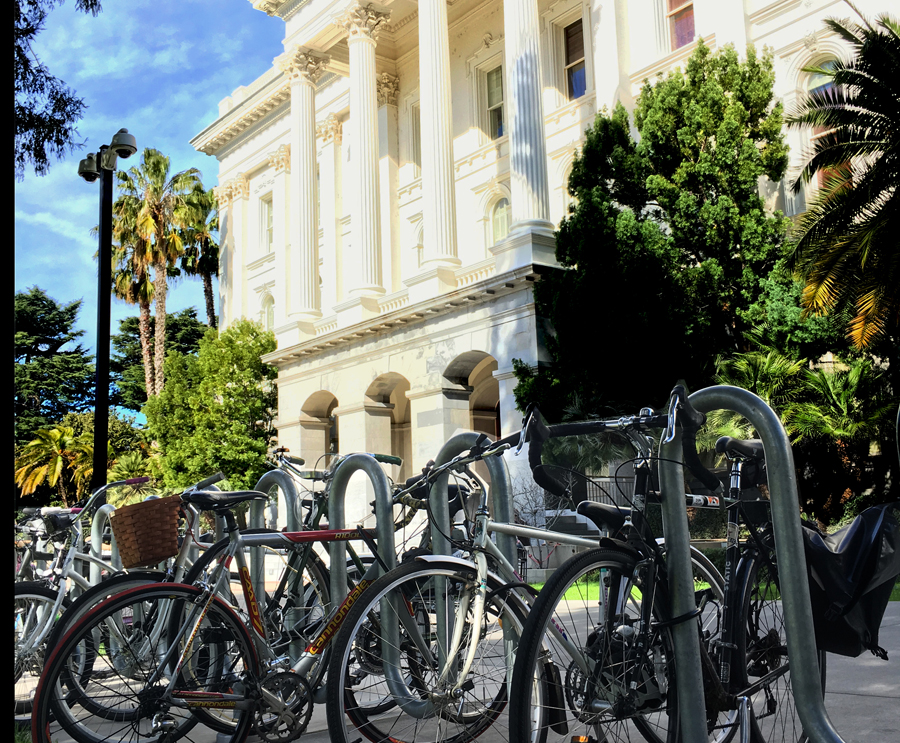
One of the journalists in attendance on the lawn of the Capitol in Sacramento shouted out a question: “Where’s the money going to come from?”
“We can’t afford not to pay for it,” replied Bonta. “There’s no bigger threat to the planet, to the state, or to people than climate change. When Congress goes to war, we don’t ask how it will be payed for. When it comes to saving the planet, you would think there would be the same political will to pay for it.”
“Of course it will be expensive,” he added. “But it’s necessary.”
The bill’s language should be available later today. Then the analysis, and the arguments, and the push for amendments, can begin.
Co-authors of the California Green New Deal include Assemblymembers Richard Bloom (D-Santa Monica), David Chiu (D-San Francisco), Kansen Chu (D-San Jose), Todd Gloria (D-San Diego), Eloise Gomez-Reyes (D-San Bernardino), Ash Kalra (D-San Jose), Kevin McCarty (D-Sacramento), Luz Rivas (D-Arleta), Robert Rivas (D-Hollister), Mark Stone (D-Monterey Bay), Shirley Weber (D-San Diego), Buffy Wicks (D-Oakland), and Marc Berman (D-Palo Alto).
Streetsblog has migrated to a new comment system. New commenters can register directly in the comments section of any article. Returning commenters: your previous comments and display name have been preserved, but you'll need to reclaim your account by clicking "Forgot your password?" on the sign-in form, entering your email, and following the verification link to set a new password — this is required because passwords could not be carried over during the migration. For questions, contact tips@streetsblog.org.