In SF, Safer San Jose Avenue Advocates Fend Off Attacks From Angry Motorists


The redesign of San Jose Avenue took a step forward a month ago when Caltrans removed a traffic lane on a Highway 280 off-ramp leading on to San Jose, a.k.a. the Bernal Cut. The plan is the result of decades of neighborhood advocacy for safer streets, but it is running into opposition from motorists who won’t stand for the road diet.

Supporters and opponents of the project are duking it out with online petitions, both launched a month ago. The opposition’s petition currently has a lead on the supporters’ petition. The SFMTA hasn’t released the results from its survey from last fall.
“There is a contingency of drivers that is working against this plan and are very active on NextDoor and talking to their supervisors,” said neighbor Collin Martin. They “seem to accept no alternatives to making this avenue safer and more sane for cyclists and pedestrians.”
Under the two-phase pilot project, Caltrans and the SFMTA are measuring how a road diet and better bike lane protection can help tame driving speeds and attract more people to bike on San Jose north of Highway 280.
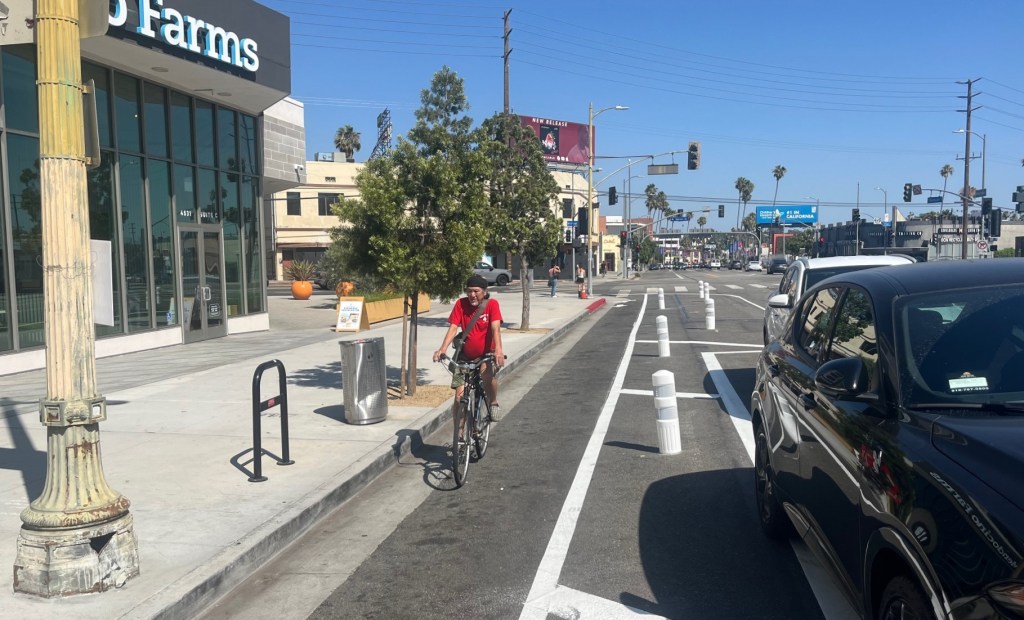
A year after the first phase, in which San Jose’s third northbound lane was replaced by a wider, buffered bike lane, the SFMTA reported a 62 percent jump in bike traffic during morning peak hours.
The removal of San Jose’s third lane didn’t achieve the SFMTA’s goal of bringing the 85th percentile speed down to 35 mph. There was “a fairly minor drop” in speeds from 49 mph to 46 mph, the SFMTA reported, and morning peak hour traffic on San Jose dropped by 21 percent.
That result triggered the project’s second phase to meet the speed reduction target, and Caltrans removed the second 280 off-ramp lane, which was added as a supposedly temporary measure in 1992. Planners are now measuring the effect on traffic speeds.
Collins said Caltrans could have done a better job implementing the ramp lane removal, “as it is causing sudden stops” that may contribute to “part of the backlash.”
“The exit should just be one lane and not two merging into one on a curve in short distance,” he said. “This is almost certainly what caused the surge in support to the petition against the road diet.”
The opposition petition calls on city officials to “stop the destruction of effective traffic flow on 280N and San Jose Ave.” The creator, Dave Wang, claims that removing the third lane on San Jose has “caused traffic standstill,” and features a Streetsblog photo of car traffic on Highway 101 in Belmont.
The petitioners say people walking and biking should take less direct routes, and that the road diet has resulted in more drivers cutting through on side streets. The SFMTA reported that car traffic and speeds have increased on Rousseau Street and St. Mary’s Avenue, and the agency plans to add traffic calming measures on those streets as a deterrent.
The petition also says that “the SFMTA has provided no data to indicate this corridor is more unsafe than others.”
But neighbors like Jon Winston have been fighting for over 20 years to “humanize San Jose,” a “de-facto freeway” that divides neighborhoods, as he wrote in the supporting petition he created.
The Bernal Cut “is a throwback to the time when the Mission Freeway was nearly built,” Winston wrote. “The road diet and traffic calming that is being tested now by the MTA with the guidance of Supervisor [Scott] Wiener is the result of decades of community organizing around making the Bernal Cut safer for everyone.”
While a petition tally shouldn’t be the deciding factor in whether to make streets safer, a show of support can stiffen the spines of decision makers and lead them to move forward with improvements.
Wiener has stood by the improvements he pushed for, and told Streetsblog last month that the Bernal Cut is “a pseudo-freeway with huge negative impacts on the surrounding areas due to over-the-top speeding.”
Many supporters who signed the petition lauded the upgrades for making San Jose safe and comfortable enough for more people to bike on. “I want my son to be able to ride San Jose,” wrote Nik Kaestner.
“This plan has been in the works for years and is intended to bring safety and sanity to San Jose Ave. and its side streets and neighborhoods,” wrote Erika Ehmsen. “Please don’t allow this well-vetted road-diet trial to be derailed by people who don’t live in our neighborhood and simply want to speed (illegally) through our neighborhood.”

Read More:
Streetsblog has migrated to a new comment system. New commenters can register directly in the comments section of any article. Returning commenters: your previous comments and display name have been preserved, but you'll need to reclaim your account by clicking "Forgot your password?" on the sign-in form, entering your email, and following the verification link to set a new password — this is required because passwords could not be carried over during the migration. For questions, contact tips@streetsblog.org.