Op/Ed: The Cameras We Fear and the Speed We Ignore
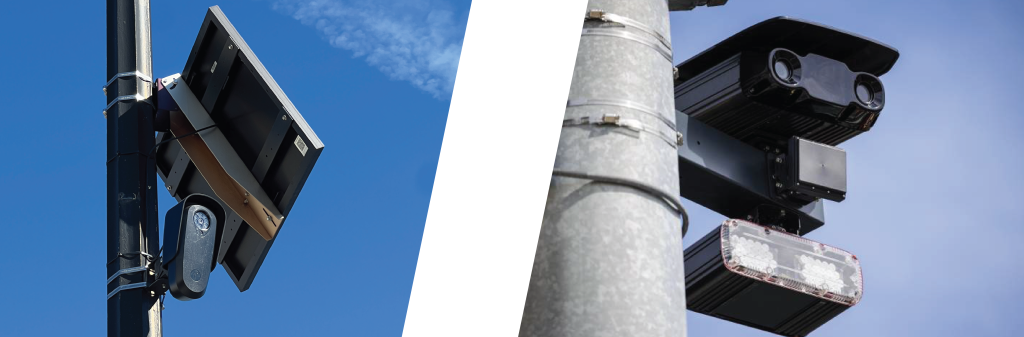
In recent months, California’s speed safety cameras have begun to blur in the public imagination with private automated license plate reader networks like Flock.
The confusion isn’t irrational. Both technologies involve cameras mounted on poles designed to read license plates, and at a moment when Americans are rightly more alert to the dangers of unchecked surveillance, it makes sense that people would approach any new camera with skepticism. But similarity at the surface is not sameness in design. These systems are built for different purposes, governed by different statutes, and constrained by different guardrails.
In short, a Flock camera is a specialized ALPR camera that records and catalogs vehicle information for public safety and investigative use, not a camera that issues traffic tickets or directly enforces speed limits. If you want more information, visit “How does Flock work” at the end of the article. Speed cameras at intersections — often called automated speed enforcement cameras — detect and document vehicles traveling over the posted limit, then generate a citation that’s mailed to the registered owner.
If we allow that distinction to collapse, we risk sidelining a narrowly tailored safety program that is already moving more slowly than the urgency of traffic deaths demands. Street safety advocates need to be clear about this difference – not to dismiss privacy concerns, but to prevent a category error from becoming a policy failure.
How do speed cameras work in CA?
In California, speeding is one of the most consistent predictors of whether a crash becomes a tragedy. A person hit at 40 miles per hour is far more likely to die than someone hit at 25. That simple law of physics should be enough to cut through ideological barriers.
Speed cameras won’t fix every broken road. But California’s Assembly Bill 645 pilot targets them where danger is most acute: high-injury corridors, school zones, and streets with repeated fatal crashes. In San Francisco, where implementation began last year – speeding dropped by 72% at key camera locations within months. That’s what enforcement that’s consistent and automatic does, it changes behavior. And the law builds in privacy limits, public oversight, equity protections, and a requirement that any revenue fund safety improvements, not city slush funds.
But speed cameras are not Flock cameras or any other automated license plate reader (ALPR) for a number of crucial distinctions:
- They don’t track people’s movements.
- They don’t use facial recognition.
- They don’t build databases of where you’ve been.
- They capture a rear license plate, at a specific place, at a specific moment, when a law has been broken.
- The way AB 645 is structured matters. Its design, as articulated and passed by the California legislature separates a speed safety system from a surveillance network at the level of architecture, not just intention. These are violation-triggered cameras, not passive license plate readers scanning and storing everyone’s movements.
If no law is broken, no record is retained; if a photo does not result in a notice, it must be destroyed within five business days. A valid citation may show only the rear of the vehicle and the license plate – and must exclude the rear window area as an explicit privacy guardrail. Facial recognition is flatly banned. Records are confidential by default and may be used only to administer the program or assess its safety impacts. Even when a citation is issued, records are generally retained only up to 60 days after final disposition and then must be destroyed.
Vendors are prohibited from selling, sharing, repurposing, or monetizing the data, and program information cannot be disclosed to other agencies, including state or federal authorities, except in response to a specific court order or subpoena. This system is designed to document a single traffic violation and then erase the record – not to build a searchable database of where Californians have been.
Privacy concerns
I understand why some Californians are uneasy. In the wake of growing awareness about private surveillance networks like Flock, people are understandably wary of cameras. In 2025, the Electronic Frontier Foundation exposed how Flock’s system was used to monitor political protests, target marginalized communities, and facilitate sweeping warrantless searches across a nationwide web of cameras. That is a surveillance architecture designed for broad tracking power. If California’s speed safety cameras operated that way, I would be against them.
We should absolutely demand strict limits, transparency, and oversight. Guardrails matter, but we should also be honest about the tradeoff in front of us.
You can debate hypothetical abuses tomorrow. We can guarantee that in 2026 hundreds of families will be shattered by vehicles going over the speed limit. If we allow fear of what cameras might become to prevent us from using a narrowly tailored tool that reduces deadly speeding in the most dangerous places, that would be a tragedy in itself.
There’s also the fear that cities will use cameras as a revenue machine. That skepticism is healthy. Government should never be given incentives to punish for profit. But AB 645 bars contracts that pay vendors per ticket, requires revenue to first cover program costs, and then directs any excess into traffic-calming improvements — crosswalks, speed humps, safer street design. The goal of a successful speed camera program is paradoxical: fewer tickets over time because behavior changes. In San Francisco, violations are already declining week over week. When enforcement is predictable and universal, speeding stops feeling like a gamble and starts feeling like a risk not worth taking.
Automated enforcement reduces the need for traffic stops, meaning fewer roadside confrontations, fewer discretionary encounters, fewer opportunities for escalation. A citation arrives in the mail a civil penalty, not a criminal charge, no points, no suspension just a clear signal to slow down. The uncomfortable truth for those who carry the mantle of “transportation justice” is that doing nothing is also a policy choice. And right now, that choice falls hardest on the very communities transportation justice advocates claim to protect.
Conclusion
We can hold two ideas at once. Surveillance systems that accumulate unchecked power deserve opposition. Tools that are narrow, transparent, and built with statutory guardrails deserve evaluation on their merits. The mistake would be treating every camera as the same kind of instrument, when architecture and intent matter.
Streets are the most democratic places we share. They are where children walk to school, where seniors cross to buy groceries, where workers bike or drive home at the end of a shift. If fear, whether of violence or of surveillance, causes us to abandon evidence-based safety measures, we make those spaces more dangerous, not more free.
Freedom is not just the absence of government. It is the presence of safety in the ordinary moments of life. It is knowing your child can cross the street and come home. It is believing that the rules apply the same way to everyone. If we can’t protect this small freedom, the bigger ones start to feel abstract.
The real choice in front of us is not cameras or no cameras. It is whether we allow preventable deaths to remain the cost of doing nothing, or whether we are willing to use tightly constrained tools to make the places we live measurably safer.
How does flock work
A Flock camera is a type of automated license plate reader (ALPR) system used by police departments, neighborhood groups and other organizations to capture and record information about vehicles that pass by a fixed camera. They’re not like red-light or speed enforcement cameras — they’re designed to photograph the rear of passing cars, read the license plate with optical character recognition (OCR), and log details like the plate number, vehicle make, model, color and other distinctive features. The images and metadata are uploaded over a cellular connection to a secure database where law enforcement or other authorized users can search them when investigating crimes such as stolen vehicles, missing persons or other serious offenses.
Flock cameras are typically solar-powered and motion-activated, so they can operate 24/7 without external wiring. They don’t measure vehicle speed and aren’t inherently traffic-enforcement tools — their primary purpose is surveillance and evidence-gathering. The data is usually stored for a limited period (often around 30 days) unless flagged for longer retention in an active investigation. Flock systems are widely used across the U.S., but they’ve also raised privacy concerns because they continuously log vehicle movement even when no crime has occurred.
–
Andrew Wright is a communications leader and parent in Burbank, California, raising his children within 500 yards of an eight-lane freeway. He works to make California’s streets and communities worthy of the people who live in them, places of safety, dignity, and profound human flourishing. He can be reached at andrewreginaldwright@gmail.com
Streetsblog has migrated to a new comment system. New commenters can register directly in the comments section of any article. Returning commenters: your previous comments and display name have been preserved, but you'll need to reclaim your account by clicking "Forgot your password?" on the sign-in form, entering your email, and following the verification link to set a new password — this is required because passwords could not be carried over during the migration. For questions, contact tips@streetsblog.org.