Republican’s Demagogue on Suspending Gas Tax and Climate Fuel Rules — Again

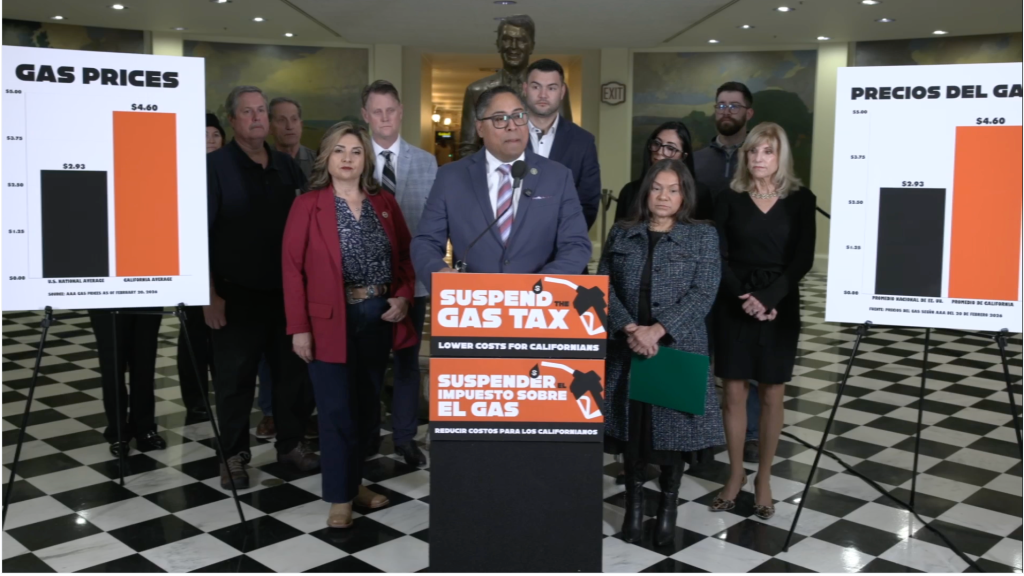
With California gas prices ticking upward while national averages fall, State Senator Tony Strickland (R-Huntington Beach) has introduced Senate Bill 1035, a proposal to suspend the state gas tax and key climate fuel programs for one year.
Strickland says the bill would save drivers about $1.08 per gallon by pausing California’s 57.9-cent per gallon excise tax, the state’s Low Carbon Fuel Standard (LCFS), and cap-and-trade fuel compliance costs.
“Californians are being crushed by high gas prices,” Strickland said in a statement. “My measure pumps the brakes on high gas prices and puts money back where it belongs — in the pockets of hardworking Californians.”
The bill contains an urgency clause, meaning it would take effect immediately if signed by the governor. Needless to say, the odds that the legislation would make it all the way to the governor’s desk and be signed are slim. Democratic leaders have already signaled resistance to SB 1035. Reporting from ABC10 notes that legislative Democrats criticized the proposal as fiscally irresponsible and politically motivated.
SB 1035 proposes temporarily using General Fund dollars to offset losses to the Greenhouse Gas Reduction Fund, but it does not identify a stable replacement revenue source for transportation funding.
In other words: the bill promises relief, but does not fully explain what gets cut — or backfilled — to pay for it.
What’s Actually on the Table
The gas tax is not a generic “Sacramento fee.” According to the California Legislative Analyst’s Office, fuel excise tax revenues are constitutionally dedicated to transportation purposes, including:
- Highway maintenance and rehabilitation
- Local street and road repair
- Bridge upgrades
- Transit capital improvements
- Debt payments on transportation bonds
The 2017 Senate Bill 1 transportation funding package significantly increased gas taxes specifically to address a multibillion-dollar road maintenance backlog.
Suspending the tax for a year would likely remove several billion dollars from the State Highway Account and local transportation budgets.
A Familiar Political Fight
This is hardly the first attempt to roll back California’s gas tax.
In 2018, opponents of SB 1 placed Proposition 6 on the ballot, seeking to repeal the gas tax increase. Voters rejected the repeal, keeping the tax in place. In 2022, Governor Gavin Newsom approved a temporary gas tax adjustment and rebate program amid inflation spikes — but that measure did not suspend climate fuel standards or fully eliminate dedicated transportation funding.
Climate Programs Also Targeted
SB 1035 would also suspend the Low Carbon Fuel Standard administered by the California Air Resources Board. The LCFS requires fuel producers to reduce the carbon intensity of transportation fuels and has been central to California’s climate strategy, helping finance cleaner fuels and EV infrastructure.
California’s cleaner fuel has long meant cleaner air. In the 1960s and ’70s, the Los Angeles region’s heavy smog prompted state leaders to adopt the nation’s first tailpipe emissions limits and vehicle inspection programs designed to curb hydrocarbons, carbon monoxide and other pollutants from cars and trucks.
Last year, the Trump Administration revoked California’s ability to regulate fuel and clean-air standards for the transportation sector. California has sued and the case is still pending.
Critics argue that pausing the program would undermine emissions reductions while doing little to address structural causes of gasoline price volatility, which are heavily influenced by global oil markets and refinery capacity constraints.
There is also a longer-term policy contradiction: California transportation funding relies heavily on gasoline consumption. As vehicles become more fuel-efficient — and increasingly electric — gas tax revenues are projected to decline regardless. Lawmakers have been studying alternatives like road-usage charges (VMT taxes), but no replacement system is in place.
Suspending the gas tax now may provide temporary pump relief. But unless lawmakers identify a durable funding source, it also widens the gap between how California funds transportation infrastructure and how people actually move around the state. In the short run, drivers could save money. But in the long run, the funding gap is likely to mean decaying delapidated infrastructure – including roads and bridges that drivers and others depend on.
Streetsblog has migrated to a new comment system. New commenters can register directly in the comments section of any article. Returning commenters: your previous comments and display name have been preserved, but you'll need to reclaim your account by clicking "Forgot your password?" on the sign-in form, entering your email, and following the verification link to set a new password — this is required because passwords could not be carried over during the migration. For questions, contact tips@streetsblog.org.