New E-Bike Legislation That Includes Mandatory License Plates Panned by Bike Safety Advocates

California lawmakers have introduced Assembly Bill 1942, also known as the E-Bike Accountability Act, as part of the 2025-26 legislative session. Sponsored by Assemblymember Rebecca Bauer-Kahan (D-Orinda), the bill would require owners of Class 2 and Class 3 electric bicycles to register those bikes with the California Department of Motor Vehicles and display a special license plate issued by the DMV. Under the bill’s language, riders would also need to carry proof of ownership matching the bike’s serial number, and enforcement officers could issue fines if these requirements aren’t met. AB 1942 would create an Electric Bicycle Registration Fund to manage revenues and enforce compliance, although it would also appropriate initial funding from the state General Fund.
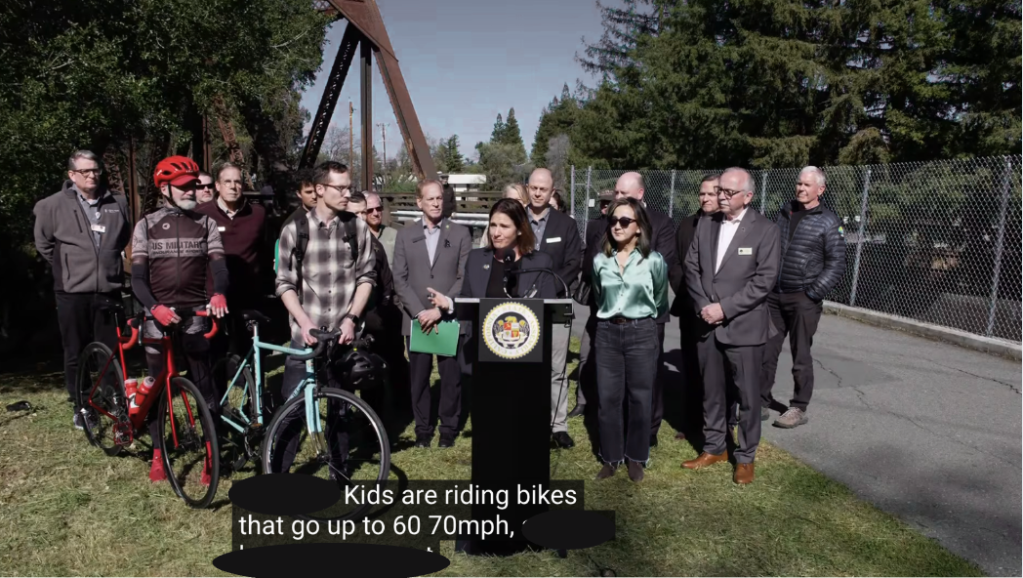
“The dramatic rise in e-bike injuries across California demands immediate action,” said Bauer-Kahan at a press event announcing the legislation (video below). “This common-sense legislation will improve accountability and help law enforcement protect our kids and all users of our roads and pathways.”
Existing California law currently classifies e-bikes into three categories—Class 1, Class 2, and Class 3—based on pedal assistance, throttle capability, and speeds, and generally treats them as bicycles rather than motor vehicles. These classifications stem from past legislation such as AB 1096 in 2015, which distinguished e-bike types so they could be used in bike lanes and paths without registration, licensing, or insurance requirements that apply to motorcycles or mopeds.
Proponents of AB 1942 frame it as a public safety measure in response to what they describe as rising e-bike injuries and enforcement challenges. At a press event in Walnut Creek, Bauer-Kahan and local officials said the dramatic increase in e-bike use has made it difficult for law enforcement to hold reckless riders accountable without a registration system and visible plates, particularly for higher-speed Class 2 and 3 models.
Early Reviews Are Bad
The bill has drawn sharp criticism from cycling advocates and community voices who argue it misses the mark on both safety and transportation policy.
On the advocacy side, groups such as Bike East Bay have called AB 1942 counterproductive, arguing that it would impose unnecessary bureaucracy and financial barriers on riders who rely on e-bikes for daily transportation.
Bike East Bay wrote that it “threatens to derail our progress by mandating license plates and registration for all Class 2 … and Class 3 e-bikes statewide,” including hundreds of thousands of bikes already in use. The group stressed that the real safety issues are outdated street design and motor vehicle traffic, not a lack of plates on e-bikes, and warned that additional DMV requirements could discourage sustainable transportation and reintroduce tools for biased policing.
At Biking in L.A., Ted Rogers has been chronicling and critiquing the state’s mish-mash of e-bike laws and how they change as one crosses municipal boundaries. However, Rogers isn’t impressed by this attempt to create some uniformity across the state.
Rogers dismisses the bill as “needlessly” rewriting e-bike law and contended that it would regulate vehicles already covered under existing statutes. The piece argued, “the practical effect of this bill would be to virtually halt all sales of Class 2 and 3 e-bikes … at a time when the need to replace motor vehicles with some other more viable form of transportation is greater than ever,” characterizing the legislation as “an asinine political stunt” rather than a thoughtful policy response.
Opponents further argue that AB 1942 focuses on the wrong targets: legal Class 2 and 3 e-bikes used by commuters, families, and workers, rather than illegal “e-motos” or heavily modified bikes that exceed legal speed limits and present more significant safety concerns. They caution that broad registration requirements could saddle riders with additional costs and compliance burdens without addressing the root causes of traffic violence or promoting safer streets.
As the bill proceeds through committee hearings and public comment, both supporters and critics are gearing up for a broader debate over how California should balance safety, equity, and sustainable transportation goals in the electric bicycle era.
Streetsblog has migrated to a new comment system. New commenters can register directly in the comments section of any article. Returning commenters: your previous comments and display name have been preserved, but you'll need to reclaim your account by clicking "Forgot your password?" on the sign-in form, entering your email, and following the verification link to set a new password — this is required because passwords could not be carried over during the migration. For questions, contact tips@streetsblog.org.