CA High-Speed Rail Approves Large Cost Overrun, Legislation Moves to Empower Inspector General, Unhinged Critics Criticize


For at least the past year, the California High-Speed Rail Authority had been on a winning streak in the media. While the Trump administration waged war on the project, the past year saw a series of construction milestones, new plans, a new CEO, and a steady stream of state funding.
That media winning streak was apparently too much for some tabloid “journalists.” In the past several weeks, some media outlets have criticized the authority, charging it with keeping secrets from the public, and approving a half-billion dollar change order. And, as Streetsblog will show below there’s some truth behind these criticisms, including excellent reporting from CalMatters. But shallow reporting and sensationalist headlines do readers a disservice by leaving them uninformed about the real issues. Of course, that is often the point of those types of articles.
CAHSRA is no stranger to these sorts of questionable criticisms. But there’s a new source of disinformation, the “California Post,” a west coast leakage of the right wing New York Post tabloid, and the new outlet is spewing new charges that need to be debunked.
AB 1608 – Bill to Limit Public Records Requirements for CAHSRA Inspector General
As first reported by CalMatters, Assembly Bill 1608, authored by Assembly Transportation Committee Chair Lori Wilson (D-Suisun City), would give the inspector general of the CAHSRA the authority to withhold investigative records that the inspector general believes would “reveal weaknesses” that could harm the state or be misused. The measure would also let individuals request that internal discussions and “personal papers and correspondence” remain confidential.
Proponents, including Wilson and the Newsom administration, argue the change would strengthen oversight by protecting sensitive information — such as whistleblower identities, fraud details, litigation documents, and security risks — that current public records law might otherwise expose.
Wilson told CalMatters, “The only way we’ll get the level of transparency and the accountability that the Legislature requires is to make sure that our (inspector general’s office), who are technically the eyes and ears of the public … have every protection they need to be able to take the full deep dive without hindrance.”
Newsom’s support goes beyond a pat on the back. The governor has included the language in a “budget trailer bill” introduced at the end of January. A budget trailer bill is legislation in California that accompanies the main Budget Act to enact statutory changes needed to implement specific budget policies. CalMatters notes trailer bills can receive less scrutiny than regular legislation.
Critics – including good-government groups, some lawmakers and media – contend the bill could broadly shield information from the public and reduce accountability for the mega-project. And mirroring what Streetsblog discussed in “Another Conspiracy Theory, This One Around a Vehicle Miles Tax, Comes to California,” Republican legislators are using the controversy to demagogue on the issue.
Wilson has stated that she is open to amendments to clarify her intent, which she says is to increase access to the inspector general’s office, not hide information from the public. Any fixes need to happen quickly as Governor Gavin Newsom introduced a budget trailer bill with the same language as AB 1608. Budget trailers are usually passed before the budget is passed in the summer without the same measure of public debate as regular legislation.

A Costly Construction Change Order
At its January 21 board meeting, the California High-Speed Rail Authority approved a $537.3 million change-order settlement with contractor Dragados-Flatiron Joint Venture.
The settlement resolves years of disputes tied to construction along a 65-mile stretch in the Central Valley. Officials described the payment as a negotiated resolution to ongoing litigation and contract claims.
Critics were quick to point out that this is the largest single change order in CAHSRA history. Change orders — modifications to a contract’s cost, scope, or schedule — are common on large infrastructure projects, particularly megaprojects involving complex engineering, land acquisition, and utility relocation. A half-billion dollar change order is bound to raise eye brows, but the context around the order matters.
In large public works projects, change orders frequently total 5% to 15% of contract value, depending on complexity and risk allocation. Historic megaprojects such as Boston’s Big Dig and California’s Bay Bridge replacement also experienced substantial cost overruns. California freeway builders eat hundreds of millions of dollars worth of cost overruns for breakfast – see for example, 405 Freeway widening (a half-billion dollar overrun c. 2013) and 5 Freeway widening ($70+ million overrun in 2021).
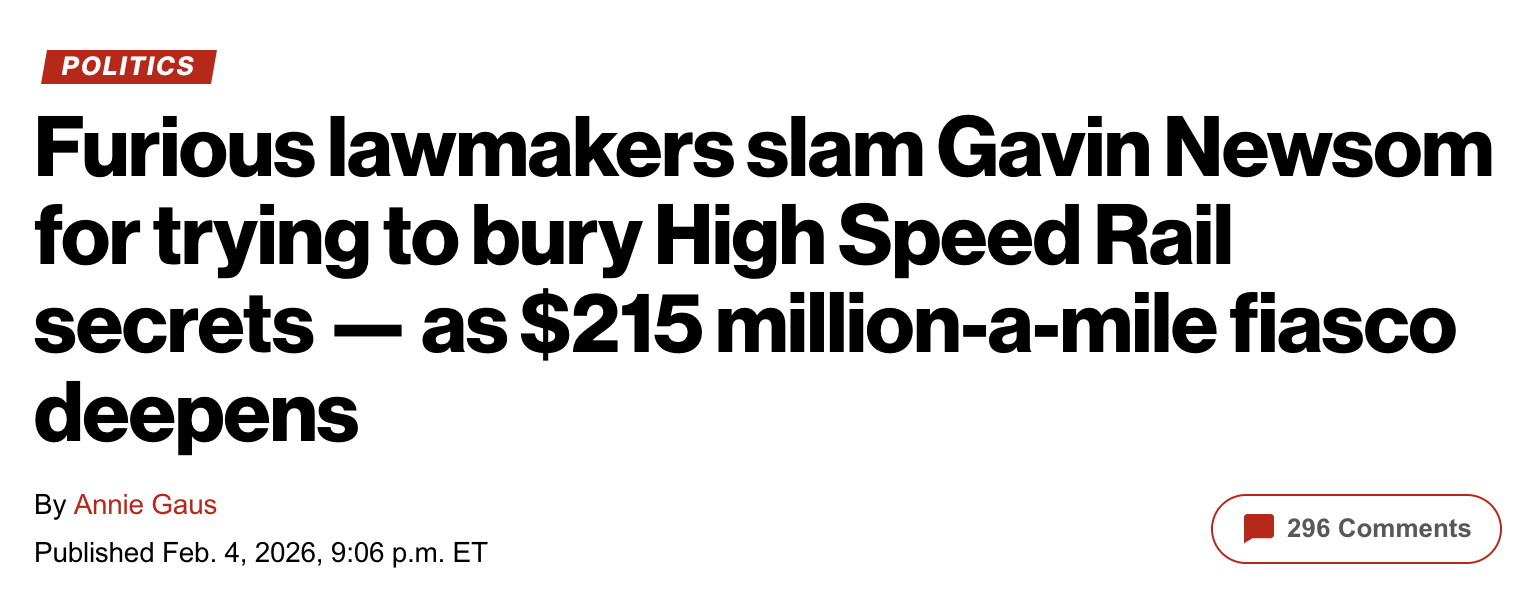
Same Slop, New Masthead: The California Post
The California Post began publication on January 26 of this year and has been obsessed with stirring the pot on anything Newsom supports, especially California High Speed Rail.
In just the last ten days, the Post has published five stories on the project, “California High-Speed Rail chiefs pitch train to Yosemite – but plan mocked as ‘gaslighting’,” by Joel Koehn “Even passengers who would use high-speed rail don’t want it – and are furious about land destroyed,” by Katie Jerkovich and “Furious lawmakers slam Gavin Newsom for trying to bury High Speed Rail secrets — as $215 million-a-mile fiasco deepens,” “Newsom mocked for posing in front of freight train to ‘celebrate’ nonexistent high speed rail,” and “California High-Speed Rail hit with new record-breaking delay bill as Gavin Newsom moves to bury records” by Annie Gaus.
Are there real issues for CAHSRA, lawmakers, advocates, and the media to grapple with? Of course. But misleading conspiratorial drivel coverage obfuscates and misinforms readers – and bounces all too quickly around an unquestioning media landscape.
Don’t believe everything you read or hear about CA High-Speed Rail. For more than a decade, the reports of its death have been repeatedly greatly exaggerated. It remains the single biggest infrastructure construction project in the United States. Resolving change orders means construction will proceed without further delay.
Streetsblog has migrated to a new comment system. New commenters can register directly in the comments section of any article. Returning commenters: your previous comments and display name have been preserved, but you'll need to reclaim your account by clicking "Forgot your password?" on the sign-in form, entering your email, and following the verification link to set a new password — this is required because passwords could not be carried over during the migration. For questions, contact tips@streetsblog.org.