OpEd: How High-Speed Rail Could Reach LA by 2039…Without Waiting for the Mountains
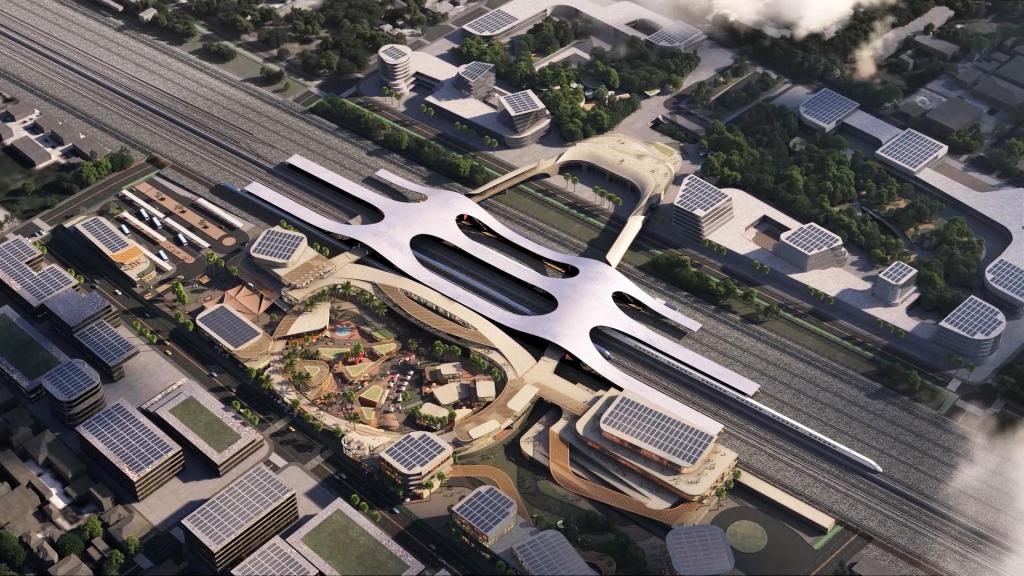
California high-speed rail’s biggest unresolved problem is not in the Central Valley. It is south of Palmdale.
Under current plans, high-speed trains are expected to reach San Francisco by 2039 while stopping short in Southern California, leaving Palmdale as the southern terminus for an indefinite period. That outcome would force passengers onto a timed Metrolink transfer—at best hourly service with long dwell times—undermining convenience and competitiveness while putting the fate of the Los Angeles terminal connection at the mercy of future funding.
There is, however, a credible interim solution that would reduce cost, derisk delivery, and deliver one-seat San Francisco–Los Angeles service years earlier: electrify and share the Antelope Valley Line.
This approach mirrors California High-Speed Rail’s own plan north of Gilroy, where trains will use Caltrain’s electrified corridor at speeds up to 110 mph. Applying the same operational logic between Palmdale and Los Angeles would allow high-speed trains to reach LA Union Station using existing right-of-way, while simultaneously modernizing Metrolink service.
The Antelope Valley Line is unusually well suited to this role. It is fully owned by LA Metro rather than a freight railroad, simplifying electrification and capacity improvements. While Union Pacific operates limited freight service, clearance concerns around catenary are well understood and solvable; comparable corridors across the world carry double-stack traffic under wire.
Mixed operations are also not an anomaly in high-speed rail. TGV services share legacy alignments in France, Eurostar and ICE routinely operate on multi-use corridors near urban terminals, and Japan’s network includes a shared segment between high-speed and conventional services. These systems demonstrate that shared operations can function reliably where speeds are moderated and dispatching is disciplined.
From a cost perspective, the contrast is stark. Electrification alone—based on Caltrain’s roughly $8 million per track-mile figure—puts the 69-mile Palmdale–Los Angeles segment at approximately $552 million. Full corridor upgrades, including double tracking and signaling, would likely bring the total into the low billions. That remains an order of magnitude cheaper than the $15–$28 billion currently estimated for a dedicated Palmdale–Los Angeles alignment through the San Gabriel Mountains, a figure that has consistently trended upward.
Capacity constraints are real but manageable. LA Metro already plans extensive double tracking through the San Fernando Valley. The primary bottlenecks—the Newhall Pass tunnel and single-track sections through Soledad Canyon—would limit high-speed service to roughly hourly without additional investment. But hourly service is sufficient to establish through running, build ridership, and generate political pressure for further upgrades. More frequent service could follow as demand and funding justify additional infrastructure.
This interim strategy also serves a critical political function. California high-speed rail faces mounting fiscal and legislative skepticism, compounded by statutory limits such as Senate Bill 198 and broader budget pressures. If the system reaches San Francisco but remains marooned at Palmdale in the south, support risks eroding just as the project nears critical mass.
Shared running prevents that outcome. It ensures Los Angeles is part of the system early, maintains statewide buy-in, and preserves optionality: a dedicated Palmdale–LA alignment can still be built later, faster, and with stronger demand to justify it.
High-speed rail does not fail because it is imperfect—it fails when it waits too long to deliver usefulness. Electrifying the Antelope Valley Line is not a substitute for a true high-speed approach into Los Angeles. It is how California finally gets one.
Chris Jones is an advocate for high speed rail and better public transportation in the US. He resides in Irvine, California and has been a railfan since he can remember, namely from exploring the various rail lines around Southern California. While his passions may lie more in the history and preservation of the trains of yesteryear, he does have a fascination with the fast-paced modern freight and passenger trains of today, including high speed rail.
Streetsblog has migrated to a new comment system. New commenters can register directly in the comments section of any article. Returning commenters: your previous comments and display name have been preserved, but you'll need to reclaim your account by clicking "Forgot your password?" on the sign-in form, entering your email, and following the verification link to set a new password — this is required because passwords could not be carried over during the migration. For questions, contact tips@streetsblog.org.