Op/Ed: More Questions About San Diego’s Airport-Downtown People Mover, Answered

Alex Wong is the Data Researcher for Ride SD.
Previously, I wrote about San Diego’s Airport Transit Connection. I promoted the People Mover concept, because it would enable Blue and Green Lines to run every 5 minutes each versus every 7.5 under the Airport Trolley alternative.
This prompted reader questions, which I’ll answer, along with other frequently-asked questions.
Who needs 5 minute Mid-Coast or Green Line frequencies? 7.5 minutes is good enough.
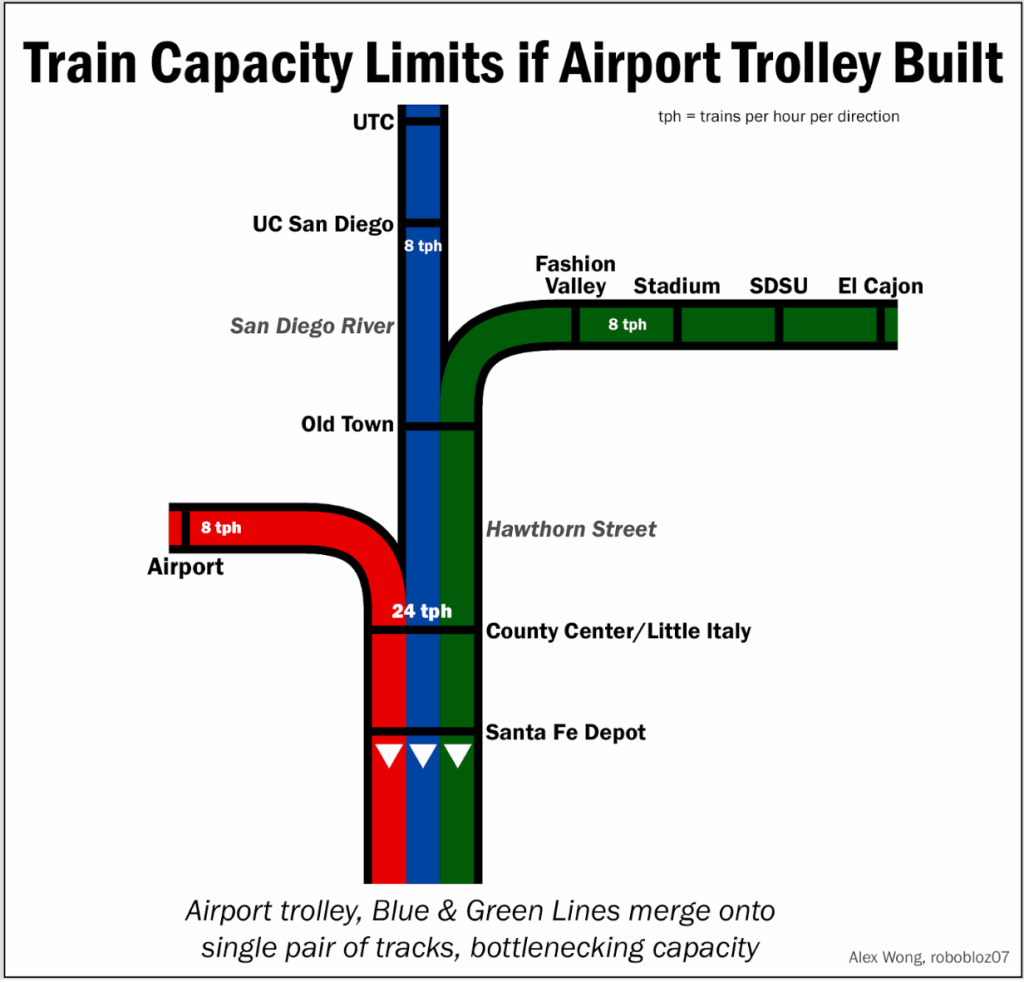
Going from 7.5 minute to 5 minute frequencies increases capacity from eight to twelve trains per hour.
The Blue Line will need 5 minute frequencies. Mid-Coast ridership has already grown so fast that were it not for budget shortfalls, MTS would have implemented 7.5 minute frequencies by June 2025. And that’s before Blue Line communities start building out according to approved plan updates. University City calls for up to 64,200 new residents and 72,000 new jobs, Clairemont up to 14,800 new homes, and Midway up to 10,155 homes. Megaprojects like Chula Vista’s Bayfront will add even more housing near the Blue Line.
All this growth requires capacity beyond three-car trains every 7.5 minutes, or eight trains per hour. Lengthening trains is not an option. Downtown Blue Line stations are confined to one block length and thus cannot accommodate trains longer than three railcars. The only solution to increasing capacity is 5 minute frequencies, or twelve trains per hour. Otherwise, overcrowding will ensue. If every other rush hour train is overcrowded, even at 7.5 minute frequencies, people could be waiting for 15 minutes before finding a train with enough space to board.
Green Line corridor population will similarly explode. Approved plan updates in Mission Valley and Grantville call for up to 50,000 and 22,000 new residents, respectively, and 17,750 new homes in College Area. These communities deserve 5 minute frequencies. After all, it would be shameful if San Diego’s transit-oriented communities had worse light rail frequency than Houston’s Red Line, which runs every six minutes in one of the world’s most sprawling and oil-dominated cities.
MTS is broke. Why plan to increase Trolley frequencies to 5 minutes?
MTS being broke now does not mean MTS will be broke forever. Designing infrastructure to allow five minute frequencies does not force MTS to run five minute frequencies. In fact, existing Blue Line infrastructure is already capable of five minute frequencies, even though the Blue Line currently runs only every 7.5 minutes, at best.
Suppose the San Diego Association of Governments (SANDAG) builds the people mover, and that upon its opening, MTS still only has enough money to run the Mid-Coast and Green Lines every 15 minutes. However, once MTS gets funding for new Trolleys and Trolley drivers, it can increase Blue Line frequency to 5 minutes each. MTS would not have to build or retrofit any tracks to enable 5 minute frequencies. That’s because the people mover would neither merge onto nor bottleneck Trolley tracks, preserving the Blue Line’s existing capacity for 5 minute frequencies.
Suppose SANDAG instead builds the Airport Trolley, which would merge onto and share tracks with the Blue and Green Lines. The resulting bottleneck would physically limit Blue Line frequencies to 7.5 minutes each, or eight trains per hour, per direction. If MTS increases Mid-Coast and Green Line frequencies to 5 minutes in this scenario, funding for new Trolleys and Trolley operators would not be enough. MTS would also need to remove the bottleneck.
This would require relocating the Airport Trolley onto a newly-built pair of tracks spanning from 12th and Imperial to Hawthorn that are parallel but separate from existing Trolley tracks–an expensive, time-consuming project that will be avoided if SANDAG builds the People Mover instead.
Where would APM trains be stored? Downtown has no space for a ten-acre APM Operations and Maintenance Facility.
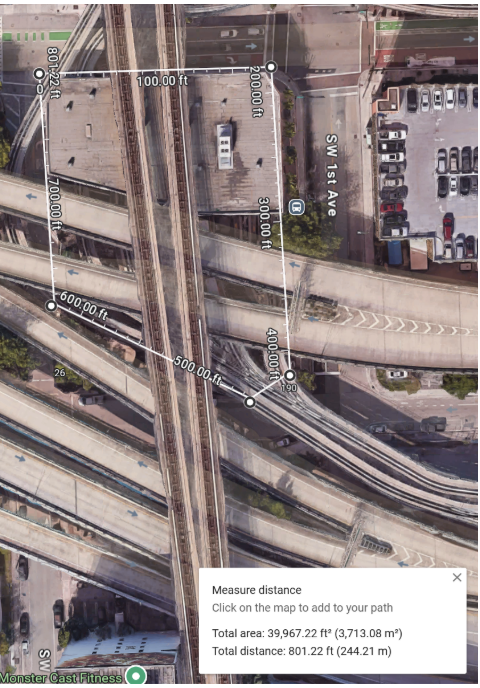
People mover yards can be ultra-compact. Miami’s Metromover APM stores its entire 46-railcar fleet inside a single Downtown maintenance facility, occupying just one acre (below). This yard is directly underneath a pre-existing elevated rail viaduct and hard against freeway ramps. If Miami can build a people mover yard in such a space-constrained location, so can San Diego.
Additional railcars could be stabled overnight at elevated stations. Seattle’s Link Light Rail stores nine 4-car trainsets overnight at four elevated stations.
For even more space, SANDAG should discuss with the Airport Authority to study if the APM yard can be built on what is now the cell phone lot. The cell phone lot is 8.5 acres–similar in size to LAX APM’s people mover yard. Given the Airport recently opened a brand new parking structure closer to both terminals that doubled the number of parking spaces for Terminal 1, it should consider relocating the cell phone parking lot to the parking structure. Then, SANDAG can build the APM yard on top of the current cell phone lot.
How much seating would San Diego’s APM have? Airport APMs (and Downtown Miami’s APM) have no seating.
San Diego can order APMs with much more seating. Mitsubishi’s Crystal Mover APM comes in several variants. However, those used on urban metro lines have far more seating than those used at airports.
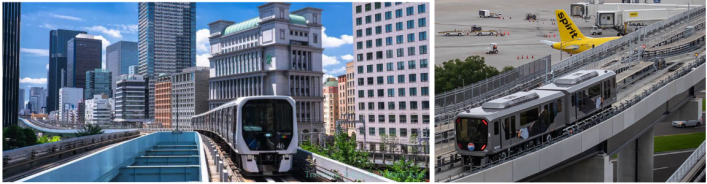
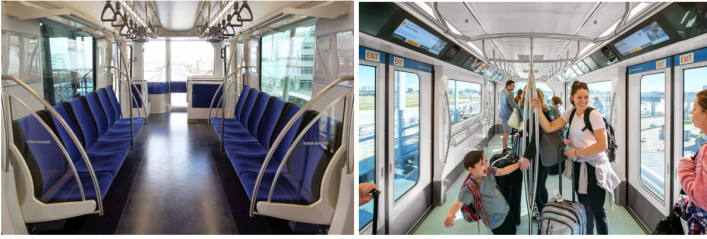
Alstom and Siemens, the other two main APM railcar makers, also offer APM models with plentiful seating.
Would People Mover trains be less accessible than Trolley Trains?
People mover trains better accommodate wheelchairs and luggage than Trolley vehicles do.
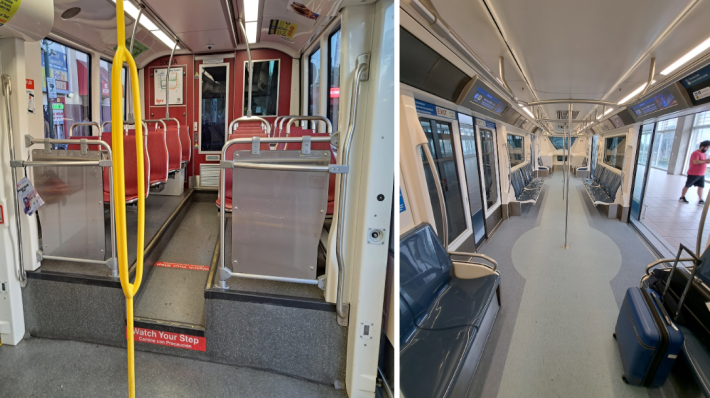
Sections of Trolley cars (above, left) have interior steps and narrow aisles that block out travellers with wheelchairs and luggage. By contrast, people mover trains (above, right) have wide aisles and zero interior steps, making their entire interiors wheelchair-accessible.
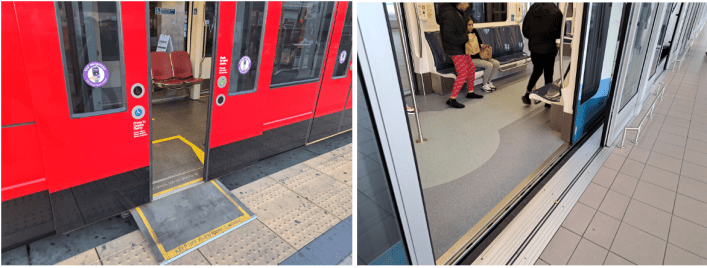
There are large gaps between Trolley vehicles and Trolley station platforms (above left). That forces travellers with wheelchairs or heavy luggage to press a button and wait for a wheelchair ramp to deploy. Unfortunately, every other door on Trolley vehicles lacks wheelchair ramps. By contrast, people movers (above, right) have zero gaps between trains and platforms, allowing travellers with wheelchairs and luggage to instantly and seamlessly roll on and off at any door. This faster passenger boarding decreases dwell times, making trips faster and more reliable.

Streetsblog has migrated to a new comment system. New commenters can register directly in the comments section of any article. Returning commenters: your previous comments and display name have been preserved, but you'll need to reclaim your account by clicking "Forgot your password?" on the sign-in form, entering your email, and following the verification link to set a new password — this is required because passwords could not be carried over during the migration. For questions, contact tips@streetsblog.org.