State Grant Will Pay for Better Diesel Trains, Not Zero-Emission Trains, for Metrolink

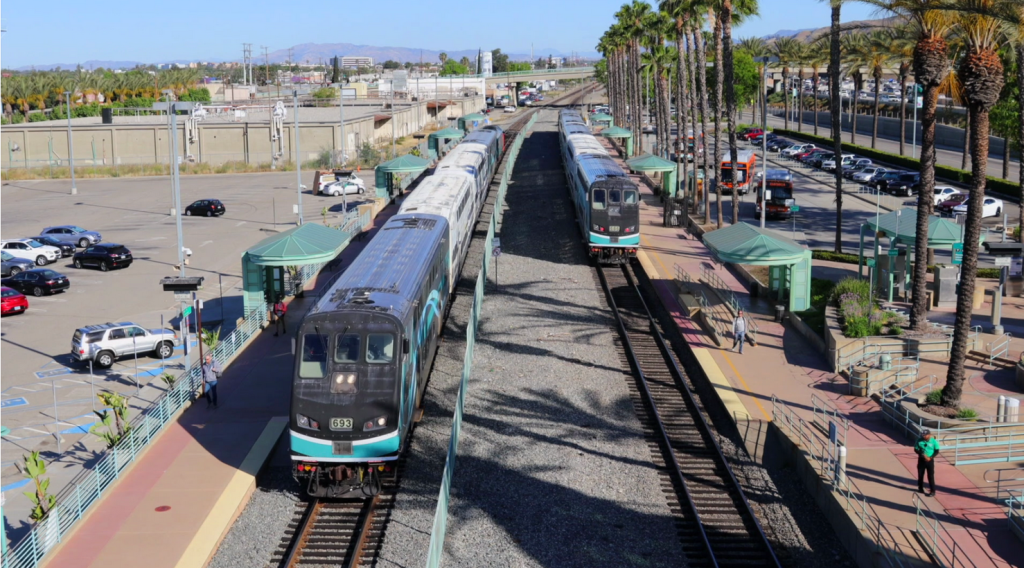
Last week, Streetsblog reported on $1.1 billion in transportation grants recommended by state agencies and approved by the California Transportation Commission at its December 3 and 4 meeting. In that article, I made an error that was flagged over the weekend by both transit advocates and Metrolink, the agency receiving one of the grants. Given the timing and the nature of the mistake, a more substantial correction than a brief update to the text felt warranted.
In the article, I wrote that Metrolink—a regional rail operator in Southern California—had received a $53 million grant to purchase “12 zero-emission (not electric) locomotives to replace aging diesel engines.” That was incorrect. The grant was for reduced emissions, not zero emissions.
Adriana Rizzo of Californians for Electric Rail was the first to flag the error. “Looking at the actual request approved, the funding was for Tier 4 diesel locomotives of the same type already operating on the Metrolink system,” she wrote.
Tier 4 locomotives are the cleanest diesel engines currently available, representing a major reduction in air pollution compared to earlier-generation Tier 2 engines built between 2005 and 2011. Tier 4 locomotives reduce particulate matter emissions by about 90 percent and significantly cut soot and smog-forming pollutants. They also reduce nitrogen oxide emissions by roughly 80 percent, lowering contributors to respiratory illness and acid rain.
But as Rizzo noted, improvement does not equal elimination. “While these engines are significantly lower-emission and compliant with certain clean air regulations, they are not actually zero-emission and still produce criteria pollutants—unlike battery, catenary, or hydrogen fuel cell trains,” she wrote.
Context
This typo-heard-around-the-Southland comes as Californians for Electric Rail and other advocates are urging Metrolink to move beyond cleaner diesel and commit to truly zero-emission technology.
Earlier this fall, Californians for Electric Rail released a report calling for multiple system modernizations, including electrification. Around the same time, Metrolink released a short video explaining its resistance to electrification that appeared to mock those advocating for cleaner technology. Although Metrolink took the video down, Streetsblog LA editor Joe Linton preserved it on his personal YouTube channel.
Linton and Streetsblog SF editor Roger Rudick—who covered Caltrain’s electrification—later wrote a piece for Streetsblog LA rebutting several claims made in the video.
“Rail operators in California, on the East Coast, and around the world are already seeing the benefits of electrification,” they wrote. “Metrolink can—and should—follow their lead. Electrification will take time, coordination, and funding, but it would greatly benefit existing riders and attract many new ones to improved Metrolink service.”
Streetsblog has migrated to a new comment system. New commenters can register directly in the comments section of any article. Returning commenters: your previous comments and display name have been preserved, but you'll need to reclaim your account by clicking "Forgot your password?" on the sign-in form, entering your email, and following the verification link to set a new password — this is required because passwords could not be carried over during the migration. For questions, contact tips@streetsblog.org.