CAHSRA Releases Environmental Documents for LA to Anaheim

Update, January 7th – The first meeting is tonight in Santa Fe Springs from 6:30 to 8:oo p.m. at Town Center Hall – Social Hall, 11740 Telegraph Road. For a full list of other hearings, click here.
Earlier today, December 5, the California High-Speed Rail Authority released the draft environmental study for the 30-mile rail corridor between Los Angeles Union Station (LAUS) and Anaheim Regional Transportation Intermodal Center (ARTIC), opening the next — and final — public review period. The rail line has already received environmental clearance for construction between San Francisco and Union Station.
“The release of this environmental document represents an important step toward full environmental clearance for Phase I of the full 494-mile statewide high-speed rail system between the Bay Area and Los Angeles/Anaheim,” says LaDonna DiCamillo, Southern California Regional Director for the Authority.
The draft Environmental Impact Report (EIR/EIS) will be available for public comment from December 5, 2025 through February 3, 2026 — a required step under both the California Environmental Quality Act (CEQA) and the National Environmental Policy Act (NEPA). To read the full review, for details on how to submit a comment, or for information on the four public hearings on the document, click here.
What the Project Covers
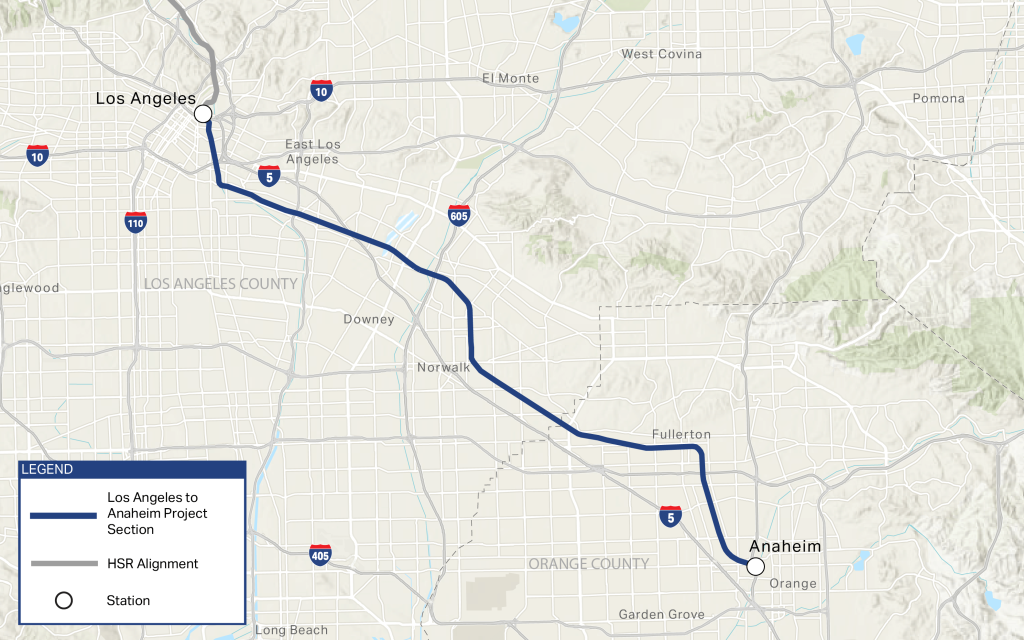
The 30-mile project section runs from LAUS to ARTIC and would follow an existing passenger and freight rail corridor, passing through parts of Los Angeles County and several Orange and Los Angeles County cities, including Vernon, Commerce, Pico Rivera, Norwalk, Buena Park, Fullerton, and Anaheim.
The project-level EIR/EIS will provide site-specific assessments of potential impacts — ranging from land use, noise, air quality, traffic and construction disruptions — as well as mitigation plans. As part of the review, the Authority will also evaluate a “No Action” alternative, i.e. what happens if the high-speed rail line is not built.
So far, the Authority has identified a “preferred alternative” alignment that would use the existing rail corridor and include a light-maintenance facility at 26th Street in Vernon. No new intermediate stations are proposed under this alternative, though the environmental review will consider whether additional stations should be studied.
What Happens Next
With this release, the Authority is formally inviting public comment. Residents, community groups, municipalities and other stakeholders will have nearly two months to review the environmental document, submit feedback, or request public meetings. After the comment period closes, CAHSRA will review submissions, respond to concerns, and eventually produce a final EIR/EIS. Only then could construction begin — assuming funding, local and state approvals, and mitigation plans are in place.
The project’s timeline and execution remain subject to multiple variables — including final design decisions, coordination with existing freight and passenger rail operators, mitigation of environmental impacts, and community response.
Significance for California’s Rail Ambitions
If fully realized, the Los Angeles–Anaheim segment would close the final gap in the planned first-phase high-speed rail route between Northern California and Southern California. For decades, the project has faced delays, funding challenges, and environmental scrutiny — but the release of the draft EIR/EIS marks a concrete step forward as the agency prepares to begin laying actual track in 2026.
Streetsblog has migrated to a new comment system. New commenters can register directly in the comments section of any article. Returning commenters: your previous comments and display name have been preserved, but you'll need to reclaim your account by clicking "Forgot your password?" on the sign-in form, entering your email, and following the verification link to set a new password — this is required because passwords could not be carried over during the migration. For questions, contact tips@streetsblog.org.