Legislative Update: Bike Safety Stop Bill Passes CA Assembly

Note: GJEL Accident Attorneys regularly sponsors coverage on Streetsblog San Francisco and Streetsblog California. Unless noted in the story, GJEL Accident Attorneys is not consulted for the content or editorial direction of the sponsored content.
To celebrate Earth Day (not really, but let’s pretend), the California Assembly passed A.B. 122, a bill from Assemblymember Tasha Boerner Horvath (D-Encinitas) that would make it legal for bicycle riders to treat stop signs as yield signs. That is, if no traffic is present, it would be enough for bike riders to slow and proceed cautiously, without having to come to a complete stop.
Streetsblog has discussed this issue and the many reasons this bill is needed many times. Stop signs were invented to make sure car drivers don’t pass carelessly through intersections, but the same rules were applied to bikes even though they pose much less risk to themselves and others. There are many arguments for acknowledging the vast difference between the two modes, among them that it takes longer for a person on a bike to clear an intersection if they come to a complete stop, the energy costs to a bike rider are huge, and other states have made similar changes to their laws and have found that bike crashes have decreased significantly.
A.B. 122 easily passed the Assembly Transportation Committee as well as the Assembly Appropriations Committee before it was passed by the entire Assembly today on a vote of 53 to 11. More than 75 organizations across the state signed a letter [PDF] in support of the bill, and the only official opposition has been from the California Highway Patrolmen’s Association – not the CHP, but a lobby group for law enforcement – which wrote to the bill’s author that that “there is a lot going on at intersections and we feel that allowing bicyclists to simply yield rather than stop will create a public safety risk.”
However, data doesn’t back up that assertion. CalBike, the bill’s sponsor, reports that none of the states who have implemented the “safety stop” law – that is, Idaho, Delaware, Oregon, Washington, Colorado, Arkansas, Utah, and North Dakota – have reported any safety problems with the new rule, and that “a recent study in Delaware found that collisions involving bicycles at intersections decreased by 23 percent since the safety stop became legal.”
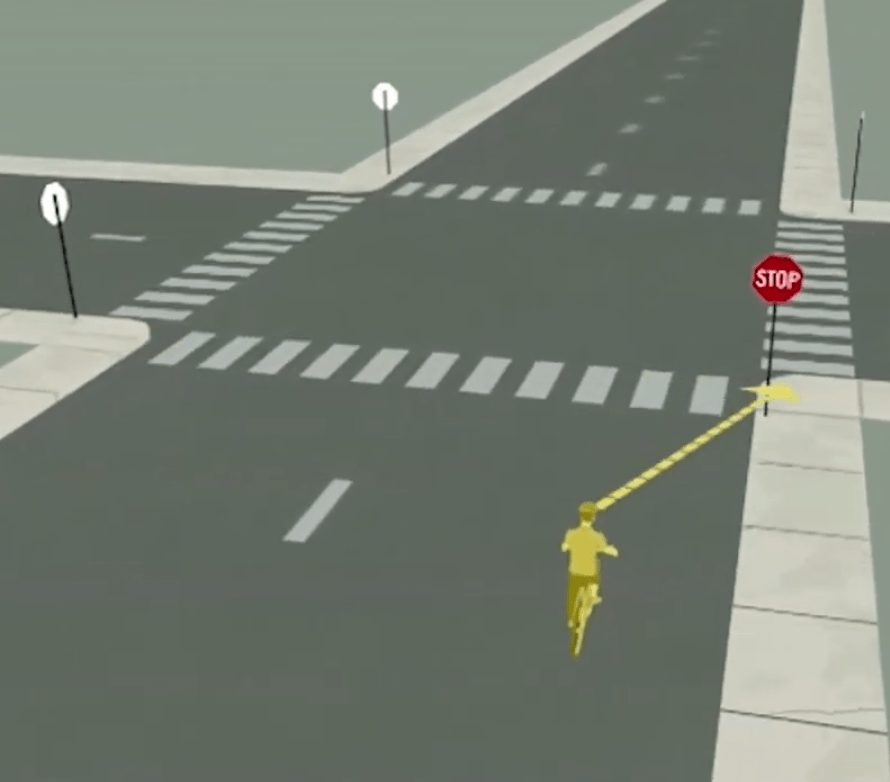
CalBike also created a video to explain how the bicycle safety stop works.
Next stop for A.B. 122 is the California Senate, where it will most likely be assigned to the Transportation Committee.
Streetsblog has migrated to a new comment system. New commenters can register directly in the comments section of any article. Returning commenters: your previous comments and display name have been preserved, but you'll need to reclaim your account by clicking "Forgot your password?" on the sign-in form, entering your email, and following the verification link to set a new password — this is required because passwords could not be carried over during the migration. For questions, contact tips@streetsblog.org.