Where “Jaywalking” Is Not a Crime

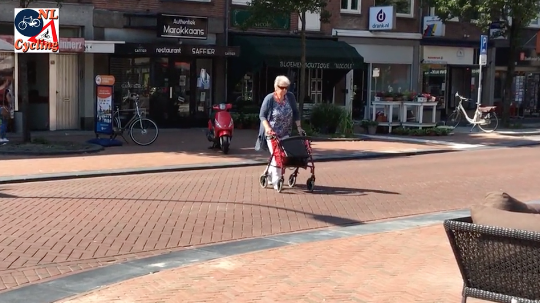
What would it be like to live in a place with safely designed streets, where people on foot can cross midblock if they think it’s safe, knowing that the law supports them?
You can see for yourself if you ever get a chance to visit the Netherlands. For the last two decades, people walking in Dutch cities have had the freedom to cross the street where they want, reports Mark Wagenbuur at Bicycle Dutch:
If you want to cross a city street you just wait for a gap in traffic and you cross. So, isn’t there an obligation to use a zebra crossing? No, there no longer is! That article 99 was scrapped from the traffic laws on 1 January 1995. Until then, pedestrians were not allowed to cross within 30 metres of a zebra crossing, effectively making it illegal to cross the street for over 60 metres with just one zebra crossing in the middle of that zone. That restriction was abolished to simplify the traffic rules and to give the pedestrian more freedom.
A zebra crossing is now just a service to the pedestrian. You are allowed to judge for yourself if you want to use it, but you are not obliged to. If you do use the zebra crossing, other traffic must yield the moment it becomes clear you are going to cross the street. Just the visible intention to use the zebra crossing already gives the pedestrian priority over motor traffic and people cycling. Unfortunately, a lot of Dutch drivers choose to forget that rule (and people cycling also tend to miss this regulation all too often) so it is best not to depend on getting that priority.
That Dutch pedestrians have had this extented freedom to cross the streets for over 20 years, now even becomes apparent in the street design. Some municipalities literally encourage people to cross wherever they like by lowering the kerbs (curbs).
It is very different across the Atlantic Ocean. In the United States, the concept of ‘jaywalking’ was propagated in the 1920s by the auto industry, with the object to restrict pedestrian movements and to give motor traffic more space in the towns and cities. Nowadays it is still illegal to cross the street mid-block in most of the United States. Although in New York even children are taught to do it carefully as it may be safer than crossing at the crosswalks. As a foreigner it would be best to stick to the rules though, or you may end up flat on the sidewalk with five police officers pinning you down, like a British professor after he crossed a street mid-block in Atlanta.
The video Wagenbuur made for the post is a must-watch:
For the record: The United States has nearly three times as many traffic deaths per capita as the Netherlands.
More recommended reading today: Smart Growth America reports on El Paso’s “transnational trolley,” a streetcar that will connect the city with Juarez, which is scheduled to open in 2018. And the New Journal at Yale profiles a New Haven bike co-op and looks at how bicycling can improve access to jobs that have sprawled farther from the city center over the years.

Streetsblog has migrated to a new comment system. New commenters can register directly in the comments section of any article. Returning commenters: your previous comments and display name have been preserved, but you'll need to reclaim your account by clicking "Forgot your password?" on the sign-in form, entering your email, and following the verification link to set a new password — this is required because passwords could not be carried over during the migration. For questions, contact tips@streetsblog.org.