In Canada, Traffic Safety PSAs Blame Jaywalkers, But Stats Tell a Different Story

As in many cities, officials in Edmonton, Alberta, have a track record of responding to traffic fatalities with victim-blaming “public education” campaigns.
This tactic — shifting responsibility to the people most vulnerable to traffic and away from the people piloting multi-ton, high-speed vehicles, in the process absolving governments that design dangerous roads — doesn’t sit well with many Edmonton residents concerned about traffic safety.
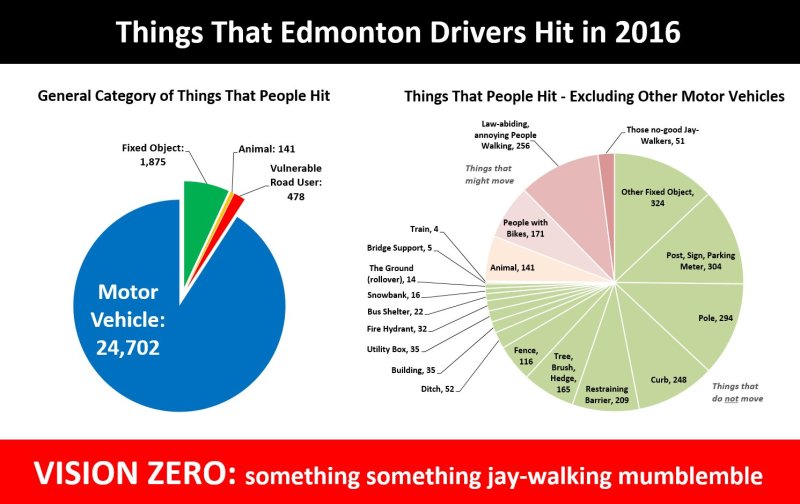
That includes Chris Nelson, who commutes to work by walking and bicycling. He used the city’s own motor vehicle collision data to make a chart showing who — or, more often, what — is on the receiving end when Edmonton motorists crash their cars. It quickly dispels any rationale for focusing on jaywalking.
Of the more than 27,000 crashes recorded in Edmonton last year, 91 percent involved another motor vehicle. Of crashes that didn’t involve other cars or trucks, three-quarters were with things that do not move, like signs, poles, barriers, trees, fences and buildings. Of the 478 collisions in which a driver struck a cyclist or pedestrian, just 51 involved people crossing without the right of way. And of the city’s 10 pedestrian fatalities last year, just one was crossing without the right of way.
Despite these facts, the city and province have focused heavily on blaming jaywalkers for traffic fatalities.
Last year, the city released a “Vision Zero” ad that featured a stick-figure pedestrian wearing reflective bands on its arms, wrists, and ankles. “Heads Up. See Me,” it warned.
The city also installed a sign telling pedestrians to “never jaywalk” and “always use crosswalks” — just feet from where two pedestrians were killed in the crosswalk in separate crashes, one by a turning driver and another by a driver running a red light.
“It feels like a punch in the face from the city,” one of the victims’ friends told the Edmonton Journal.
Then, months later, the province released an ad showing a driver striking a cartoon crash test dummy in a crosswalk, while the pedestrian dummy wore headphones, consumed alcohol, and looked at a mobile phone.
“It was meant to remind pedestrians that, though they may have the right of way, driver behavior cannot be guaranteed and pedestrians can stay safe by being alert and paying attention to their surroundings,” a spokesperson for the provincial transportation department told Metro. The province withdrew the ad after people complained about it.

Lately, it seems Edmonton’s city government is getting the message. “We need to start by recognizing that some users are more vulnerable than others,” Mayor Don Iveson said in March, according to Metro, “and the more we draw people out into our streets and public spaces, the more we need to do to ensure they have a safe and inviting experience.”
Nelson, who also created a series of ads mocking Edmonton’s anti-pedestrian PSAs, hopes Edmonton can reverse its anti-pedestrian approach to Vision Zero.
“It gets frustrating to see the government PSAs which are always blaming people who walk or bike, and doing everything to encourage driving,” Nelson told Streetsblog. “I think the most promising thing is that in the last few months the City and Province have both had to walk-back victim-blaming PSAs, because of pushback on social media.”
Streetsblog has migrated to a new comment system. New commenters can register directly in the comments section of any article. Returning commenters: your previous comments and display name have been preserved, but you'll need to reclaim your account by clicking "Forgot your password?" on the sign-in form, entering your email, and following the verification link to set a new password — this is required because passwords could not be carried over during the migration. For questions, contact tips@streetsblog.org.