Oakland’s Swift Safety Strategy Coming to Lake Merritt Station
Note: GJEL Accident Attorneys regularly sponsors coverage on Streetsblog San Francisco and Streetsblog California. Unless noted in the story, GJEL Accident Attorneys is not consulted for the content or editorial direction of the sponsored content.
Oakland’s Department of Transportation is planning a round of inexpensive and quick-to-install safety fixes around the Lake Merritt BART station. “We want to improve five intersections,” explained Nicole Ferrara, Vision Zero manager for Oakland, during an infrastructure improvement tour Wednesday afternoon. The intersections are Jackson at 8th, Madison at 7th, 8th, and 9th, and Oak at 8th. “They are where we see the biggest problems,” she added.
Anyone who uses the Lake Merritt BART station has probably noticed upgrades going on with the traffic signals; the city is installing arms to hold signals directly over the lanes, which improves compliance, explained Teresa Peterson, also with Oakland’s DOT. They will be adding leading pedestrian intervals to the signals. And they have upgraded curb ramps. All of this is in response to past fatal and injury crashes around the station.
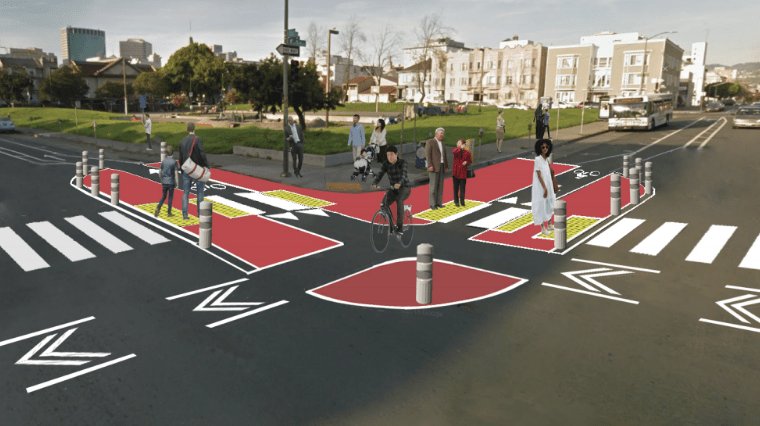
The signal improvements are being funded by a Highway Safety Improvement Program (HSIP) grant, explained Ferrara and Peterson. This signal project started planning years ago, before the creation of Oakland’s DOT. Its director, Ryan Russo, now going into his second year at the helm, asked Oakland staff to look for ways to further improve pedestrian and bicycle infrastructure around the traffic lights and intersections. “We saw an opportunity to narrow all the approaches to the intersections,” said Peterson. “There are already bike lanes, so we’re able to pull the bike lanes in to do these protected intersection treatments.” The plans also have buses stopping in the “shadow” of the painted bulb-outs (see the bus in the upper-right corner of the lead image).
The intersections will get paint and bollard treatments, similar to what San Francisco does, but Oakland will use larger K71 bollards instead of safe-hit posts (see the last photo). Ferrara reports that the K71’s seem to hold up better. Two of the five intersections will get bicycle protection.
There won’t, however, be protected bike lanes. The data, explained Ferrara, shows that the intersections are where most serious injuries and fatalities occur, so it makes sense to tackle them first and visit the question of parking-protected bike lanes later. They are also varying the paint color. “Just because it’s for safety doesn’t mean it has to be boring,” she said. In the case of the BART station, because it is the station for Chinatown, they decided to go with maroon, since gold and maroon are Oakland Chinatown’s thematic colors.
The project has hit a small setback, however. To save time, the city wanted to hire the same contractors doing the already-in-progress-and-nearly-complete traffic signal and curb-ramp upgrades. But the contractors on site wanted to charge $500,000 to do the extra work on the five intersections, rather than the $200,000 the city estimates it should cost. Oakland staff is now looking at how to get it done separately.
How long will all this take? The traffic signal upgrades are basically finished, but the timeframe for the additional pedestrian and bike improvements isn’t yet established. Ferrara explained they will follow the quick-fix strategy they used at the intersection at 23rd and Harrison. As previously reported, that crosswalk upgrade was installed in August of 2017 after a pedestrian was killed that June. According to DOT spokesman Sean Maher, the city estimated that the upgrades cost about $30,000. They included a trapezoidal crosswalk and extending out the pedestrian refuge area to give added protection and prevent motorists from making left turns across the pedestrian space. They also narrowed Harrison from three lanes in each direction to two, which reduced “egregious speeding” without reducing overall traffic throughput. If the Lake Merritt BART area upgrades use the same materials and strategy, they should be installed in a couple of months.
Meanwhile, Ferrara reports that motor vehicles now yield to pedestrians at 23rd and Harrison 96 percent of the time, where previously the yield rate was ten percent (which compares quite favorably to signalized crossing treatments, such as HAWK lights, by the way). Further planned upgrades will improve the crossing with concrete.

Streetsblog has migrated to a new comment system. New commenters can register directly in the comments section of any article. Returning commenters: your previous comments and display name have been preserved, but you'll need to reclaim your account by clicking "Forgot your password?" on the sign-in form, entering your email, and following the verification link to set a new password — this is required because passwords could not be carried over during the migration. For questions, contact tips@streetsblog.org.