Metro Board Discusses Bike-Share; Report and Transit-Bike Transfers Both Due in September
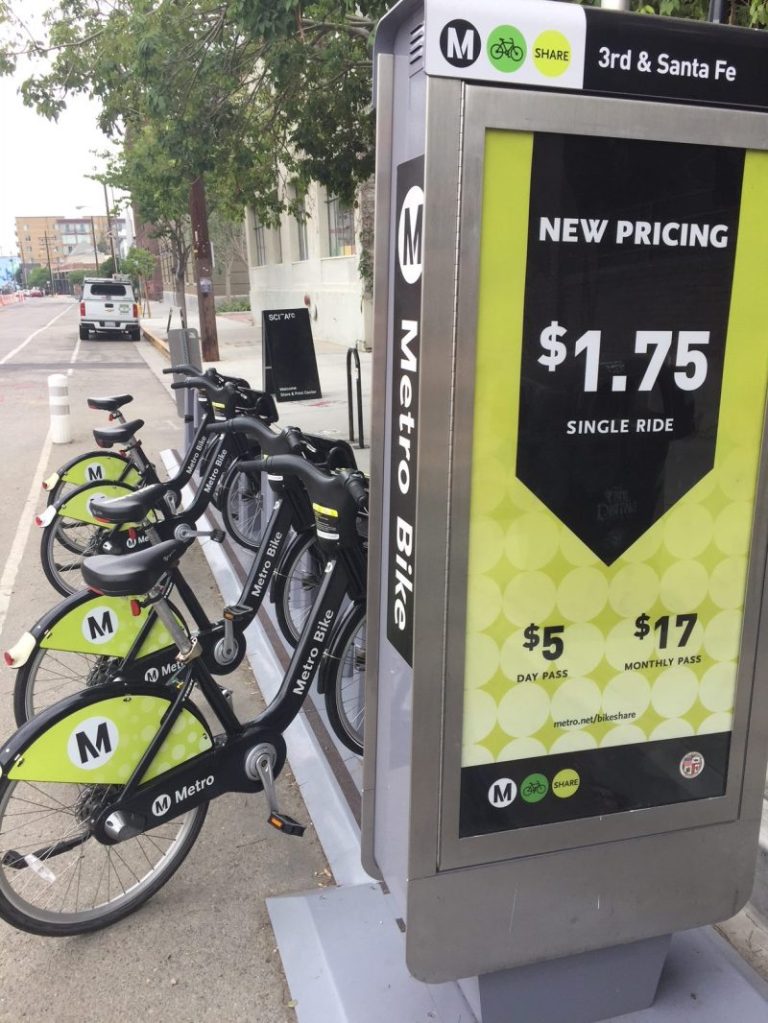
At yesterday’s Metro board meeting, a couple of announcements and some boardmember discussion offered some hints regarding the future of Metro Bike Share. Further decisions on the fledgling system will be the subject of a staff report due back at the board’s September meeting.
As part of her board chair remarks yesterday, County Supervisor Sheila Kuehl announced that Metro Bike Share walk-up usage is up 50 percent since the agency reduced prices in early July. Kuehl also announced that “bike-transit transfers” would be available this September: “With TAP card integration, transit users will be able to ride our bikes after their transit ride without any extra payment.”
More of the board’s positions on bike-share became clearer when a narrow bike-share staff report back grew into a broader discussion. Metro staff were responding to a request from boardmember and Glendale City Councilmember Ara Najarian for Metro to push legislatively to have bike-share trips count as transit transportation. While bike-share is eligible for some governmental funding programs, including many California greenhouse gas reduction programs, bike-share is not uniformly eligible for Federal Highway Administration (FHWA) funds. Metro staff recommended that Metro support Oregon congressmember Earl Blumenauer’s bill H.R. 3305 which would clarify that bike-share is eligible for FHWA funding.
The brief discussion on the funding triggered a broader bike-share discussion among the Metro board:
- Long Beach Mayor Robert Garcia, whose city operates Long Beach Bike Share a smart-bike CycleHop system, decried Metro’s over-reliance on funding its smart-dock system.
- Duarte Councilmember John Fasana, citing ofo private dockless bike-share’s withdrawing from the U.S. market, questioned whether Metro should be directly operating bike-share especially in such a dynamic market.
- County Supervisor Kathryn Barger expressed her disappointment that Metro was consistently “one step behind” on bike-share, citing Pasadena’s decision to withdraw.
- L.A. City Councilmember Mike Bonin, a major champion of bike-share, expressed that Metro shouldn’t lock into any one bike-share technology, and stressed the importance of TAP integration and inter-operability among multiple systems.
- County Supervisor Hilda Solis stated that bike-share needed to advance equity by serving commuters, not just “leisure” use. She also pushed for Metro to work with the county bring bike-share to the East L.A. portion of her supervisorial district.
- Chair Kuehl outlined her vision that Metro riders would utilize multiple systems, where “at every station something would be available but it’s not necessarily ours.” She also proposed that Metro look into TAP integration with e-scooters.
Metro staff emphasized that the Metro Bike Share program did make recent changes, and that staff are due to report back to the board in September. A performance report and a full discussion on the program’s future will take place then.
Metro bike-share staff are in an unenviable position. Their systems compete with private sector mobility devices – dockless bike-share, e-bike share, e-scooters – that are subsidized by venture capital. These private companies have the ability to more-or-less turn on a dime responding to situations on the ground. Metro Bike Share is nowhere near that nimble. It must be responsive to directions of thirteen Metro boardmembers who meet ten times each year. Proposed changes must be vetted with agency and board staff, approved by the board, then rolled out; the process can easily take a few months. Metro is working to expand the system, and to convert the Venice fleet from smart-dock to smart-bike, but these upgrades will still be underway in September.
Metro’s September discussion will likely be based on only a couple months’ of utilization data under the new pricing structure. Though the system is working well in Venice and adequately in central Los Angeles, this may not suffice for the approval of boardmembers who represent other parts of the county.
Metro Bike Share certainly has some flaws. Among these are an inability to serve the mobility needs of low-income people, and a lack of utility in that it covers only a fairly limited geographical area. But Metro’s freeway projects, which cost several orders of magnitude more than Metro’s bike-share investment, also fail to serve the needs of low-income Angelenos. These highway expansions generate greater pollution burdens for low-income communities – a drawback that bike-share does not share. Metro’s rail system has been criticized for its limited geographic reach, even after 25 years of growth.
To make Metro Bike Share effective, the board and staff will need to keep on top of the dynamic market. Bike-share ridership growth will take time. Investment and expansion need to be strategic. As Garcia, Bonin, and Kuehl have asserted, a single rigid one-size-fits-all approach is unlikely to succeed, especially in a quickly changing mobility environment. Over time, though, bike-share has the potential to serve as a key ingredient in a rich mix of mobility options open to all Angelenos.
Streetsblog has migrated to a new comment system. New commenters can register directly in the comments section of any article. Returning commenters: your previous comments and display name have been preserved, but you'll need to reclaim your account by clicking "Forgot your password?" on the sign-in form, entering your email, and following the verification link to set a new password — this is required because passwords could not be carried over during the migration. For questions, contact tips@streetsblog.org.
More from Streetsblog California
The Week in Short Videos


The Measure RTM Campaign Kicked Off Yesterday. The Fate of Regional Transit Is In Your Hands.
La Jolla Planners to SANDAG: Move the Tracks Off the Bluffs Now
The rail bluffs are eroding. The Time to Act Is Now.
The post La Jolla Planners to SANDAG: Move the Tracks Off the Bluffs Now appeared first on Streetsblog San Diego.