L.A. Metro Could Kill 710 North Freeway Tunnel

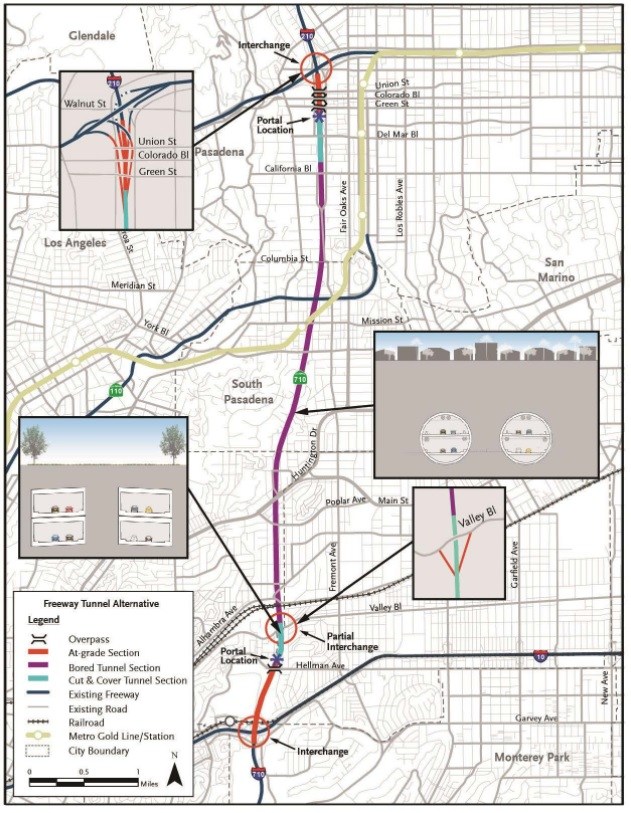
At this morning’s Metro board Ad Hoc Congestion, Highway and Roads Committee, board chair John Fasana introduced a motion that, if approved by the full board next week, could spell the end of efforts to extend the 710 freeway north via a $6 billion tunnel.
The 710 freeway extension has been pushed, and pushed back against, since the 1970s. That it has not been built is a testament to community freeway fighters’ ceaseless efforts. The project was partially funded in Measure R in 2008. Opposition to the 710 was sufficiently strong to have Metro leave it out of the subsequent 2016 Measure M, and even to include a proviso in M to restrict funds from going to the project.
Today’s committee item appeared to be a routine “receive and file” action. Metro staff reported that they were expecting to complete the project’s $50 million Environmental Impact Report (EIR) by the end of 2017, with Caltrans expected to select a preferred alternative in early 2018. Staff reported that only about twenty percent of the project is funded, about $1 billion of $5.8 billion. Staff projected about 50 percent of the funding to come from future tolls.
The public comment was lengthy, with more than a dozen commenters on each side. Proponents continue to assert that building the $6 billion tunnel would reduce congestion and improve air quality, though, of course, no freeway project has ever delivered these results.
After some board discussion, chair Fasana, who has been supportive of the 710 in the past, said that “the path has run out to get this thing built,” and he introduced a motion that would effectively kill the freeway tunnel. Fasana’s motion would put Metro on record as supporting a Transportation System Management/Transportation Demand Management (TSM/TDM) as the Locally Preferred Alternative (LPA). According to the motion, this would bring “timely implementation of cost-effective transportation improvements,” essentially focusing the remaining 710 North funds on smaller-scale improvements such as soundwalls, resurfacing, transit, signals, and bicycle and pedestrian improvements in the cities of Pasadena, South Pasadena, Alhambra, La Cañada Flintridge, and the 90032 zip code (largely the L.A. City neighborhood of El Sereno).
The motion was opposed by County Supervisor Janice Hahn, who said she found it troubling to “break promises” to voters. Boardmember Jacquelyn Dupont-Walker pushed to have the decision go to the full board. Ultimately it was approved on a 3-2 vote, with Fasana, Ara Najarian, and Kathryn Barger in favor, and Hahn and Dupont-Walker against.
This sets up a big showdown for the full board’s decision on the motion at its May 25 meeting.
Streetsblog has migrated to a new comment system. New commenters can register directly in the comments section of any article. Returning commenters: your previous comments and display name have been preserved, but you'll need to reclaim your account by clicking "Forgot your password?" on the sign-in form, entering your email, and following the verification link to set a new password — this is required because passwords could not be carried over during the migration. For questions, contact tips@streetsblog.org.