Trains, Boats, and Bikes: Sonoma-Marin Rail and Bike Path Update

Streetsblog was given a tour of the southernmost segment of the Sonoma-Marin Area Rail Transit (SMART) project, which is currently doing finishing work and testing on the initial 43 miles of line, running from near Sonoma County Airport to downtown San Rafael. SMART is re-purposing the historic Northwestern Pacific Railroad corridor, an old 70-mile rail line that hasn’t had passenger service for half a century. SMART has replaced all tracks and put in modern signal and safety systems. Service on this first phase will start late this year.
“65 percent of greenhouse gases come out of our tailpipes,” explained Matt Stevens, SMART’s Community Education and Outreach manager. “This is a way to make a contribution.” But for drivers who crave something beyond helping the environment, there are other reasons to take the train. “It’s got WIFI, tables, plugs for chargers and a bar,” he added. Stevens also said the counties have plans to focus future development around station hubs. It’s hoped the train will alleviate–or at least give people an alternative to–the heavily trafficked 101.
SMART uses Diesel Multiple Unit (DMU) trains, built by an American subsidiary of Japan’s oldest train car maker, Nippon Sharyo. DMUs are essentially buses running on train tracks; they combine the interior space, speed and comfort of a train, with the low operational costs of a bus. That’s because unlike Caltrain and other commuter railroads, they don’t require big, bulky locomotives to pull them. Instead, each car has its own on-board diesel engine for propulsion.
The advantage of DMU is flexibility. Trains can be made as short or as long as demand requires, with no impact on performance. So SMART can run single-car trains very early in the morning or late at night, when ridership is low, or long trains during rush hour when ridership is high. And the system, if ridership is high enough, can be electrified later, which would permit even faster speeds and more frequent, BART-like service. Unlike BART, though, the trains are standard gauge, so freight trains can share the tracks for local deliveries. Meanwhile, DMUs, which are commonplace overseas, are starting to gain in popularity in the U.S. The “eBART” extension of Bay Area Rapid Transit to Antioch is employing them, as does the Sprinter train in North San Diego.
Although the initial phase of the SMART project will start operating later this year, the last four miles or so to Larkspur won’t be online for about a year and a half. This phase of the project was delayed over a decade ago by an anti-rail Larkspur City Council that didn’t want to participate. “The council even ripped down a trestle” that could have taken the trains closer to the ferry landing, explained Stevens.
That said, politics have shifted–and traffic has gotten worse–and Larkspur is now on board. With the trestle gone, SMART opted to build a station at nearby Larkspur Landing with a short pedestrian and bike bridge to bring people across Sir Francis Drake Boulevard and down to the level of the ferry terminal. That means it’s “about a five minute walk from the train station to the ferry,” said Stevens.

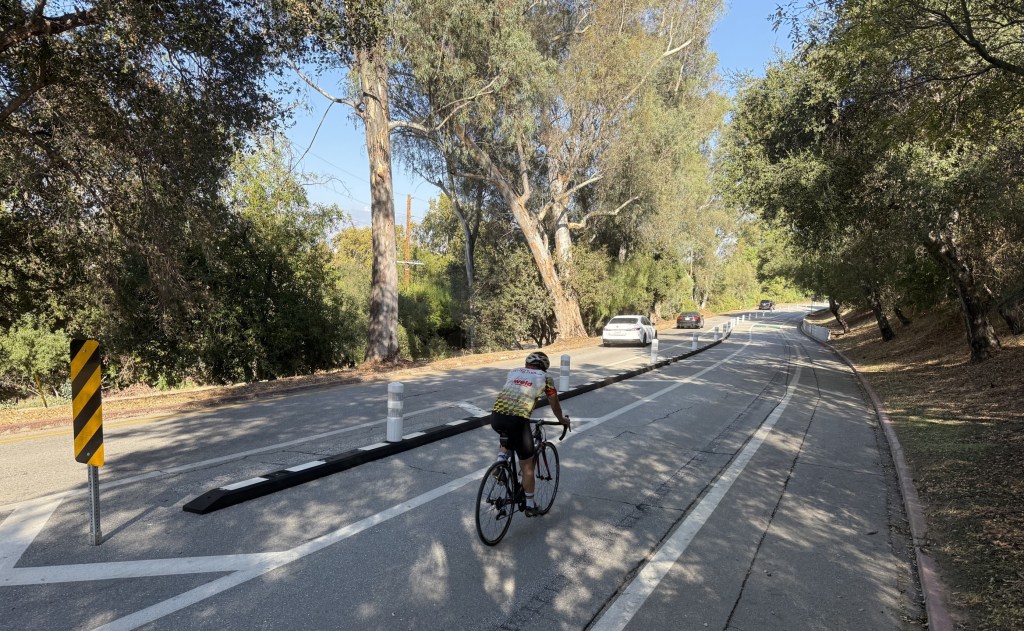
For cyclists, however, progress has been faster. And the Larkspur Landing tunnel and track has a great, off-road bike path; it’s already popular with cyclists using it for commuting and recreation.

That bike path will eventually continue directly, along with the pedestrian route, to the Larkspur Ferry Terminal.


Streetsblog has migrated to a new comment system. New commenters can register directly in the comments section of any article. Returning commenters: your previous comments and display name have been preserved, but you'll need to reclaim your account by clicking "Forgot your password?" on the sign-in form, entering your email, and following the verification link to set a new password — this is required because passwords could not be carried over during the migration. For questions, contact tips@streetsblog.org.