Newsom’s Climate Record Is Better Than Most Governors. That’s Not Good Enough.

California is doing a lot of things right on Climate Change, certainly more than most states in America.
According to numbers released by the California Air Resources Board, California’s greenhouse gas emissions fell 3.9 percent in 2024 while the state’s economy grew 3.2 percent. Emissions are now 28 percent below their 2004 peak, even as the state’s economy has nearly doubled. Transportation posted the largest total decline in emissions, helped by the growth of renewable diesel and zero-emission vehicles.
California has sold 2.7 million zero-emission vehicles and built more than 216,000 public and shared EV chargers. The state is also producing more renewable energy and cutting emissions from a wide range of sectors.
But better isn’t good enough…especially when the state has set such lofty standards for itself.
California is increasingly approaching transportation climate policy by focusing on creating a better system for cars in two ways: cleaning up the cars we already have through urging a transition to electric vehicles and requiring cleaner-fuel for gas-powered cars than most of the rest of the country.
California also needs to invest much more in a transportation system that makes it possible for people to drive less. That means supporting transit (both operations and expansion), projects that emphasize walking and biking, and housing projects that make those options useful.
And increasingly, it means making those alternatives resilient enough to survive the Climate Change that California has already helped create.
Highway Investments to Fight Climate Change
The Newsom administration recently announced $2.7 billion for more than 150 transportation projects, describing the package as an “investment in safety, multimodal transportation and resilience against Climate Change.”
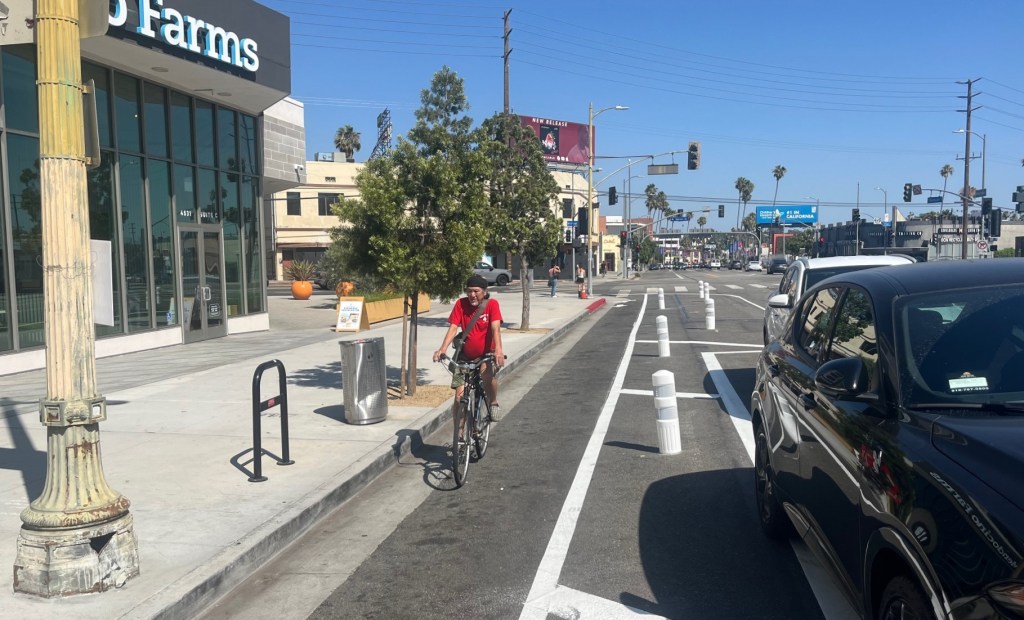
There are a few items in the package worth supporting. It includes a $9.4 million project for a 4.5-mile corridor connecting Interstate 710 to Union Station with a peak-period bus lane and a new Class IV bike facility, along with funding for pedestrian improvements, transit stations and bicycle infrastructure.
But the same package includes $63 million to add two lanes to State Route 37 in Sonoma County, the much-lampooned expansion project that Caltrans has admitted might be underwater before it’s completed. Nearly $50 million will widen SR-99 in Madera County from four lanes to six. There’s another $12.5 million to widen SR-59 in Merced. $11 million to widen the 405 in Orange County. The list goes on, and on.
It should go without saying the highway widenings are terrible for the environment and Climate Change on a number of fronts: the construction releases greenhouse gas into the air, the roads induce more people to drive, and wider highways lead to sprawl development patterns. The list of reasons not to increase highway capacity also goes on and on.

Rail Is Both a Climate Change Solution and Victim
The impacts of Climate Change are already here, and already disrupting the state’s rail systems. In all three of the examples below, the state moved quickly to fix the climate-caused disruption. But, California should be making these rail systems more resilient before there’s an interruption and right now those investments aren’t happening.
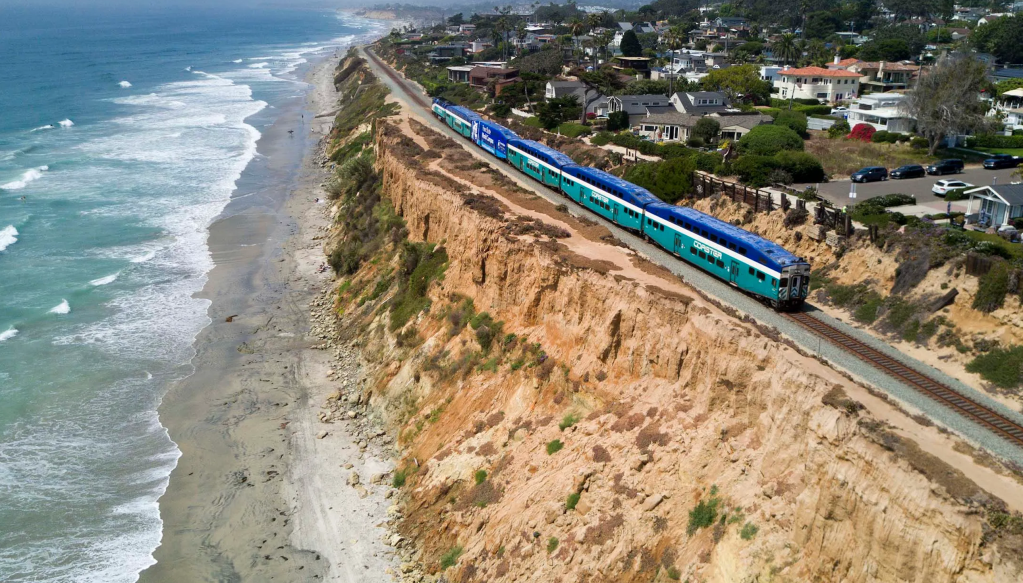
Earlier this month, high tides and coastal erosion damaged the rail corridor at San Clemente, forcing the suspension of Amtrak Pacific Surfliner, Metrolink and BNSF service. The tracks are part of the only rail connection between San Diego County and the rest of the national rail network. Meanwhile, the bluffs at Del Mar continue to erode, threatening the tracks in one of the state’s most important rail corridors.
In July, a brush fire near the BART tracks between South Hayward and Union City temporarily shut down service. BART had to rely on AC Transit buses to move passengers between stations while firefighters dealt with the blaze.
That same month, high ambient temperatures combined with mechanical stress led to the breakdown of a Metrolink train carrying about 500 people in Anaheim Hills because of overheated engines, leaving riders stranded for roughly two hours. Several passengers were treated for heat exhaustion.
Not every rail disruption is caused by Climate Change. But together these incidents illustrate the vulnerability of a rail system that California increasingly needs to rely on.

Show Me Your Budget
Joe Biden liked to say, “Don’t tell me what you value, show me your budget, and I’ll tell you what you value.” Beyond the rosy press release titles, California’s transportation budget says it values highway expansion more than it’s willing to admit. It’s past time that it corrects its budgeting: fund transit, not highways.
It’s interesting that Newsom decided to use numbers from 2024 to show the state’s improvement on emissions, because 2024 saw a 12 percent drop in state funding to fight Climate Change from the previous year. As demonstrated in a previous Streetsblog article, 2025 and 2026 continued that decline in funding, despite billions from the state’s Cap-and-Trade (or Cap-and-Invest) program buffering dramatic cuts from the general budget.
And with the Newsom-supported changes to Cap-and-Trade taking effect for next year’s budget, the decline in funding for climate projects will be even more in future budgets unless the next governor changes course.
Which is why it’s imperative that the state start spending money more intelligently now.
California should be moving vulnerable tracks away from eroding coastlines. It should be hardening infrastructure against wildfire and extreme heat. It should be modernizing aging equipment, signals, power systems, bridges and tunnels.
Yes, California under Newsom has done better than many states in fighting in Climate Change, but the budgets tell a different story than the press releases. A mixed record is better than a bad one, but the world is in crisis and better isn’t good enough.
Streetsblog has migrated to a new comment system. New commenters can register directly in the comments section of any article. Returning commenters: your previous comments and display name have been preserved, but you'll need to reclaim your account by clicking "Forgot your password?" on the sign-in form, entering your email, and following the verification link to set a new password — this is required because passwords could not be carried over during the migration. For questions, contact tips@streetsblog.org.