Legislature Sends High-Speed Rail Right-of-Way Bill to Newsom
There’s a lot of reasons California High-Speed Rail is not running trains already despite funding for the project being approved by voters decades ago; unrealistic timelines and cost estimates upfront being some of the largest. But in recent years the legislature seems to be working to reduce the less-exciting practical hurdles facing the rail’s construction.
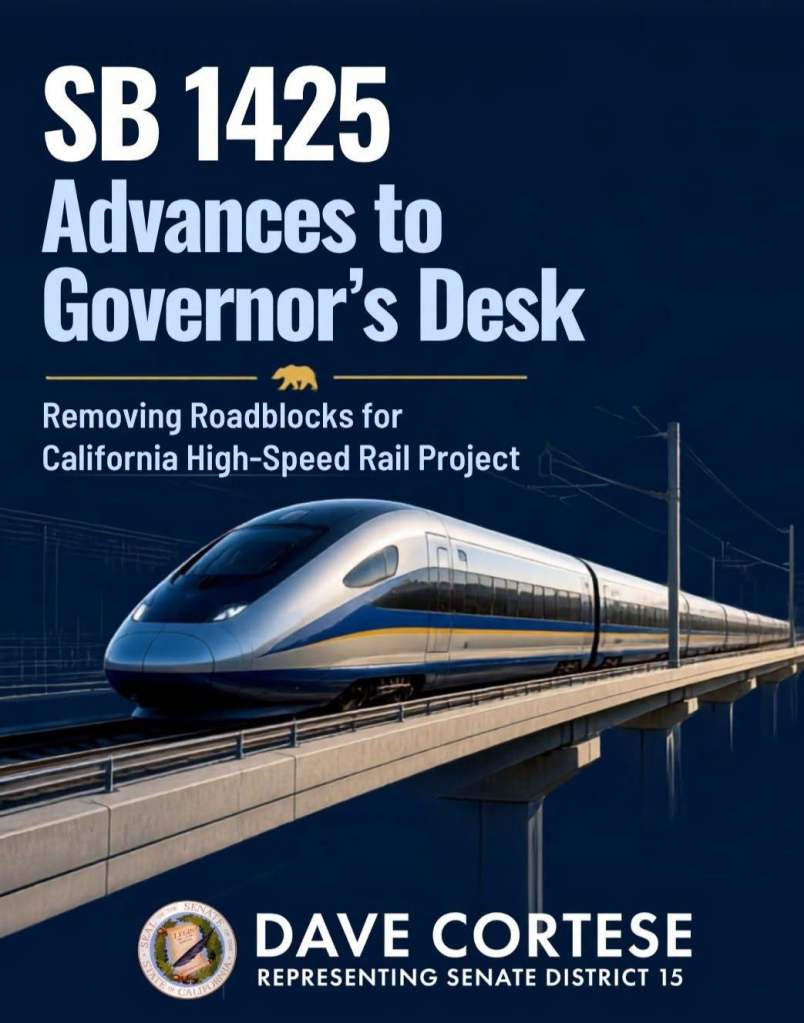
The latest high-speed rail bill to reach Gov. Gavin Newsom’s desk isn’t about funding the railroad or adding another mile of track. Instead, Senate Bill 1425 addresses a more mundane problem: what happens when someone needs to build, repair or operate infrastructure on property owned by the California High-Speed Rail Authority.
Last week, the legislature approved the bill by Sen. Dave Cortese (D-San Jose), sending it to Newsom for his signature.
“SB 1425 is about cutting red tape, establishing clear rules where they are needed, and keeping High-Speed Rail moving forward,” Cortese said.
The bill would give the High-Speed Rail Authority the power to to establish its own permitting program for “encroachments” on its property and operating rights-of-way. In practice, that could mean giving utilities, local agencies and other entities a defined process for getting permission to work within or cross the railroad’s property.
CAHSRA already owns or controls lots of property, but it lacks explicit statutory authority to issue its own encroachment permits. That creates a weird gap: a utility or other entity may legitimately need to put something across, under, over, or within the rail corridor, but there isn’t a clear, standardized process administered for granting that permission. In its testimony, the authority specifically identifies utility installations, excavations, vegetation work and surveys as examples.
To paraphrase Streetsblog’s favorite fictional rail master, this has led to confusion and delay.
A New Permit System for the Rail Corridor
As the High-Speed Rail Authority acquires property for the railroad, its holdings don’t exist in isolation. Roads, utility lines, drainage facilities, telecommunications infrastructure and other public and private facilities often need to cross or operate alongside the future rail line.
SB 1425 would allow the authority to create a formal permit system for those activities. The goal is to replace what has become a case-by-case process with rules spelling out when and how outside entities can use or occupy portions of CAHSRA property.
That may sound like a relatively small change compared with the enormous challenges facing California’s high-speed rail. But supporters argue that resolving these kinds of property and permitting questions before construction reaches a particular location can prevent delays later.
Robert Pearsall, California political director for U.S. High Speed Rail, which sponsored the legislation, argued that the need for a clear permitting process will become more important as the project moves into its next phase.
“With the California High-Speed Rail Authority now executing a co-development agreement with a private consortium to accelerate the project, eliminating unnecessary barriers to completion is critical,” Pearsall said.
Now the Bill Goes to Newsom
SB 1425 passed the Legislature in late August and was presented to Newsom on Aug. 31. The governor has until Sept. 30 to sign or veto the legislation. If he takes no action by the deadline, the bill will become law without his signature.
Streetsblog has migrated to a new comment system. New commenters can register directly in the comments section of any article. Returning commenters: your previous comments and display name have been preserved, but you'll need to reclaim your account by clicking "Forgot your password?" on the sign-in form, entering your email, and following the verification link to set a new password — this is required because passwords could not be carried over during the migration. For questions, contact tips@streetsblog.org.