Streetsblog Reviews Last Weeks California Bike Summit, Part 1: Advice on Living with Caltrans

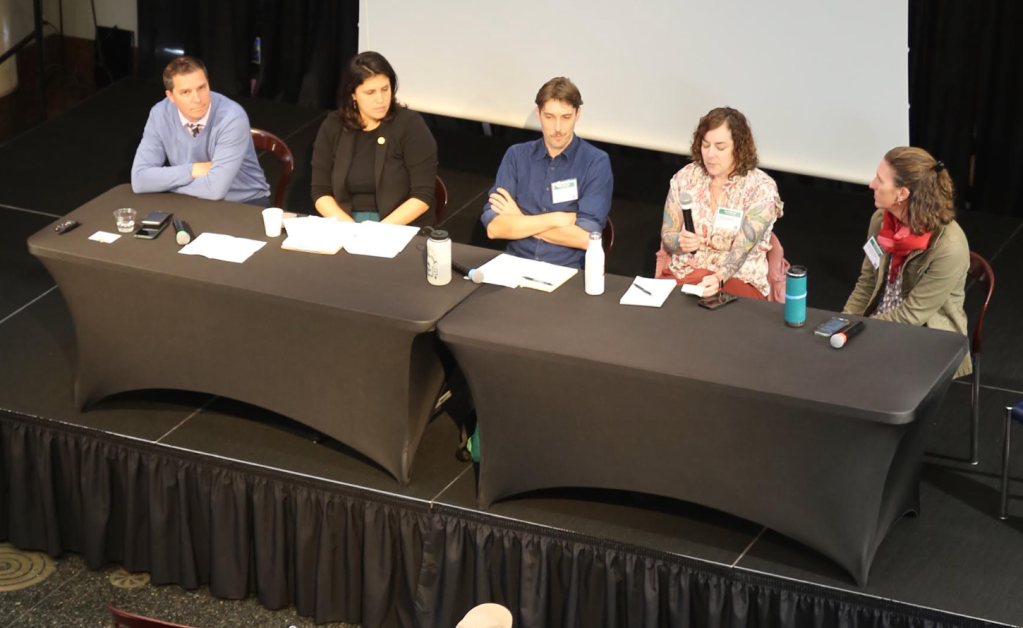
Last week, the California Bicycle Coalition held its biennial Bike Summit, and Streetsblog California caught a few of the sessions.
One was a check-in on Senate Bill 960, the Complete Streets bill passed in 2024 — after numerous attempts — that requires Caltrans to include safe infrastructure for bike riders and people on foot when it does repairs or maintenance on its highways.
Keep in mind that many main streets in California’s cities are state highways, and thus under Caltrans’ control and jurisdiction – so this is not about adding bike lanes or sidewalks on freeways. It’s about making sure city streets are safe for everyone using them.
Jeanie Ward-Waller, who has years of experience both as an advocate and a former deputy director for planning and modal programs, spent a few minutes at the beginning of the session to trace the history of road safety progress. It can be painfully slow, but it is nevertheless real.
A decade ago, Caltrans was still referred to as the State Highway Department, concerned most of all with moving cars along. That mindset hasn’t disappeared yet, but it is eroding at the edges.
In the last fifteen years, according to Ward-Waller, “while challenges remain, we have come amazingly far.”
Caltrans adopted its first Complete Streets policy in 2008— and that early version was pretty weak. It said that Caltrans would “consider” adding safer infrastructure when it did repairs on the existing highway system. That policy has been updated three times since then, and the 2021 update can be regarded as a model policy, said Ward-Waller.
During the same span of years, Caltrans created a sustainability program and set goals to shift travel towards bikes and walking (2015). In 2008, said Ward-Waller, there was one “bike guy” at Caltrans headquarters, and one woman working on Safe Routes to Schools. Today, there is a growing “army” of passionate, hardworking people at Caltrans advocating for change from the inside.
Other state institutions have similarly been evolving. As an advocate, Ward-Waller started attending California Transportation Commission meetings in 2012 to argue for funding for better road projects. Commissioners didn’t know quite what to make of her, and frequently responded to testimony about safety by asking her why bicyclists run stop signs. “At the latest CTC meeting,” she said, “there was an hour-long discussion about safe streets.”
Because Caltrans “now has to include things like sidewalks and bike lanes, if they are in local plans,” said Ward-Waller, “this has changed the whole conversation.”
But yes progress is slow. Susan Lindsay, Caltrans Lead Advisor on Completes Streets, pointed out that the average timeline for Caltrans project delivery is nine years. This seems like an unconscionably long time, but it applies to all projects, whether there is a bike and pedestrian aspect to them or not. It does mean changes from S.B. 960 won’t be seen on the streets any time soon.
Also, warned Lindsay, “Caltrans is conflict-averse. We’re not forcing projects on communities that have resistance.” That is, unless there is clear local consensus the changes required by SB 960 won’t happen at all.
Some Cities Still Struggle with Caltrans
Costa Mesa City Councilmember Arlis Reynolds had a lot to share about her city’s experience with trying to convince Caltrans to adopt changes.
“I have been really frustrated with some of your Caltrans colleagues,” she told Lindsay. “It should be enough for a city councilmember to say: ‘Just stop people from getting killed.’ In Costa Mesa, we have been doing everything right, but we are not getting what we need (from the local Caltrans district.)
Doing everything right included identifying the roadway where half of all the city’s pedestrian and bicycle deaths occur, working with UC Berkeley’s Safe Transportation Research and Education Center on community engagement, and starting discussions with Caltrans when they first learned that there was a $100 million project to improve the road in question. But at some point, a new Caltrans district director came on board – that would be District 12 Director Lan Zhou, a twenty-year veteran of Caltrans, and the city was told that it was too late to change anything.
“At that point, I had been working on this for years,” said Reynolds.
Caltrans also made unreasonable demands and patronizing excuses for not including the city’s input on the project, she said. It demanded not just community support — which was strong and clear — but also unanimous city council support. So Reynolds got the council to pass a detailed resolution requesting specific safety fixes that would meet specific city goals. They also submitted a support letter from their state Assemblymember Cottie Petrie-Norris; they invited CTC commissioners to tour the area; they met multiple times with Caltrans staff, and marked up Caltrans plans with detailed suggestions for improvements.
“So far, we’ve got signage and markings,” said Paul Martin, Transportation Services Manager for Costa Mesa.
Advice for Advocates
Hunter Oatman-Stanford, representing Caltrans District 4 (Bay Area), had advice for advocates who work on projects that involve Caltrans. Get involved as early in the planning process as possible, he said. But if you aren’t involved early, the second-best time to get involved is whenever you can. As Ward-Waller said, “do not give up just because the project has already been through the planning process. Don’t take no for an answer. Be annoying. Call staff, call the District Director. Let them get to know you.”
Oatman-Stanford also suggested asking for the strongest safety features you can think of, even if connecting streets don’t have them yet. Again, progress takes time, and if it has to be piecemeal don’t let Caltrans facilities be the ones holding back safety.
Also, “get to know DIB 94,” he said. This is a 2024 Caltrans Director’s Bulletin that allows local jurisdictions to go beyond basic Complete Streets requirements.
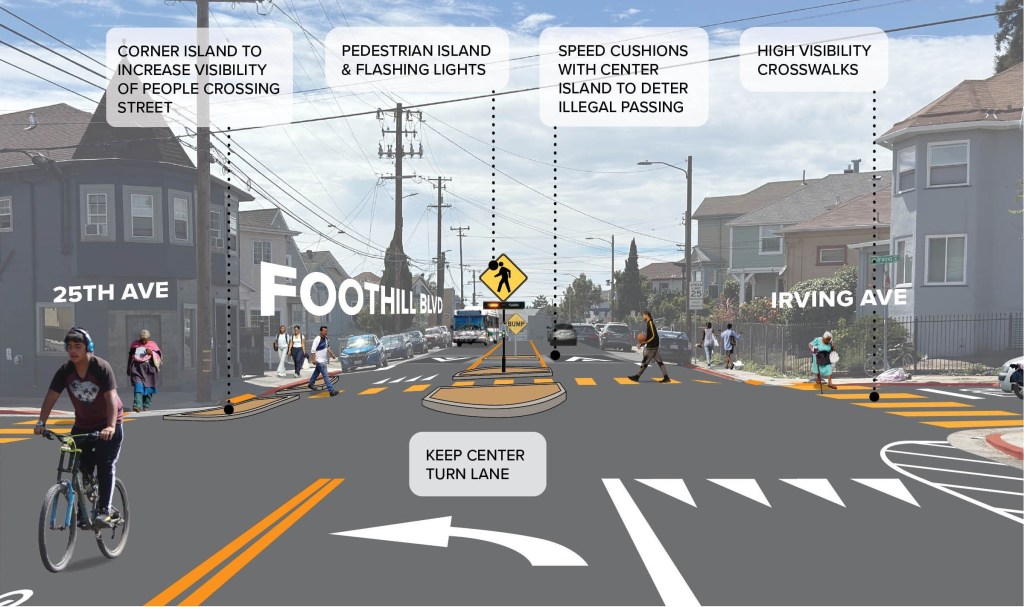
The bulletin includes a lot of specific potential safe streets designs that are not necessarily required, but could be included if local jurisdictions want them. And, clearly, push hard for them.
Reynolds had told the audience that she is coming to the end of her term on City Council, and is unhappy because she feels like the local Caltrans district just waited her out on this project. While city staff, local residents, and other elected officials are clearly still concerned about it, it’s unclear what will happen once her term is up.
She had not been a bike advocate when she was first elected to her position, she said, but is now. That came about when local bike groups invited her to ride with them and she saw from their perspective how dangerous streets are.
“What really got me,” she said, “was when I understood that traffic deaths are preventable – and therefore unacceptable.”
This is part 1 of a mini-series on the conference. More to come…
Streetsblog has migrated to a new comment system. New commenters can register directly in the comments section of any article. Returning commenters: your previous comments and display name have been preserved, but you'll need to reclaim your account by clicking "Forgot your password?" on the sign-in form, entering your email, and following the verification link to set a new password — this is required because passwords could not be carried over during the migration. For questions, contact tips@streetsblog.org.