Fresno’s New Active Transportation Plan Sets an Ambitious Course — Advocates Say Execution Will Be Key – Comments Due March 5
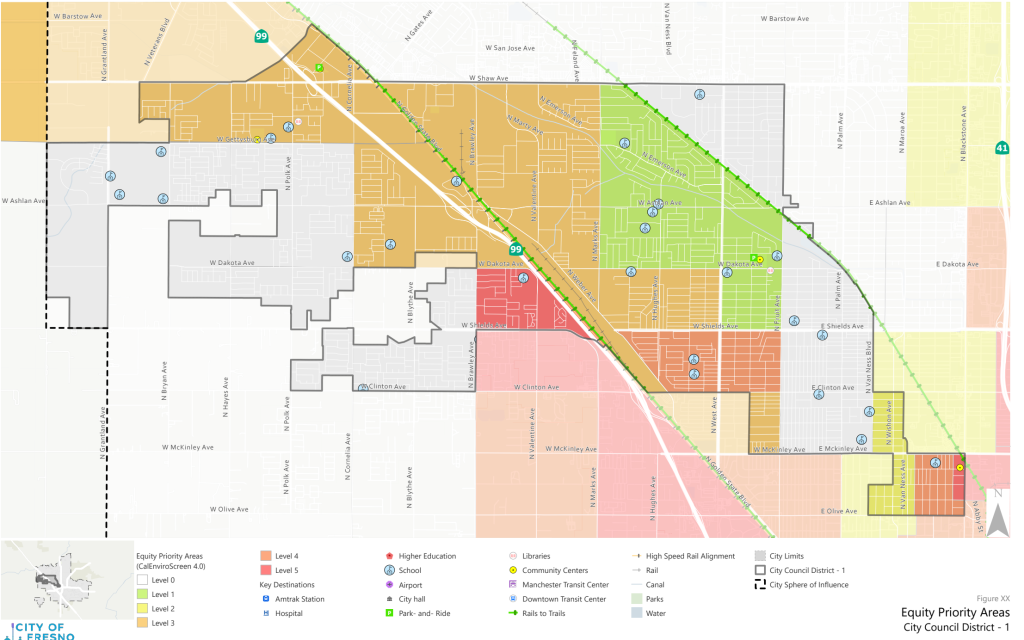
The city of Fresno is accepting public comments on its draft 2026 Active Transportation Plan (ATP). The new plan updates Fresno’s 2017 ATP and lays out an expanded network of bikeways, trails, sidewalks, and intersection improvements intended to make active transportation safer, more convenient, and more equitable over the coming decades.
Comments are due March 5. Submit via email or in person to: Andreina Aguilar, Public Works Department, 2600 Fresno Street, Room 4019, Fresno, CA 93721.
View ATP specifics at the city’s summary of the proposal, watch this meeting of the City of Fresno Disability Commission, or this meeting of the Fresno Active Transportation Advisory Committee.
Advocates with the Fresno County Bicycle Coalition (FCBC) say the draft marks a major step forward in ambition and vision. At the same time, they are urging the city to tighten the plan’s implementation framework, correct mapping errors, and more clearly align infrastructure investments with real-world engineering constraints and equity priorities.
The City’s Vision
The draft ATP paints a hopeful picture of a Fresno where residents of all ages and abilities can safely bike to school, walk to parks, and access jobs and transit without relying exclusively on cars. While the city deserves some credit for these worthwhile aspirations, the situation on the ground is the opposite. Last year Smart Growth America ranked Fresno the as the country’s 7th most dangerous city for walking and bicycling.
But city leaders hope to change that. The draft plan emphasizes:
- An expanded priority bikeway network, including Class 1 multi-use paths, Class 2 bike lanes, Class 3 routes, and Class 4 protected bikeways (cycle tracks).
- Improved pedestrian infrastructure, including sidewalk gap closures, safer crossings, ADA upgrades, and traffic calming.
- Equity-focused investment, prioritizing underserved neighborhoods and areas with higher crash rates.
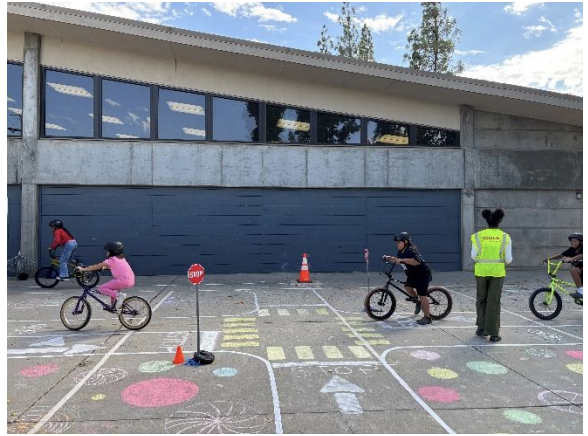
- Safe Routes to School enhancements, aimed at protecting children walking and biking near campuses.
- Integration with transit, recognizing that walking and biking are essential first- and last-mile connections.
- Data-driven safety improvements, aligned with the city’s broader traffic safety and Vision Zero efforts.
Compared to the 2017 plan, the draft includes a more detailed network map and attempts to prioritize corridors for future grant applications, including state Active Transportation Program funding.
The plan frequently outlines what “the City of Fresno should” do to improve safety and access. It also anticipates leveraging multiple funding streams, including local sales tax revenues, development impact fees, and state and federal grants.
In short, the vision is expansive: safer arterials, protected bikeways, better crossings, and a more connected network across neighborhoods long divided by wide, high-speed roadways.
FCBC: Ambitious, But Lacking a Roadmap
The Fresno County Bicycle Coalition wrote to Streetsblog with a detailed summary of their concerns with the plan. Although they described the draft as “ambitious and visionary — a significant improvement over the 2017 plan.” They worry that the document reads more like a consultant’s wish list than an actionable implementation roadmap.
At the top of the coalition’s concerns is accountability. But given the concerns with the future of Fresno County’s transportation sales tax (read recent Streetsblog coverage here and here) there is also real concern that the wish list will never become reality.
Here’s a summary of FCBC’s concerns.
1. No Clear Implementation Structure
FCBC argues the plan does not assign responsibility to specific city departments or staff, nor does it establish a coordination structure to ensure projects move from concept to construction.
- The draft does not specify which departments are accountable for delivering specific improvements.
- It does not outline mechanisms to break down silos between departments that work on streets, public works, planning, and enforcement.
- It lacks a formal internal task force model, similar to the multi-disciplinary structure used in the city’s Vision Zero efforts.
External coordination is another gap. Fresno’s patchwork of county “islands” complicates infrastructure planning. The ATP designates bikeways through areas outside direct city control without clearly explaining whether Fresno County will cooperate.
FCBC also highlights the absence of a clear implementation pathway for major destinations such as California State University, Fresno (Fresno State), which draws thousands of students daily and is widely viewed as a critical hub for safe bicycle access.
2. Map Errors and Classification Issues
Community members reviewing the draft identified what they describe as multiple facility mapping errors and confusing classifications:
- Van Ness Extension is shown as a Class 2 bike lane but is built as a Class 1 multi-use path.
- Peach Avenue south of McKinley is labeled as a planned Class 2 facility but is reportedly under construction as a Class 4 separated bikeway.
- Spruce Avenue in northwest Fresno is shown with a Class 4 designation despite low density and a wide roadway that may not justify that level of investment.
- Alluvial Avenue east of Marks is also depicted as a Class 4 corridor, raising similar questions.
Additionally, FCBC says the maps are difficult to interpret because existing and proposed facilities are displayed using the same line styles, making it hard for the public to distinguish what is already built from what is planned.
3. Cycle Tracks vs. Buffered Bike Lanes
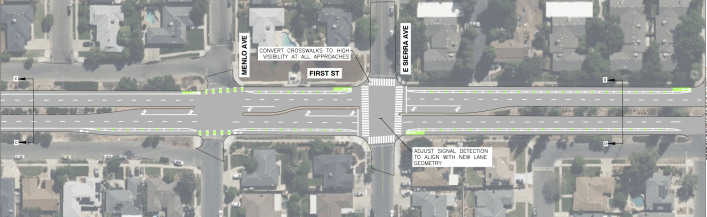
Perhaps the most technically detailed critique centers on the plan’s reliance on Class 4 separated bikeways, or cycle tracks.
While protected bikeways are often considered the gold standard of bike infrastructure, FCBC argues the draft overestimates how feasible they are on Fresno’s wide, truck-heavy arterials.
Key engineering concerns include:
- Converting a standard Class 2 bike lane into a Class 4 facility typically requires about three to five additional feet of width per direction for buffer space.
- Narrowing Fresno’s common 12-foot travel lanes to 11 feet only yields two extra feet — enough for a buffered Class 2 lane, but not a full cycle track.
- Many arterials are designated truck routes, where reducing lane width may not be viable.
- Removing landscaped medians to create space for cycle tracks is considered unlikely.
As a result, FCBC contends that on many corridors the most practical near-term upgrade would be a buffered Class 2 bike lane — a treatment that offers high visibility at a significantly lower cost per mile.
The coalition also cautions against overreliance on flex-post delineators, commonly used in Fresno along Belmont, Palm, Van Ness, and R Street. These posts are typically considered quick-build infrastructure with a 3- to 5-year lifespan and do not physically prevent vehicles from entering the bike lane. In a city that continues to struggle with impaired and distracted driving, FCBC argues, the perceived protection may exceed the actual protection provided.
4. Equity and Investment Priorities
The draft ATP emphasizes equity, but FCBC urges the city to align its infrastructure types with genuine need.
If funding is limited — and both local and federal sources remain uncertain — the coalition argues that expensive Class 4 facilities should be targeted to:
- High-crash corridors
- Underserved neighborhoods
- Areas with limited access to safe transportation options
Placing high-cost infrastructure in affluent, low-density areas simply because the roadway geometry makes it easier, the coalition says, would not represent an equitable allocation of resources.
5. Maintenance: The Missing Chapter
Another major concern is maintenance.
The ATP proposes a substantial expansion of bicycle and pedestrian infrastructure but does not detail how Fresno will maintain it. FCBC’s community feedback urges the city to plan to resolve:
- Potholes and pavement failures that take extended periods to repair.
- Tree root damage breaking through asphalt.
- Trash bins placed in bike lanes during curbside collection.
- Commercial vehicles, such as food trucks in the Tower District, using bike lanes.
- Habitual parking in bike lanes near apartment complexes with limited enforcement.
An infrastructure plan without a maintenance plan, FCBC argues, is incomplete.
6. The Measure C Wildcard
Finally, funding looms large.
Measure C — Fresno County’s long-running transportation sales tax — is up for renewal. Two competing citizen initiatives are currently gathering signatures, each requiring roughly 30,000 to 35,000 signatures to qualify. Because they are citizen initiatives, they would need only 50 percent plus one vote to pass. If both qualify and pass, the measure with the most votes would govern.
The initiatives reportedly differ in how they allocate funds between roads and transit, and it remains unclear whether either includes a complete streets requirement or a dedicated active transportation carve-out.
That uncertainty makes the ATP’s funding assumptions fragile. Federal Active Transportation Program grants are also uncertain under the current administration.
A Moment of Opportunity
Despite the critiques, FCBC leaders describe this as a moment of opportunity. The coalition’s legislative committee is preparing a formal comment letter to the city ahead of the March 5 deadline, to be signed by Board Chair Edna Pedroza. Community members are also being encouraged to submit individual comments.
Streetsblog has migrated to a new comment system. New commenters can register directly in the comments section of any article. Returning commenters: your previous comments and display name have been preserved, but you'll need to reclaim your account by clicking "Forgot your password?" on the sign-in form, entering your email, and following the verification link to set a new password — this is required because passwords could not be carried over during the migration. For questions, contact tips@streetsblog.org.