Are Embarcadero BART Fare Sweeps Justified?
Note: GJEL Accident Attorneys regularly sponsors coverage on Streetsblog San Francisco and Streetsblog California. Unless noted in the story, GJEL Accident Attorneys is not consulted for the content or editorial direction of the sponsored content.
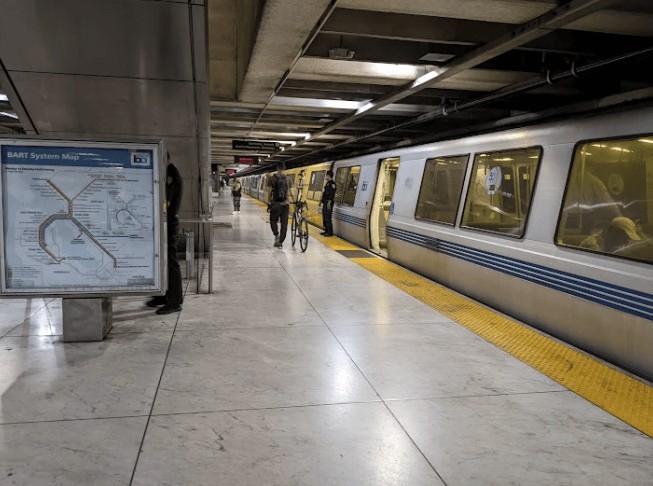
An Oakland-bound rush-hour BART train was holding at Embarcadero while police and transit ambassadors checked fares Tuesday morning, Sept. 6. I was arriving from Oakland and noticed the train and the police as I was walking towards the station exit. I asked a BART officer what was going on and he said the trains are “only delayed for a couple of minutes” while fare inspections are handled.
I had read about this practice–of BART police delaying trains at Embarcadero to check fares–on social media and in the Chronicle, but I thought it was a short-term effort while ridership was low due to COVID. Apparently this is part of an open-ended program to hold East Bay bound trains and do fare-inspection sweeps, with the idea of connecting indigent riders with social services. It started in late 2019.
“BART’s strategy of conducting focused proof of payment inspections during weekday mornings at the Embarcadero Station is intended to address customer concerns and service disruptions that are the result of un-ticketed passengers who are using the system for shelter as opposed to transportation. Our experience has demonstrated that a large number of un-ticketed passengers enter the system in San Francisco during the early morning hours and board trains,” wrote Jaswant Sekhon, Zone 3 Commander with the BART Police Department.
Streetsblog isn’t refuting that the police and BART ambassadors can identify and help people more efficiently by stopping and swarming trains when the lines and riders are consolidated just before the Transbay Tube. But I’m not aware of any transit agency going so far as to delay entire trains full of riders, even for a couple of minutes, for this purpose. Reliability is a big factor in attracting and keeping riders. And the inspections can be done in stations and on moving trains, even if it is less “efficient” for the police and social service workers.
Moreover, going by a discussion during a July 28 board meeting about this practice, it’s unclear that the delays are truly insignificant. “I’ve heard from people who have missed their Capitol Corridor train connections,” said BART Board Director Rebecca Saltzman. She added that if someone misses a tight connection from BART to another system, a few minutes can translate into hours.
“I’m not a huge fan of this program,” said BART Director Janice Li, who represents the Embarcadero station, at the same meeting. Like Saltzman, Li said she’s read posts and emails from riders about missed connections thanks to the sweeps. “I also want to acknowledge the significant and consistent complaints.”
On the other hand, “the inspections have also resulted in lower calls for service into our dispatch center during the hours of activity,” wrote Sekhon in his email to Streetsblog.
BART’s Chief of Police, Ed Alvarez, who presented about the delays and the program at the meeting, explained that they will stop delaying trains when ridership grows to a point that the sweeps become unmanageable. He assured the board that the practice reduces calls for police, although the board asked for clearer metrics on delays as well as whether it’s really necessary to stop entire trains.
What do you think? Should BART police be stopping trains for non-emergency reasons? Post your thoughts.
Streetsblog has migrated to a new comment system. New commenters can register directly in the comments section of any article. Returning commenters: your previous comments and display name have been preserved, but you'll need to reclaim your account by clicking "Forgot your password?" on the sign-in form, entering your email, and following the verification link to set a new password — this is required because passwords could not be carried over during the migration. For questions, contact tips@streetsblog.org.