Dockless Companies Deliver Bike-Share to Underserved Areas

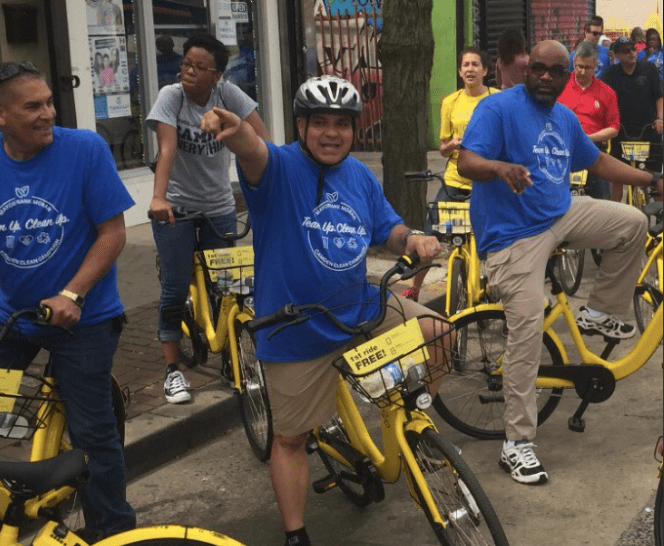
Dockless bike-share is still very new in American cities and we’re just beginning to understand the positives and negatives.
But one of the more exciting possibilities is the potential to bring bike-share to new areas, especially lower-income neighborhoods or neighborhoods of color that have been left out. There’s no reason conventional docked bike-share couldn’t do the same, given the political will, and some cities are doing better at that than others.
But where docked systems are falling short, in some cases private dockless companies are picking up the slack. Chinese bike-share firm ofo arrived in in Camden, New Jersey, last week with 200 bikes. The grant-supported pilot is meant to gauge whether the community can support a permanent bike-share system. Bikes will be available for $1 per hour during the seven-month trial and can be locked anywhere.
Charles Brown, of the New Jersey Bicycle and Pedestrian Resource Center, says Camden is now the lowest-income city (median income $27,000) in the U.S. to have a bike-share system.
Meanwhile, Chicago launched a small bike-share pilot on the majority-black Far South Side. As Streetsblog Chicago has reported, Pace, Lime Bike, and ofo are all taking part. But like Camden’s pilot, the Chicago experiment is limited. So far Chicago has permitted no more than 750 bikes for a service area that covers roughly a fifth of the area of the city of 2.7 million, so there may not be sufficient bike density, although it’s possible more companies will join the pilot.
Washington, DC, is another area where dockless companies — like Mobike, Spin, ofo, Lime Bike, and JUMP — have moved into neighborhoods on the city’s majority-black southeast section that Capital Bikeshare has not. Anecdotally, DC dockless bike-share ridership is more diverse than that of the public docked system, where ridership is only about 4 percent black.
Brown thinks dockless bike-share presents opportunities for communities that have not been well served by traditional bike-share. Although Camden’s pilot is relatively small, the demonstration may show there’s an appetite for many more bikes.
“They were willing to invest in places that other people were not and I think that in itself is noble,” Brown told Streetsblog.

Streetsblog has migrated to a new comment system. New commenters can register directly in the comments section of any article. Returning commenters: your previous comments and display name have been preserved, but you'll need to reclaim your account by clicking "Forgot your password?" on the sign-in form, entering your email, and following the verification link to set a new password — this is required because passwords could not be carried over during the migration. For questions, contact tips@streetsblog.org.