Parking Madness: Fremont vs. Hicksville

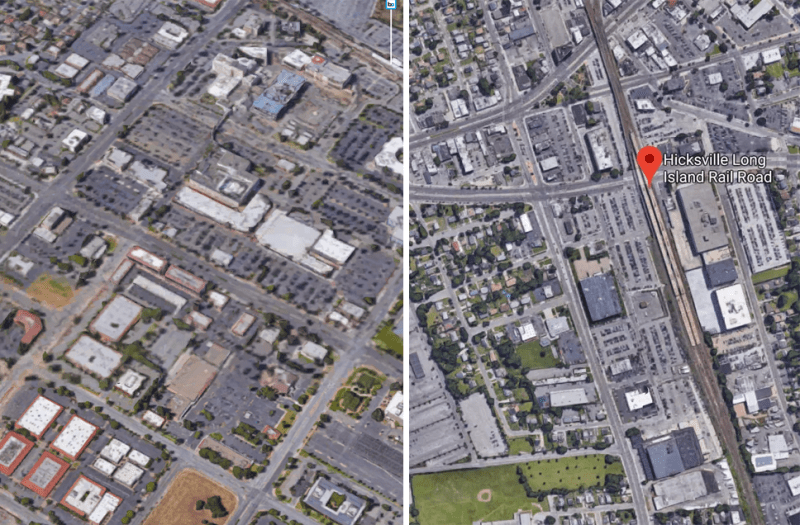
If you’ve ever wondered what’s wrong with American commuter rail, take a good look at the two parking craters facing off today for a spot in the Parking Madness semi-final.
They are within the orbits of San Francisco and New York, offering convenient access to two of the nation’s largest job centers. But even though housing is constrained and increasingly unaffordable in both regions, these commuter rail stations are surrounded by fields of car storage.
With Lansing and Philadelphia through to the next round and voting still open in the Nashville vs. Providence match, the winner of today’s contest will represent the nation’s transit station parking craters in the Final Four. Watch as Fremont’s BART station area takes on Hicksville’s Long Island Railroad station area.
Fremont

This kaleidoscope of wasted space is directly south of the Fremont BART station. Fremont (population: 214,000) is one of four (!!!) BART stations that have been featured in Parking Madness over the years.
Suffice it to say that land use is not a strong suit in these Bay Area commuter rail suburbs. The whole region, but especially higher-income suburbs, have been notoriously resistant to the construction of more housing, even as a booming job market intensifies housing pressures and sends prices skyrocketing.
Plans are underway to extend BART service south to San Jose — but it won’t be cheap. Meanwhile, past transit investments are squandered on these unwalkable parking craters. No wonder California is having trouble meeting its climate targets.
Hicksville

The Northeast can’t really claim the high ground. Hicksville, on Long Island, is a 25-mile train trip from New York’s Penn Station. But there’s been no effort to create a walkable environment around this LIRR stop, as all that nearby big box retail parking attests. Combined with rigid commuter rail scheduling and crummy local transit service, the land use around this and other LIRR stations keeps ridership very low compared to regional rail systems in Europe.
This crater was nominated by reader Shaul Picker, who writes:
Hicksville gets about 133 trains per day and is only about 40-50 minutes away from Penn Station. Instead there is a big crater of parking. To get to a talk with Neil deGrasse Tyson I had to take the LIRR to Hicksville and take a slow bus. At Hicksville I saw nothing but parking lots. You essentially have to walk through parking lots to get out of the station. There is so much potential here, but it is waste.
We’ve surveyed the damage, and it’s time to choose which one of these craters should move on to the Final Four.


Streetsblog has migrated to a new comment system. New commenters can register directly in the comments section of any article. Returning commenters: your previous comments and display name have been preserved, but you'll need to reclaim your account by clicking "Forgot your password?" on the sign-in form, entering your email, and following the verification link to set a new password — this is required because passwords could not be carried over during the migration. For questions, contact tips@streetsblog.org.