N-Judah Incident Highlights Need to Examine Muni Bike Ban
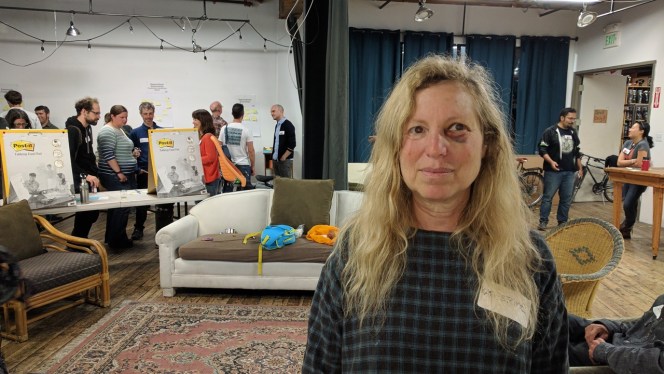
Katherine Roberts was biking home to the Haight from a Passover Seder in the Dogpatch at 11:30 on April 11. It was raining heavily. She got to Church and Duboce and slowed to let an outbound N-Judah pass. When she started to pedal again, the wheel of her folding bike slipped and got caught by a steel plate that wasn’t flush with the pavement. She crashed and smashed her head.
Her partner, Jym Dyer, was with her. Another outbound N-Judah train approached. They realized the fastest way to get medical attention was to take the N-Judah to UCSF Medical Center, a ten minute ride. “It can go through the tunnel,” said Roberts. “I didn’t want to wait for an ambulance–that takes four times as long.”
But the train driver wouldn’t let them board with their bicycles.
They both had folding bikes, which are permitted on Muni as long as they are folded. But the train was empty, and given her injuries and the crack on the head, it didn’t occur to her to fold her bike. “As soon as I showed the driver my injuries, I thought he would just say ‘okay’ and drive the train,” said Roberts. “I was disoriented and weak and I wasn’t really thinking ‘oh, it’s really important for me to fold the bike right now!'”
The driver told them to get off the train and refused to move. He called over a fare inspector. The inspector forced them off the train and told them to call an ambulance if they needed help. But for some reason he also told them they could take the next train, which was right behind them (that’s three N-Judah’s bunched in a row, in case anyone’s counting). However, he still wouldn’t let Dyer on with his bike, folded or not, because it is a larger, folding cargo bike model. Dyer had to ride his bike behind the train while Roberts–with cuts and a large bump growing on her head–was left alone with her now-folded bike.
The train driver, meanwhile, stopped at the next stop, at Duboce Park, and came out of the cab to yell at Roberts to “secure her bike” which had flopped over on the floor. “I was weak. I had a concussion,” she said. “The car was almost empty. I wasn’t blocking anybody.”
Roberts finally got to the hospital, where she was treated. She is slowly recovering, but she hasn’t been back on her bike yet. “I’m woozy and I’m tiring very easily. I’m not ready to bike at all.”
From Streetsblog’s perspective, the incident highlights two issues. Firstly, if there’s any truth to what happened that night, it speaks to real problems with Muni’s employee culture. Two drivers and an inspector can’t show a little compassion in such a situation? As it turns out Robert’s injuries were not life threatening, but she could have died as a result of their time-wasting shenanigans.
And secondly, why are we banning bikes on late-night trains in the first place!
The San Francisco Bicycle Coalition fought hard, and finally succeeded, in opening up BART to bikes at all times. Obviously, Muni trains are much smaller. Nobody’s arguing that full-sized bikes should be allowed during peak periods. But what would be the big deal if bikes were allowed, space permitting, during off hours?
As this old edition of the SFBC’s newsletter talks about, if New York can handle bikes on its subway, and Portland, Los Angeles, San Diego, Sacramento and many other cities can handle bikes on their Light Rail Vehicles, what makes Muni so special?
Either way, “the incident with Katherine is disheartening, both in terms of how she was treated and in light of the strict enforcement of an antiquated policy, especially in an emergency situation,” said Rachel Hyden, Executive Director of the San Francisco Transit Riders. “San Francisco Transit Riders is supportive of a policy amendment that would allow bikes on LRVs, especially during off-peak hours.”
Erica Kato, an SFMTA spokesperson, told the San Francisco Examiner that the drivers and inspector were just following policy and that “protocol when it comes to medical emergencies is to call Central Control, which will then dispatch emergency services.” She also used the “liability” excuse. Streetsblog has asked for clarification from SFMTA and will update this post.
But if we’re going to talk liability, Roberts crashed because of a steel plate that the city failed to properly maintain (it’s still sticking out, by the way). If the city can’t maintain the streets, the least they could do is take us to the hospital when we crash as a result.
Streetsblog has migrated to a new comment system. New commenters can register directly in the comments section of any article. Returning commenters: your previous comments and display name have been preserved, but you'll need to reclaim your account by clicking "Forgot your password?" on the sign-in form, entering your email, and following the verification link to set a new password — this is required because passwords could not be carried over during the migration. For questions, contact tips@streetsblog.org.