Op/Ed: A Quiet Car, Please! California’s Trains Need More Than New Equipment


For more of James’ work at Streetsblog, click here.
Recently, I rode Amtrak’s San Joaquins train through California’s Central Valley, now branded as the Gold Runner. The new train cars are wonderful—comfortable, modern, and a much-needed investment in California’s passenger rail system. But while the trains have improved, passenger behavior has not.
Sometimes, it makes you want to cry when you realize what a hot mess we Californians can be in public spaces.
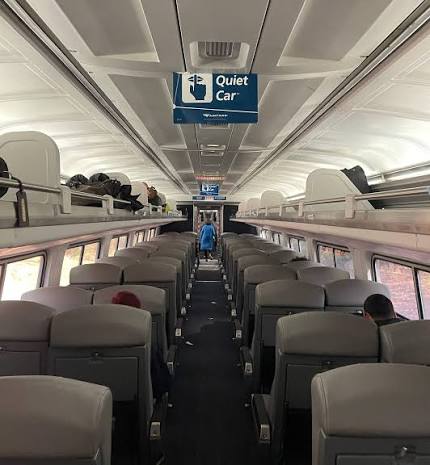
On our trip from Hanford to Oakland, a woman sitting across the aisle from us spent nearly five hours talking nonstop on her phone, much of it on speaker. We learned more about her personal life than we ever wanted to know. Apparently, her car had been towed in San Luis Obispo, and her baby’s insulin was inside. She was frantically calling people trying to locate the vehicle.
I felt sympathy for her situation, especially the concern about her baby’s medication. But I couldn’t understand why everyone else on the train had to become part of her crisis. Or why she was traveling from Hanford to Oakland to resolve a problem in San Luis Obispo.
Meanwhile, other passengers were watching television, listening to music, and carrying on conversations, sometimes without headphones. The train became a rolling collection of competing sounds, with little opportunity for silence.
As a Latino, I understand that we often take pride in being loud, expressive, and social. Noise is part of the cultural landscape I grew up with in East Los Angeles. I love the sounds of families gathering, children playing, street vendors calling out, and neighbors talking across fences. These sounds bring life to our neighborhoods.
But there is a time and place for noise, and public transportation requires a different kind of social awareness.
When people travel, they are often at their most vulnerable. They may be exhausted, anxious, worried about making connections, traveling to medical appointments, or simply trying to get home. Unlike in a park or plaza, passengers cannot easily walk away from someone else’s noise. They are sharing an enclosed space for hours where the noise becomes amplifided.
I especially thought about the young Latino students traveling between their Central Valley communities and colleges throughout California. For many, the train is more than transportation. It can be a place to study, read, reflect, or simply enjoy a few hours of peace between the demands of school, work, and family.
Why shouldn’t they have that opportunity?
The train attendants seemed barely able to keep up with their responsibilities, let alone enforce basic standards of passenger courtesy. Announcements were made over the intercom reminding passengers to be considerate, but few seemed to listen.
And that is the problem. We can design beautiful trains, build new stations, and invest millions in rail infrastructure, but if we don’t address how people behave in these shared spaces, we undermine the very public investment we are trying to make.
As an urban planner, I have spent much of my career thinking about how people experience the built environment through their senses. Sound is one of the most powerful, yet overlooked, elements of public space. It can make us feel connected, energized, anxious, or overwhelmed.
Good urban design is not simply about physical infrastructure. It is also about creating the social conditions that allow people to feel comfortable, respected, and safe.
That is why I believe California’s Gold Runner should designate at least one car as a Quiet Car, similar to the quiet-car options offered on some East Coast Amtrak services.
A Quiet Car would not require silence throughout the entire train. Families could still talk, children could laugh, and people could enjoy their journeys in other cars. But passengers seeking peace would have a choice. Phone calls would be prohibited, electronic devices would require headphones, and conversations would be kept to a minimum.
It is a relatively simple operational change that could dramatically improve the passenger experience.
California is investing billions in the future of rail transportation. But successful public transportation is not measured only by the number of miles of track, new equipment, or stations we build. It is also measured by the quality of the experience we create for the people who use it.
Public transportation is a shared civic space, and sharing space requires empathy, consideration, and respect for others.
Sometimes the most important improvement we can make to our transportation system isn’t another multimillion-dollar investment.
Sometimes it is simply giving people a little peace and quiet.

Streetsblog has migrated to a new comment system. New commenters can register directly in the comments section of any article. Returning commenters: your previous comments and display name have been preserved, but you'll need to reclaim your account by clicking "Forgot your password?" on the sign-in form, entering your email, and following the verification link to set a new password — this is required because passwords could not be carried over during the migration. For questions, contact tips@streetsblog.org.