Streets for All: SoCal Could Fund All of Southland’s High-Speed Rail with EIFD

A new report from Streets for All argues that Los Angeles County is leaving billions of dollars on the table that could be used to fund high-speed rail and other transit improvements, if the region could tap into that funding by using Enhanced Infrastructure Financing Districts (EIFDs).
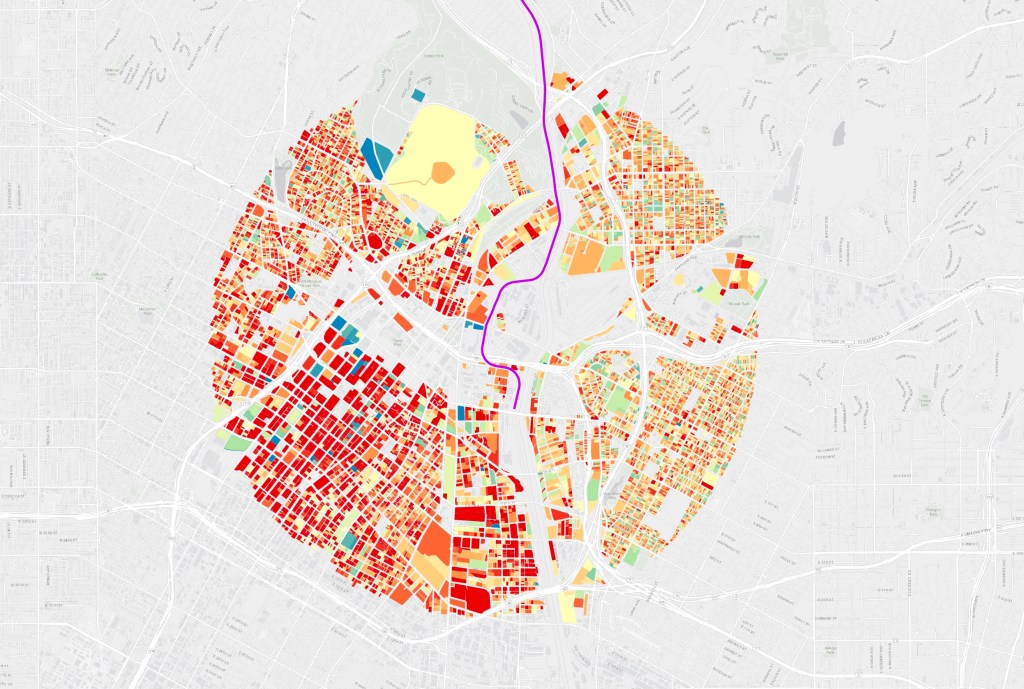
EIFDs are tools that capture rising property values around transit and reinvest that growth into infrastructure. While value capture is widely used around the world, the report suggests the county has yet to take full advantage of it, despite having the density and development potential to do so. While Streets for All’s research finds L.A. County alone could raise around $15-23 billion through this method, it assumes an EIFD radius of two miles from each station.
There will be three high-speed rail stations in Los Angeles County: in Palmdale, Burbank and Downtown Los Angeles’ Union Station.
In the case of Union Station in Downtown Los Angeles, that would include nearly all of Downtown, Chinatown, Boyle Heights, the Arts District, Little Tokyo and even a chunk of Dodgers Stadium. It would be a heavy political lift to get the EIFD supported by the right politicians for approval, but L.A. is planning on significant development in its Arts District (which would be in the EIFD area).
The Burbank Station will be adjacent to its airport and Streets for All sees modest opportunities for investment there. “With many small parcels and limited vacant land, Burbank is likely to see more modest property value appreciation with the opening of a HSR station,” they write.
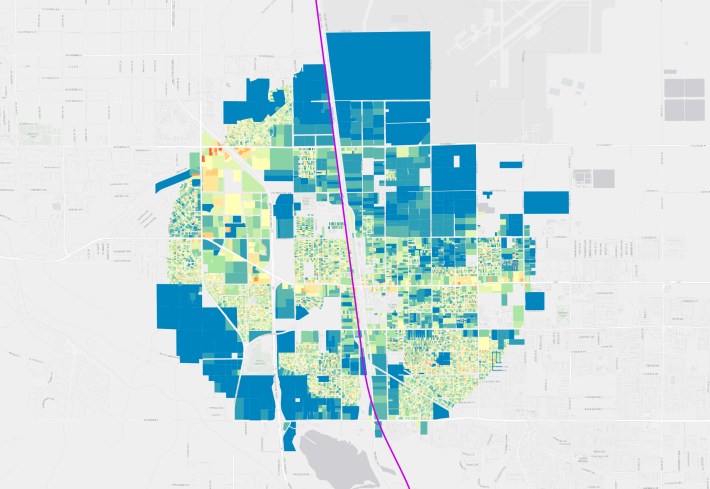
Palmdale Station could be the key. With significant land available for development and a much shorter commute into Downtown Los Angeles, the opportunities to build housing of all types is high.
Primary Findings
At the core of the report is a simple premise: major transit investments increase nearby property values, and governments can capture a portion of that increase to help pay for the infrastructure itself.
Streets for All’s analysis finds that Los Angeles County could generate significant revenue by establishing EIFDs around future high-speed rail stations and key transit corridors. Because these districts capture future growth in property tax revenue—rather than raising existing taxes—they are often framed as a way to fund infrastructure with “new” money created by the investment itself.
“Countries all around the world have used value capture to fund High-Speed Rail projects,” said Josh Vredevoogd, Director of Data and Creative at Streets for All. “Our research shows Los Angeles is similarly positioned and could deliver massive benefits to Angelenos with effectively free money.”
The Streets for All report points to the scale of development potential, particularly near planned or proposed high-speed rail stations. With large amounts of underutilized land and opportunities for transit-oriented development, the region could see substantial increases in property values if high-speed rail is completed and integrated into local transit networks.
But that value doesn’t automatically flow back into the system. Without tools like EIFDs, the increased taxes created by investment spurred by new transit will go to the city/county general funds.
The California High-Speed Rail Authority is in the early phases of exploring an EIFD, or something similar to it in Fresno to fund work in the Central Valley. The initial discussion there centers on capturing a portion of the increased value within a half-mile of the high-speed rail station. However, there is local opposition because that area includes all of Fresno’s downtown core and a good chunk of its Chinatown and local political leaders argue those areas will see increased property values and investments as the city redevelops, regardless of the future of high-speed rail.
What is an EIFD?
An Enhanced Infrastructure Financing District, or EIFD, is a California financing tool that allows local governments to capture increases in property tax revenue within a defined area and use that money to fund infrastructure.
Unlike traditional tax increases, EIFDs do not raise property taxes. Instead, they redirect a portion of the growth in property tax revenue—known as “tax increment”—to pay for projects like transit, roads, parks, and other public improvements.
EIFDs were created in 2014 as a replacement for redevelopment agencies. They can be formed by cities, counties, or special districts and often require multiple agencies to agree to participate.
In practice, EIFDs allow governments to borrow against future increases in property tax revenue, using those funds to pay for infrastructure upfront—an approach that makes them particularly appealing for large, capital-intensive projects like rail.
As Melanie Curry explained in a StreetSmart podcast, EIFDs are essentially a form of value capture that can help fund major infrastructure “without raising taxes,” though they require coordination and political will to implement.
They are not without challenges. Revenues can take years to materialize, and setting up an EIFD requires cooperation from multiple taxing entities. But the Streets for All report argues that Southern California has the right conditions—strong real estate markets, major planned transit investments, and significant development potential—to make the tool work.
Conclusion
The report lands as California continues to grapple with how to fund high-speed rail in the long-term and even how to fund operations for existing transit operations. With costs rising and traditional funding sources uncertain, EIFDs offer a potential path forward that relies less on new taxes and more on capturing the value created by public investment.
For Los Angeles, that could be especially significant. As the region expands its transit system and prepares for the “car free” 2028 Olympics, the ability to fund infrastructure at scale will shape what gets built—and how quickly.
The Streets for All analysis makes a straightforward argument: the value created by transit investments is real and measurable. The question is whether local governments will take the steps needed to capture it.
Streetsblog has migrated to a new comment system. New commenters can register directly in the comments section of any article. Returning commenters: your previous comments and display name have been preserved, but you'll need to reclaim your account by clicking "Forgot your password?" on the sign-in form, entering your email, and following the verification link to set a new password — this is required because passwords could not be carried over during the migration. For questions, contact tips@streetsblog.org.