Streetsblog California Endorsements on Transit Funding Measures Across the State

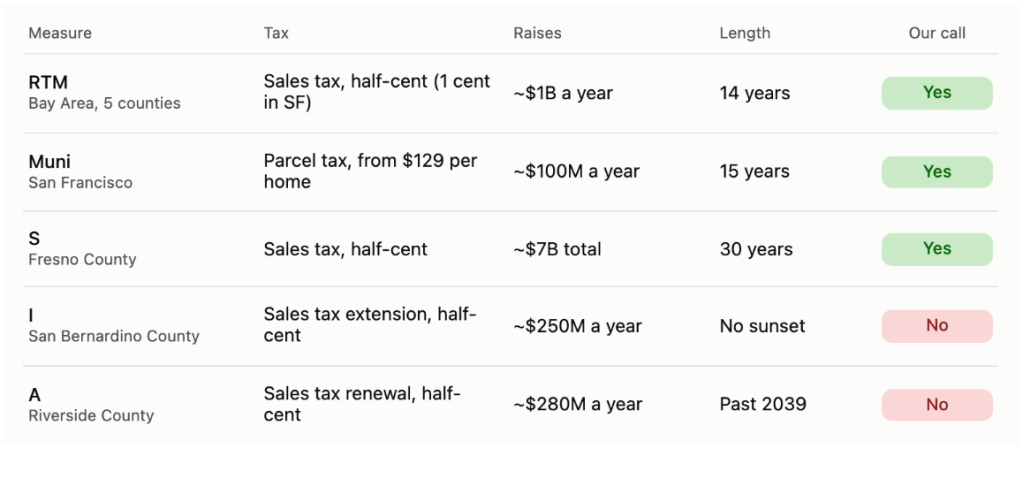
Streetsblog California is proud to endorse three funding measures, two in the Bay Area and another in Fresno County, that will put much needed money into regional transit systems.
There’s two other transit taxes on the ballot, one in San Bernardino County and the other in Riverside County. Both are extensions of existing taxes that don’t expire for a decade. Streetsblog believes that is enough time for the counties to do better on their spending plans and urges a “no” vote on both.
While it’s hard to draw too many conclusions based on one election cycle, it’s worth noting that the three progressive measures that Streetsblog is endorsing are voter initiatives, meaning they were written and placed on the ballot by normal citizens who went out and gathered signatures to get these measures on the ballot.
By contrast, the two regressive measures that raise more red flags were both created by government agencies and placed on the ballot by politicians. One of the themes that has repeated itself over and over is that the state’s elected leaders are less progressive on issues including Climate Change and transportation reform. Based on this limited analysis, it appears that is true of local leaders as well.
Measure RTM – Bay Area – VOTE YES
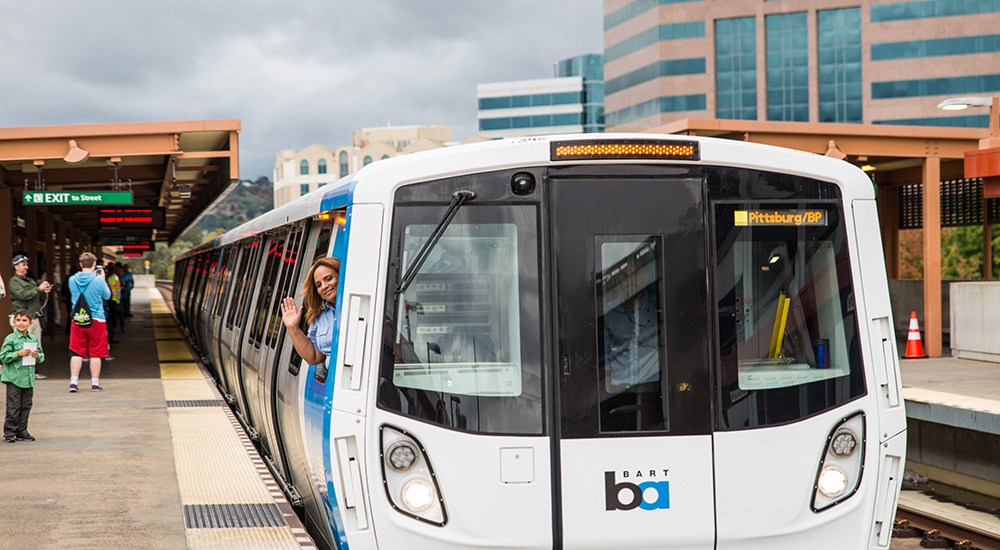
Measure RTM, the Regional Transit Measure, would raise roughly $1 billion a year for 14 years through a half-cent sales tax in Alameda, Contra Costa, San Mateo and Santa Clara counties, and a one-cent tax in San Francisco. The funding would support BART, Muni, Caltrain, AC Transit and other transit services, along with improvements to safety, cleanliness, reliability and connections between systems.
There has been a massive volunteer and legislative effort to bring this measure to the ballot and despite some concerns about the regressive nature of sales taxes, it would be an absolute disaster for the Bay Area should this measure fail.
Streetsblog SF has written a lot about this measure over the past several years. There’s a lot of great sources about the measure you can draw on including this one by TransForm. The measure requires a majority of votes to pass.
Proposition H – Bay Area – VOTE YES
Proposition H, aka the “Muni Measure” aka the Stronger Muni for All Measure, would raise roughly $100 million annually through a 15-year parcel tax on real estate in San Francisco starting at $129 for single-family homes. The revenue would directly support San Francisco Municipal Railway (Muni) operations to avert severe budget shortfalls, maintain service frequencies, and prevent major route cuts across the city’s bus and light rail system.
Streetsblog gives Muni a hard time for its ban of bicycles on trains and the poorly-thought-out center running bike lane on Valencia (they fixed it!). But they also run a pretty good transit service, and it needs more money to maintain its existing service. Give them a “yes” vote, and we’ll keep on top of the bikes on trains ban.
You can visit the Stonger Muni for All website for more information, or head over to Streetsblog SF for our coverage. The measure needs a majority to pass.
Measure S – Fresno County – VOTE YES
Measure S, the Fresno County Transportation Sales Tax Measure, would raise roughly $7 billion over 30 years through a half-cent sales tax across Fresno County to replace the expiring Measure C. The revenue would fund local road repairs and public transit operations while improving traffic flow, bicycle lanes, and air quality initiatives throughout the region.
The story of how this measure got to the ballot could be a Netflix series with competing measures, political malfeasance, legislative heroes, missed deadlines and finally the legislature, governor, and judges getting the measure on the ballot. It’ll be worth it if it passes.
Streetsblog California has written a lot about Measure S. You can read all of our coverage, here. The advocates who got the measure on the ballot created a great website that’s worth checking out too. The measure needs a majority of votes to pass.
Measure I – San Bernardino County – VOTE NO
Measure I, the San Bernardino County Transportation Sales Tax Extension, would renew the county’s existing half-cent sales tax to generate approximately $250 million annually for transportation projects. The measure supports local street and road repairs, freeway and interchange upgrades, traffic congestion relief, and public transit services.
Under Measure I, there is no sunset date for the tax and the expenditure plan and it only guarantees 30% for transit operations (25%) and active transportation (5%) in a given year. Capital transit projects would be competing with highway projects for the “regional mobility” category which takes up half the sales tax. The 5% active transportation guarantee comes from the “local mobility” category which is the other 25% of the budget.
Transit and active transportation should receive much higher than the 30% that’s guaranteed. Instead, the existing project list for the current Measure I is chock full of highway expansion projects.
Since the current Measure I doesn’t expire for over a decade, Streetsblog would like to see a better funding plan and encourages a “no vote.” However, we’re in strange times. The federal government is actively encouraging people to drive themselves in gas-powered cars and the state has seemingly retreated on its prime source of transit operations subsidies. If all of that spooks you, and you decide to vote for the measure to lock in that 30% well…it’s not what we’d do, but we understand.
Read more about Measure I in the San Bernardino Sun. The measure needs a ⅔ vote to pass.
Measure A – Riverside County – VOTE NO
Measure A, the Riverside County Transportation Sales Tax Renewal, would continue the existing half-cent sales tax across Riverside County beyond its current 2039 expiration to generate roughly $280 million annually for local transportation projects. The measure preserves the core geographical return-to-source funding formula—returning revenues back to Western Riverside County, Coachella Valley, and Palo Verde Valley based on what each area generates—while streamlining western county categories into Highways and Regional Corridors, Local Streets and Roads, and Public Transportation.
The current tax sunsets on March 31, 2039. The renewal would continue the half-cent rate beyond that date, for a term that expires only if voters repeal the ordinance. Even then, a repeal can’t take effect until all outstanding bonds are paid off. The new rate would kick in on April 1, 2039. Until then the tax stays at the current rate, so there’s no tax increase in the meantime.
As with the tax in San Bernardino, we believe a never-ending sales tax to fund transportation should include a dedicated fund for transit operations, bicycle, and pedestrian projects at a much higher rate than what Measure A proposes. We have 13 years before the current tax expires. That’s plenty of time to come up with a better tax.
For more on Measure A, visit the official website or read this fact sheet. Measure A needs ⅔ of the vote to pass.

Streetsblog has migrated to a new comment system. New commenters can register directly in the comments section of any article. Returning commenters: your previous comments and display name have been preserved, but you'll need to reclaim your account by clicking "Forgot your password?" on the sign-in form, entering your email, and following the verification link to set a new password — this is required because passwords could not be carried over during the migration. For questions, contact tips@streetsblog.org.