Streetsblog Endorsement: No on Prop. 45

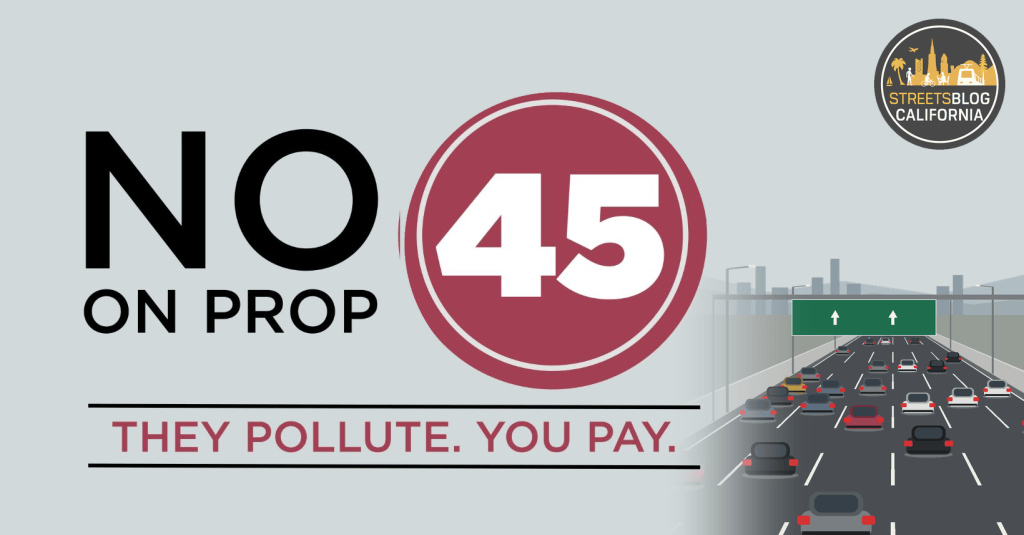
Streetsblog California is urging voters to reject Proposition 45. The measure is being pitched as a way to modernize the state’s landmark environmental protection law, the California Environmental Quality Act; but its impact would make it easier to build new highways or complete highway expansion projects by limiting the study of alternatives, opportunities for public input, and the timeline for legal challenges.
If California is going to streamline transportation permitting, it should make sure the process distinguishes between projects that help create a cleaner, safer and more multimodal transportation system versus projects that primarily add capacity for driving.
While Prop. 45 specifically excludes high-speed rail from the definition of an essential transportation project. That’s right, the largest rail project in the country, a project that has been beleaguered by permitting and other delays, is called out by name as ineligible for faster permitting under the project. Other transit, as well as bicycle and pedestrian projects, are already excluded from CEQA review.
The full ballot language can be found here, the portion on transportation is excerpted at the end of the article.
Bad Highway Projects Derailed
More importantly, CEQA has been a major factor over the years in disastrous highway projects being shelved or modified.
The most obvious example is the decades-long attempt to extend the 710 in the Pasadena area to connect to the 210. Over the years, various proposals were studied to demolish homes in Pasadena and South Pasadena or, hilariously, dig a giant tunnel.
Environmental lawsuits were a major part of the decades-long battle. In 1973, a lawsuit forced Caltrans to prepare an environmental impact statement before proceeding. Later litigation challenged the adequacy of the environmental documentation, including CEQA compliance.
A federal judge issued an injunction in 1999 after finding serious environmental-law problems with the project. The Federal Highway Administration eventually rescinded its approval, and the California Transportation Commission withdrew its environmental determination in 2004.
Even after L.A. Metro added 710 funding to its 2008 sales tax measure that has powered the region’s rail growth, the tunnel project never gathered the public support to be built. Metro abandoned the project nearly a decade ago.
Other bad projects that have been hamstrung by CEQA reviews include the SR 241 Foothill South Toll Road extension through San Onofre, which was struck down by courts in 2023 citing information gathered during CEQA review. The SR 94 Widening in East San Diego County that SANDAG abandoned in 2000 after CEQA review brought up many environmental issues with the project.
And it’s still working today. Caltrans proposed widening and reconfiguring about one mile of the 101 through Richardson Grove State Park in Humboldt County so that larger commercial trucks could use the route. The project would have required work around old-growth redwoods. The project isn’t dead, but it’s on life support as the courts have thrown the project back into environmental review several times over Caltrans’ objections.
Another example is that expansion efforts along California’s Interstate 80 (I-80) corridor from Davis to Sacramento, known as the Yolo 80 Corridor Improvements Project, have been tied up in courts and CEQA review for years thanks to the National Resources Defense Council, Sierra Club and Planning and Conservation League. If built, this project would cut through the Yolo Bypass Wildlife Area, which NRDC describes as “a 25-square-mile home for almost 200 species of birds, dozens of threatened and endangered species, and important wetland ecosystems. “
These are exactly the kind of projects that would qualify for Prop 45’s streamlined, single-alternative review and likely would be paved if it were already law.
Current Highway Review Regulations
Under Senate Bill 743, California shifted the way transportation impacts are evaluated under the California Environmental Quality Act. Instead of relying primarily on automobile delay and congestion, transportation analysis increasingly focuses on vehicle miles traveled (VMT.)
Adding roadway capacity in congested areas will always induce additional driving. Despite its seemingly endless appetite for adding highway lane miles, Caltrans admits that induced demand is not just a theory but well-proven fact, increased lane miles result in additional trips and longer trips, increasing VMT and the pollution that comes with it. Caltrans has also developed an induced-travel calculator for analyzing these effects on highway projects.
That makes environmental review particularly important for highway projects. Adding more cars to the highway doesn’t happen in a vacuum. It adds stress to the surrounding transportation grid as well.
Prop. 45 would not eliminate CEQA for these projects. But it would change how environmental review works for projects that qualify for the streamlined process. It would also require a future initiative to change, meaning the changes made under Prop 45 will be with us for a generation or more, similar to Prop 13.
The measure establishes new deadlines for environmental review and permitting. It also limits the alternatives considered during review. Under the measure, the project applicant can develop one project alternative for consideration rather than requiring the agency to consider a range of alternatives that could reduce environmental impacts.
Prop. 45 also establishes restrictions and deadlines affecting public participation and legal challenges.
The result would be a faster process, sure. But faster doesn’t necessarily mean more efficient. In this case it means less thorough.
Vote No on Prop. 45.

Streetsblog has migrated to a new comment system. New commenters can register directly in the comments section of any article. Returning commenters: your previous comments and display name have been preserved, but you'll need to reclaim your account by clicking "Forgot your password?" on the sign-in form, entering your email, and following the verification link to set a new password — this is required because passwords could not be carried over during the migration. For questions, contact tips@streetsblog.org.