Steve Hilton’s Plan to Abolish the DMV and Slash Fees Is Not a Serious Proposal

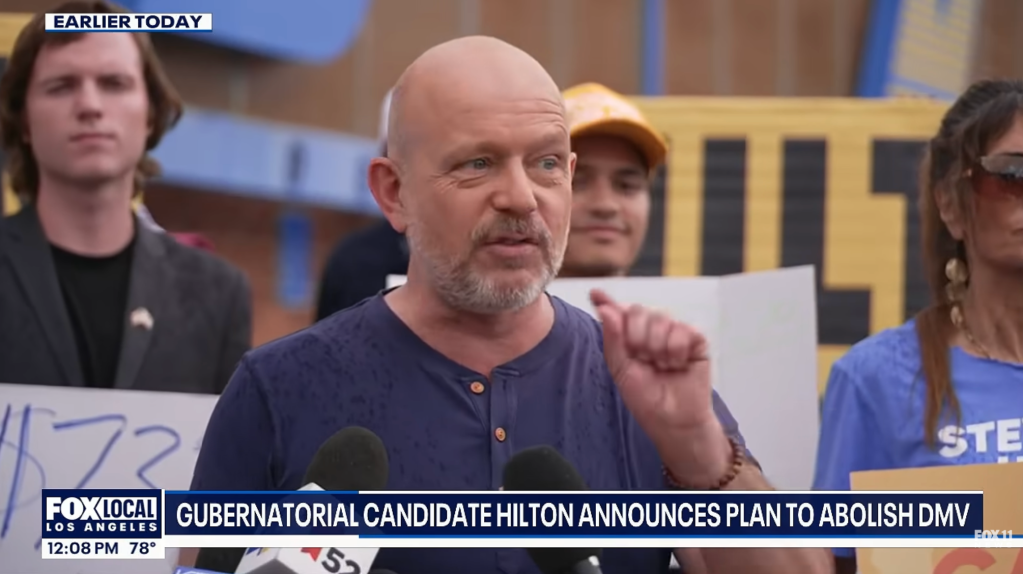
Republican gubernatorial candidate Steve Hilton says he wants to abolish the California Department of Motor Vehicles and slash annual vehicle registration fees to a flat $73.
It’s being sold as a bold government-reform proposal, and it sure did generate a lot of headlines for the longshot campaign for the state’s highest office. But, it’s not serious. It’s just an old political trick: find a government agency everyone loves to hate, promise to make an unpopular fee disappear, eviscerate the hated agency, and call it a day while ignoring the consequences.
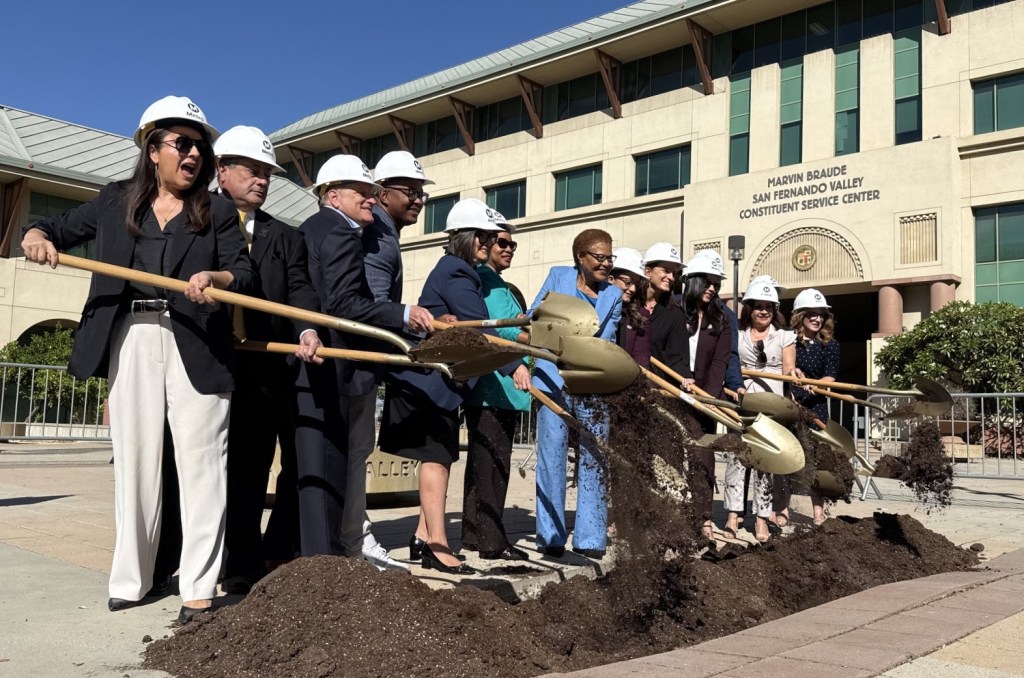
Hilton announced the “proposal” Tuesday outside the West Hollywood DMV (watch the announcement). Surrounded by nearly a dozen supporters, Hilton called the agency a “bloated, nanny-state bureaucratic agency” and promised to replace it with online services, county offices, and “certified private providers.” His campaign says a smaller state operation would remain to handle driver’s licenses, REAL ID, fraud prevention and other functions.
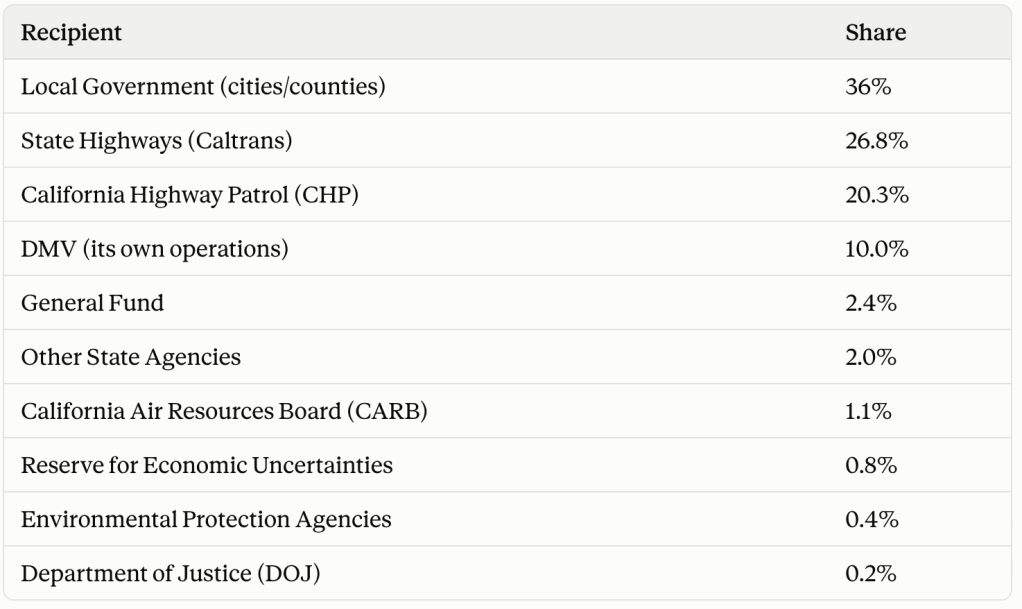
According to the state’s 2026–27 budget, the California DMV pulls in roughly $15.5 billion in total annual revenue. Last year, the DMV registered 36,190,654 vehicles. At $73 a vehicle that’s ~$2.64 billion. Only 10% of the $15.5 billion collected is spent to operate the DMV, the rest goes to other agencies and the CHP to maintain California’s transportation networks.
So how does Hilton propose to handle the $10 billion state budget hole his plan would create? He doesn’t. Hilton claimed his broader “Operation Zero Waste” plan will find the savings elsewhere to backfill these programs.
But, the DMV Is Not the Point
Hilton’s plan is built around the idea that eliminating the DMV will save taxpayers money because the state won’t have to operate 170 field offices and a department with a budget of roughly $1.5 billion.
But California still needs to issue driver’s licenses. It still needs to maintain vehicle records. It still needs to register cars, process titles and investigate fraud. It still needs to enforce the rules that keep unlicensed and unsafe drivers off the road. Hilton’s plan is to just move those duties around to cities and counties with the $73 going straight to DMV-type programs in those areas.
This plan is objectively bad; if one state agency is “wasteful” there’s no reason to believe that one hundred smaller agencies wouldn’t be more wasteful. But for the sake of argument, pretend this is a sound policy decision that makes sense. Even in this fantasy, Hilton’s proposal is still nonsensical because…the DMV is NOT the only agency to receive funds from the current vehicle registration fee.
Currently, just over one third of what one pays goes straight to the local city/county, about a quarter goes to Caltrans for state highways, another fifth helps fund the CHP (patrol, enforcement). Only about 10% covers the DMV’s own operating costs (offices, staff, systems). The rest is split among smaller programs: air quality/emissions enforcement, the general fund, and other state agencies.
Nowhere in Hilton’s proposal is there any hint of how the state (or whoever) will pay for those projects or whether he just plans to further cut funding for transportation projects and highway safety enforcement. This will lead to faster deterioration of the state’s transportation infrastructure, particularly highways, plus fewer CHP officers on patrol, and even reduced service at the new local DMV centers who don’t have access to the technology or staffing that the current state agency has.
Hilton’s announcement ignores the standard faux-populism that one often hears about slashes to transportation funding (“we all use the same roads”) because he ignores the DMV’s role in transportation completely. The entire argument is DMV=bad, registration fee=too high. And that oversimplification is not lost on his opponent.
“Nothing says ‘safer roads’ like outsourcing driver safety checks to the lowest bidder,” snarked Jonathan Underland, the communications director for Hilton’s opponent, Xavier Beccera.
And It’s a Tax Cut for Expensive Cars
And while Hilton continues to cloak his ideas as common-sense everyman proposals, abolishing the DMV is the first step in what he is calling “Operation Zero Waste,” a series of proposals to dramatically shrink the size of California’s government so average Californians can “keep more of their money.”
Abolishing the DMV and slashing vehicle registration fees is a terrible choice for kicking off a press tour around affordability, because the proposal disproportionately benefits the richest Californians.
California’s current registration system isn’t a flat fee, because the state recognizes a basic principle: someone driving a much more expensive vehicle can afford to contribute more toward the public costs associated with owning and operating it.
The Vehicle License Fee is based in part on a vehicle’s value. The system also includes transportation-related fees that vary according to vehicle value.
Under Hilton’s proposal, the owner of a $100,000 Cybertruck would get a much bigger tax cut than the owner of a $20,000 Nissan Sentra.
At the current 0.65% Vehicle License Fee rate, the first-year VLF on a $100,000 vehicle would be about $650, compared with about $130 for a $20,000 vehicle, before depreciation and other fees are considered. Under Hilton’s proposal, both owners would pay $73.
And of course, the proposal would save $0 for a family that doesn’t own a car either by choice or because they can’t afford it.
While it made headlines, Hilton’s newest proposal isn’t serious. It’s campaign slop. File it away with his pledge to reduce gas prices to $3 per gallon (the lowest gas prices in the country are $3.45 in Indiana at the time of publication) as another idea that’s meant to sound populist but reduces costs for the richest amongst us on the backs of those that can least afford it.
Streetsblog has migrated to a new comment system. New commenters can register directly in the comments section of any article. Returning commenters: your previous comments and display name have been preserved, but you'll need to reclaim your account by clicking "Forgot your password?" on the sign-in form, entering your email, and following the verification link to set a new password — this is required because passwords could not be carried over during the migration. For questions, contact tips@streetsblog.org.