Is It Time to Redefine the Bike Lane?

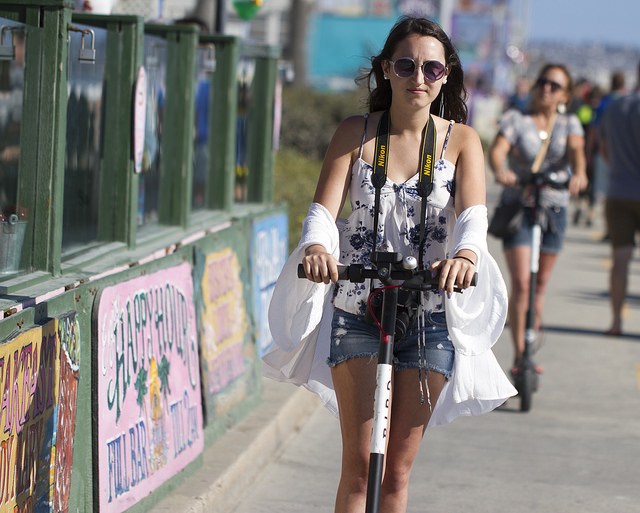
In a matter of months, electric scooter companies have set up fleets in dozens of American cities. Where do these vehicles belong on our streets?
Not sidewalks: The scooters move too fast to interact comfortably with pedestrians. Motor vehicle lanes will do in a pinch, but just like people on bikes, people on scooters are too vulnerable to share lanes with fast, heavy cars and trucks.
The most logical place for them seems to be bike lanes. That’s how scooter firm Bird sees it — the company wants to help cities build bike lanes so its customers can safely ride in the street without impeding people on sidewalks.
Someone on a scooter accelerates and moves differently than someone on a bike, so sharing space can be a little awkward. But maybe the introduction of these vehicles should cause us to recalibrate how we think about bike lanes, says transit consultant Jarrett Walker in a new post at Human Transit.
On major streets, Walker imagines two types of lanes in between sidewalks and car lanes — a slow lane for motorized wheelchairs, runners, and slower bicyclists; and a somewhat faster lane for electric scooters and fast bicyclists, including e-bikes. And he asks: What should these lanes be called?
The idea here is that a street with a speed limit over 30 km/hr will need to separate these three kinds of traffic, because they differ in both speed and width. At lower speeds you can mix them more.
Where speed and width come apart, however, speed has to be the defining feature. You can’t ride a motorbike at 30 km/hr down a “bike” lane, even though it may be narrow enough. You have to ride it in the traffic lane, even though that’s a waste of space.
All this came up because I was trying to think of the correct new term for “bike lane” as we proliferate more vehicle types that run more or less at the speed and width of bicycles but are clearly not bicycles, such as electric scooters. The two logical terms seem to be narrow lane or midspeed lane. One way or another the two concepts will need to track with each other.
I wonder if this kind of language can make our sense of the role of these lanes more flexible, and thus less divisive.
There is a lot of room for individual choice here about which lane to use. Cyclists, for example, already choose between midspeed “bike” lanes and full-speed traffic lanes, depending on their preferred balance of speed and safety. Meanwhile, an 8 year old learning to ride a bike should probably be on the sidewalk. Another reason that “cycle lane” may be a misnomer.
In my observations in Cleveland, Bird scooters seem to have generated a whole new constituency supporting bike lanes almost overnight. People who aren’t interested in bicycling may find something more appealing about a scooter. If their energy increases the momentum to carve out street space for bicycling and other modes that are lighter, safer, and less polluting than cars, it could be a huge boon for cities.
Should “bike lane” still be the term to describe this space on the street? Tell us what you think.

Streetsblog has migrated to a new comment system. New commenters can register directly in the comments section of any article. Returning commenters: your previous comments and display name have been preserved, but you'll need to reclaim your account by clicking "Forgot your password?" on the sign-in form, entering your email, and following the verification link to set a new password — this is required because passwords could not be carried over during the migration. For questions, contact tips@streetsblog.org.