The Death of California High-Speed Rail Is Greatly Exaggerated…Again

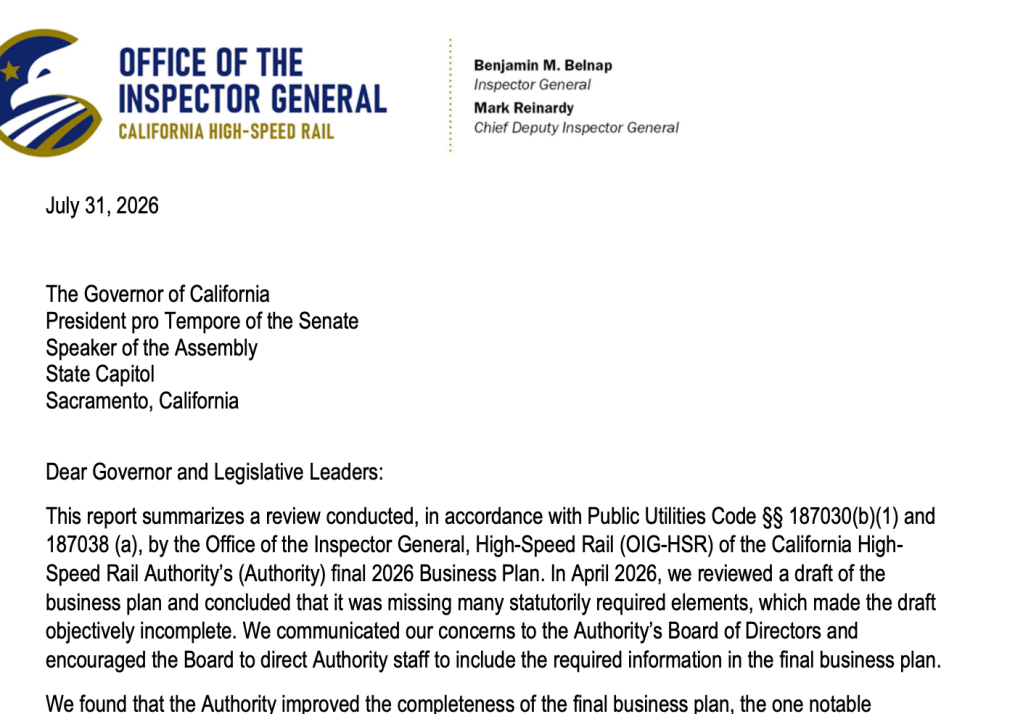
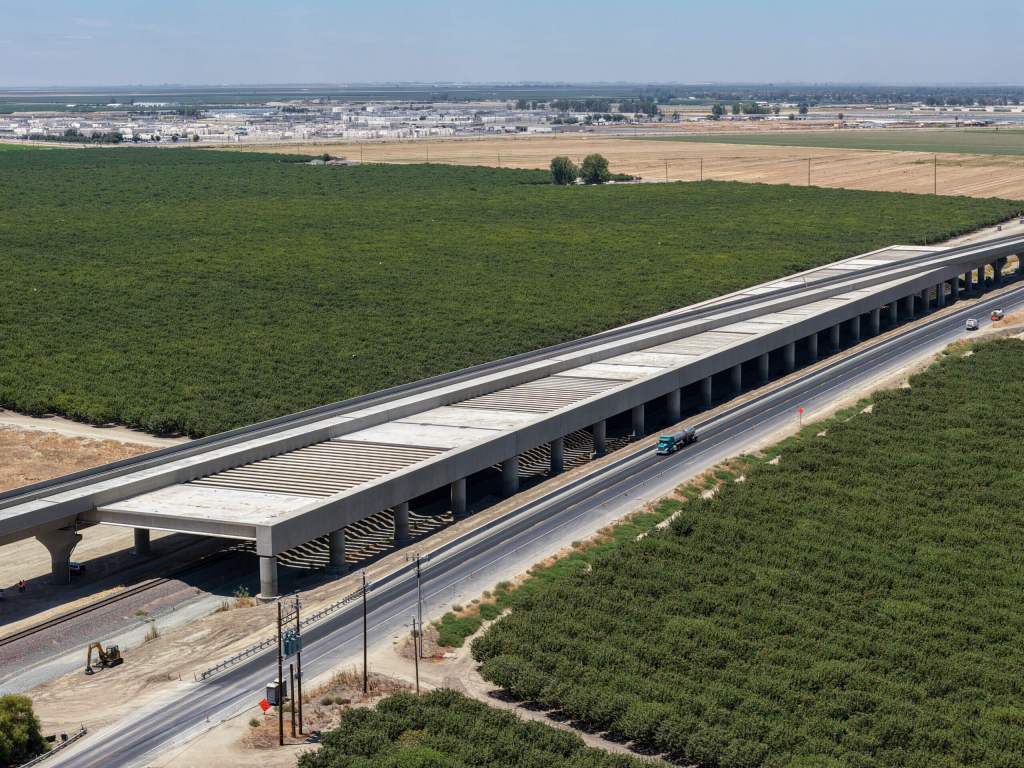
It’s hardly news that California’s high-speed rail project is facing a serious funding problem, however a new report by the agency’s inspector general gives that crisis a timeline. According to the IG, the California High-Speed Rail Authority could exhaust its available cash as soon as December 2027 unless it secures additional financing.
That doesn’t mean construction will stop in 2027, despite the alarming headlines. The agency has several options to keep building into 2028, bring in more funding, develop the public-private partnerships it has been exploring, or take out loans that would keep the project moving but increase the price tag.
What the Inspector General Found
The Office of the Inspector General’s review of the Authority’s 2026 Business Plan found that the plan still does not clearly communicate some of the project’s most important financial and scheduling challenges.
The Authority has identified about $39.3 billion in long-term funding, including $1 billion annually from California’s Cap-and-Invest program. But that money arrives over many years, while construction expenses are concentrated in the next few years. As a result, the Authority’s own projections show that it could run out of available funding in December 2027. It would need approximately $9.5 billion in financing between fiscal years 2027-28 and 2031-32 to maintain its planned spending schedule.
The IG also raised concerns about the Authority’s cost estimates for the Merced-to-Bakersfield segment. The Authority’s preferred reduced-scope version is estimated at $35.7 billion, but that figure does not include billions of dollars in potential financing costs if new funding isn’t identified.
Financing costs could add $3.6 billion to $6.6 billion to the price tag. Other costs, including contingency funding and infrastructure that the Authority expects third parties to pay for, are also not included in the headline estimate.
The inspector general also found that some of the project’s apparent savings come from building less, rather than from finding ways to build the same project more cheaply. The preferred plan shortens the Merced-to-Bakersfield segment and changes some station and track plans.
And the schedule has slipped. While the Authority continues to discuss initial operations in 2032-33, the inspector general’s risk-based analysis suggests completion could extend to September 2034.
And the last concern concerns the state financing. While Newsom and the legislature have promised $1 billion annually for two decades from the state’s cap-and-trade program, that revenue stream could be changed by future elected officials. To further muddy the picture, changes adopted by the California Air Resources Board earlier this year have significantly reduced the amount of money collected under the pollution permitting system.
The Private Investment Gamble
The Authority’s solution is increasingly centered on bringing private money into the project.
As Grist reported last month, the state has a $25 million agreement with a consortium of companies to explore private financing opportunities for high-speed rail. The goal is to determine how private investment, public-private partnerships, and commercialization of Authority assets could help finance both the current project and future expansion. A report on this is expected in early 2027.
Authority CEO Ian Choudri has been particularly vocal about changing the way California approaches the project.
“We need to turn this project into a business,” Choudri told Grist.
That business could extend beyond passenger fares. The Authority is looking at revenue from station-area development, real estate, advertising, broadband infrastructure and energy projects along the rail corridor. The hope is that these assets could generate revenue that can then be used to support rail investment.
The strategy makes some sense. Successful high-speed rail systems around the world often generate economic value beyond ticket sales, particularly through development around stations. There’s also marketing, advertising, and sponsorship opportunities and the authority is expected to announce deals with utility companies, solar farms, and installation of fiber optic lines.
That leaves California with a familiar infrastructure dilemma. The investments that could make high-speed rail financially attractive to private investors, particularly connections to the Bay Area and Southern California, will themselves require enormous amounts of capital.
The Authority is betting that public investment and the value of the system’s future assets can be used to leverage that private capital.
Politics Don’t Help
The funding problems deserve serious scrutiny. But the familiar partisan debate over high-speed rail isn’t particularly useful.
Recent stories in the “California Post,” Fox News, and Daily Signal, to name just a few outlets, have portrayed the project as a Democratic “boondoggle,” and love to heap blame on Newsom. But many of the challenges facing California High-Speed Rail are caused by Republicans and have been from the first cost estimates made twenty years ago.
The original financial analysis for California’s high-speed rail system was conducted in 2007-08, when Republican Arnold Schwarzenegger was governor. When voters approved Proposition 1A in 2008, the approximately $9.95 billion bond was never presented as enough money to build the entire system. The state’s voter guide estimated the full Phase 1 system would cost tens of billions of dollars and explicitly anticipated a combination of state, federal and private funding.
That balanced combination of funds has been elusive and unreliable. Some limited federal funding has been awarded, but then pulled back, depending who is in the Oval Office. Even Democrat-controlled state funding has been a struggle.
The fact that the initial state bond money is not enough to build high-speed rail from San Francisco to Los Angeles isn’t a new revelation. It was part of the plan voters were presented with nearly two decades ago.
Streetsblog has migrated to a new comment system. New commenters can register directly in the comments section of any article. Returning commenters: your previous comments and display name have been preserved, but you'll need to reclaim your account by clicking "Forgot your password?" on the sign-in form, entering your email, and following the verification link to set a new password — this is required because passwords could not be carried over during the migration. For questions, contact tips@streetsblog.org.