Legislation Moving to Make It Easier to Build High-Rises Near Transit in CA’s Seven Largest Cities

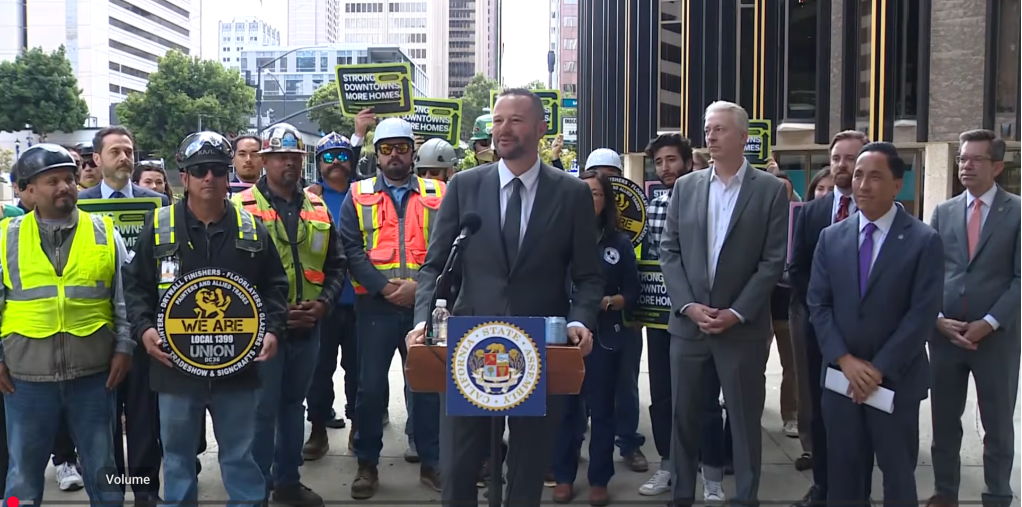
Assemblymember Matt Haney (D-SF) has been traveling the state to rouse support for Assembly Bill 2074: Regional transit hub districts: downtown housing developments, his legislation that would make it easier to build high-rises near major transit stops. Last week, he appeared at the Assembly Standing Committee on Housing and Community Development, and yesterday he was in San Diego where he was joined by union members, advocates and Mayor Todd Gloria to stump for the legislation.
What Would the Legislation Do?
The bill would require California’s seven largest cities, (Los Angeles, San Diego, San Jose, San Francisco, Sacramento, Oakland, and Long Beach) to create designated regional transit hub districts in their urban cores by mid-2027. Within these districts, high-density housing developments would be treated as an allowed use and eligible for streamlined, ministerial approval, reducing local discretionary review that can delay or block projects.
The bill also includes major financing and incentive tools, most notably a state-backed Downtown Revitalization Loan Fund administered through the California Housing Finance Agency. This revolving fund would provide low-interest loans to qualifying projects and be replenished as loans are repaid, helping address financing gaps that often stall high-rise construction.
In addition, AB 2074 sets development standards for these districts, including minimum density requirements and affordability provisions, and it ties eligibility for streamlined approvals to compliance with labor standards and other state-defined requirements.
Supporters Say Legislation Is Necessary to “Save” Downtowns
“This is the kind of policy that big cities need right now,” said Gloria at yesterday’s event. “It makes it easier to build more affordable housing while directly supporting good-paying jobs. In San Diego, we’ve done the work to get housing built faster, and we’re seeing the results. This bill takes the next step by turning underused spaces into homes near jobs and transit.”
As more people choose to work-from-home after the pandemic forced businesses and government to allow it, downtowns are struggling. According to a fact sheet prepared by Haney, because of their density of activity, investment in downtown areas generates outsized economic returns. While downtowns make up an average of just 3% of citywide land, they produce roughly 16% of property tax revenue, 42% of hotel tax revenue, and 12% of sales tax revenue.
However, without fewer people working out of offices, those numbers are dropping. Haney’s solution? Build more dense housing in those downtowns, and the increased number of people will make up for the reduced number of workers heading downtown.
“Downtowns are actually some of the best places to build housing,” Haney said at yesterday’s event. “There’s transit. There’s jobs and restaurants. There’s arts and culture. There’s public spaces. Everything that people need is already here.”
Concerns About Affordability
While the legislation passed the Assembly Standing Committee on Housing and Community Development on a 10-1 vote, there is opposition. Critics primarily expressed concerns that there was no affordable housing mandate in the legislation. Both speakers at the hearing who spoke in opposition professed to being open to working with Haney to improve the legislation.
“…This bill focuses specifically on high rises and only provides financing opportunities for those types of projects which tend to be the most expensive and the ones that have the least affordable units that are available,” testified Graciela Castillo-Krings with the California Housing Consortium. “And I’m not just talking about deed-restricted, but just affordable options in general.”
Castillo-Krings went on to testify that she loved the idea of the loan program outlined in the legislation, but would like to see it expanded to more than just the state’s largest cities.
Her concerns were echoed by Natalie Spivak with Housing California who hopes their work with the authors will lead to a bill that both Housing California and the California Housing Consortium can support.
AB 2074 still needs approval by the Assembly Local Government Committee and Natural Resources Committee before heading to the Budget Committee and then the Assembly floor.
Streetsblog has migrated to a new comment system. New commenters can register directly in the comments section of any article. Returning commenters: your previous comments and display name have been preserved, but you'll need to reclaim your account by clicking "Forgot your password?" on the sign-in form, entering your email, and following the verification link to set a new password — this is required because passwords could not be carried over during the migration. For questions, contact tips@streetsblog.org.