Opinion: Cars Do More Damage to Business Districts Than Local Officials Admit

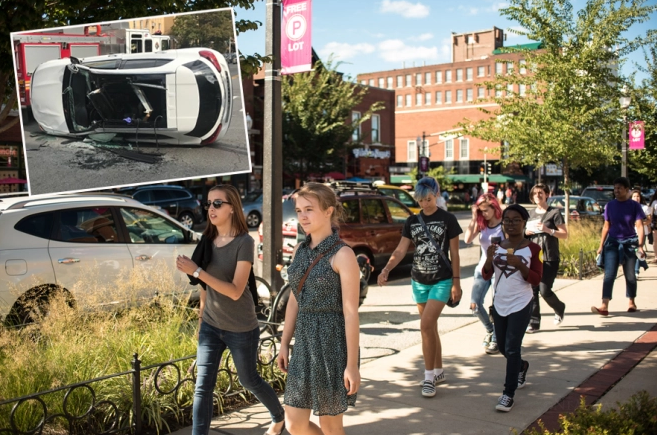
Too many reckless drivers lack car insurance, do not possess a valid driver’s license, and/or drive with expired registration.
And the disproportionate number of crashes they cause end up defeating the business-friendly and safety purpose of design strategies such as complete streets, road diets, curb extensions, and other traffic-calming elements that encourage bike- and pedestrian-safe main streets.

For instance, in the past 10 years along just six blocks of South Grand Boulevard in St. Louis, we have incurred over $70,000 in damages from reckless drivers. Of these incidents, nine out of 10 motorists did not have car insurance or possess a valid driver’s license.
Of course, we need legislative action to remove illegal drivers from the street and enforce penalties for driving illegally not only for the obvious safety reasons — 42,915 people died in motor vehicle crashes in 2021, a 10.5-percent increase from 2020, according to federal authorities — but also because crashes deter visitors from frequenting even a well-designed Main Street (not to mention that potential employees are not interested in working in dangerous places).
And would-be new businesses owners will think twice about opening on a commercial strip if there are many vehicular crashes.
This domino effect of careless drivers affects the livelihood of small businesses.
Legislation at the state and local level is needed to hold drivers accountable. For instance, in 2007, Ontario introduced new legislation that made speeding above 50 kilometers an hour (31 mph) a serious offense, punishable by an immediate license suspension, car impoundment, and heavy fine or jail time.
Also, in the United Kingdom motorists are fined $355 for not having insurance and receive six penalty points on their license for driving without insurance. Penalty for not passing the proper test are fined up to $1,185. If you are found to be driving without insurance and get in a crash or merely speed, your vehicle could be seized, clamped, or destroyed and you may end up in court.
These and other programs in other countries demonstrate a cultural shift to curb very avoidable deaths. To start, social service programs should be created to help those who do not have the funds to purchase car insurance. Nonprofits can provide grants for the first year to help those in poverty. Just because someone needs a vehicle to get to an employer doesn’t mean that person can afford insurance — so providing some sort of financial assistance to help obtain insurance in the end benefits everyone. (The same is true of driver education, which is not mandatory in many states, but may also be costly.)
We can also promote better land-use policy and transportation planning to work on building environments in which individuals do not need to own a car to gain economic prosperity.
And lest we forget, the added weight of trucks and SUVs are more lethal to pedestrians, and such bulky, poorly designed trucks are substantially more likely to hit pedestrians when making turns, according to the Insurance Institute for Highway Safety. A pedestrian was killed on South Grand by the driver of an SUV despite being within a marked crosswalk. A cyclist was fatally struck in a hit-and-run by a driver without proper registration with expired temporary tags.
To move forward, we all need to be held accountable. By allowing reckless driving and a general disregard for obeying the rules of the road, we will harm our communities. If vehicular crashes overshadow the benefits of a main street, these places will no longer be destinations to live, work and play. In addition to better designs standards, communities need better coordination with local law enforcement, local and state legislation to hold drivers accountable, and social service and educational programs to make streets safer and foster vibrant places.
Rachel Witt is executive director of the South Grand Community Improvement District and the South Grand Cultural Alliance.
Streetsblog has migrated to a new comment system. New commenters can register directly in the comments section of any article. Returning commenters: your previous comments and display name have been preserved, but you'll need to reclaim your account by clicking "Forgot your password?" on the sign-in form, entering your email, and following the verification link to set a new password — this is required because passwords could not be carried over during the migration. For questions, contact tips@streetsblog.org.