Group of E-Bike Regulation Bills Advance in Assembly

On Monday night, the Assembly Transportation Committee advanced four pieces of legislation designed to regulate the growing e-bike and e-motorcycle industries. As the popularity of e-bikes and e-motorcycles has grown, so has the number of crashes and fatalities.
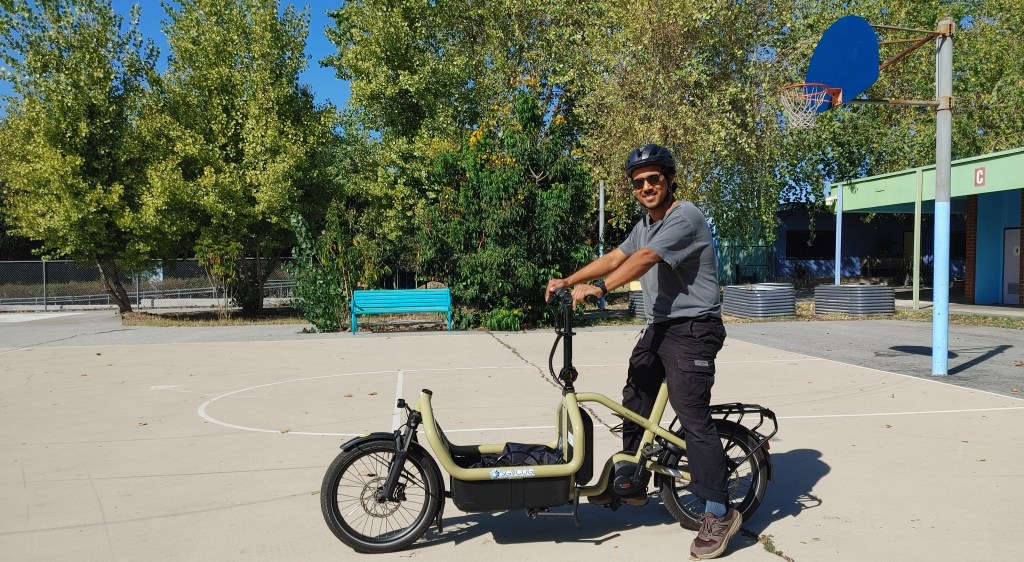
There is a lot of confusion around the differences between e-bikes, which use electric motors to make bicycling easier and safer, and e-motorcycles, which are just what the name says. E-motos are often marketed as e-bikes, especially to youth. Police complain they have trouble telling the difference, and parents are purchasing bikes for the children to ride that are too powerful.
Cities have responded unevenly throughout the state. Many times well-meaning regulations do nothing to stop the spread of e-motos to younger riders while putting up barriers for people seeking to use e-bikes safely.
This year, the legislature is attempting to create clarity, laws, and guidelines. Senate Bill 1167 (covered here) creates clear standards for what is, and isn’t, an e-bike. Assembly Bill 2284 (discussed below) creates a database of what is and isn’t an e-bike and what pieces of technology can be used to turn an e-bike into an e-moto. Both bills are universally supported.
But other legislation is also advancing that furthers the confusion. In addition to AB 2284, four other pieces of legislation advanced on Monday, two of which treat e-bikes and e-motos, and their riders, the same.
Two other pieces of legislation were passed with no opposition, both had to do with safety for children. One mandates education programs and another authorizes a pilot program creating age limits on who can ride on e-bikes.
In order they were discussed, here’s a summary of the five pieces of e-bike legislation moved on Monday.
Assembly Bill 1942: Electric bicycles: registration and special license plates.
First, the Assembly Transportation Committee passed Assembly Bill 1942, which would require Class 2 and Class 3 e-bikes to be registered with the DMV and display license plates, similar to motor vehicles. The bill also creates a new registration fund, authorizes fees to cover administrative costs, and establishes fines for riders who fail to comply, effectively making violations an infraction under state law.
The debate on AB 1942 focused on how to address rising e-bike safety concerns while avoiding unintended consequences. Author Rebecca Bauer-Kahan (D-San Ramon) emphasized accountability and growing safety risks, stating, “This bill is really focused on the question of accountability. Our streets have laws… but these bikes are not being enforced effectively.” Supporters cited rising injuries and enforcement challenges, particularly among youth riders.
Opposition, including Kendra Ramsey, argued the bill would burden legal riders without addressing illegal devices. Ramsey said, “E-bikes are a critical tool in reducing car dependency… and imposing motor vehicle-style registration requirements really undermines these goals.” Critics also raised concerns about equity, costs, and implementation challenges, including strain on the DMV.
AB 2284: Electric bicycles: Attorney General list.
The Assembly Committee also advanced Assembly Bill 2284, a measure aimed at clarifying confusion around what qualifies as a legal e-bike. Authored by Assemblymember Diane Dixon (R-Newport Beach) and sponsored by Streets For All and the California Bicycle Coalition, the bill targets the growing problem of high-powered electric motorcycles—often called “e-motos”—being marketed and sold as e-bikes.
AB 2284 would require the state Attorney General, working with bicycle advocacy groups, to publish and maintain a public list of electric two-wheeled devices that do not meet California’s legal definition of an e-bike. This includes products that exceed speed or power limits or are misleadingly advertised, which can create safety risks and confusion for consumers, law enforcement, and schools.
Supporters argue the bill is a “common-sense” step that improves transparency without placing new burdens on riders. By helping people distinguish between legal e-bikes and illegal devices, the legislation is intended to strengthen enforcement of existing laws while avoiding the broader regulatory approach proposed in other bills. Overall, AB 2284 reflects a more targeted strategy: addressing deceptive marketing and unsafe products rather than imposing new requirements on lawful e-bike users.
On a first vote, the legislation failed to pass the committee as concerns that the Attorney General’s office had not been consulted on the legislation. However, after circulation of a statement by the AG that addressed e-bike safety and asked for more tools, the legislation was moved 15-0 with one member not present.
Assembly Bill 1557: Vehicles: electric bicycles.
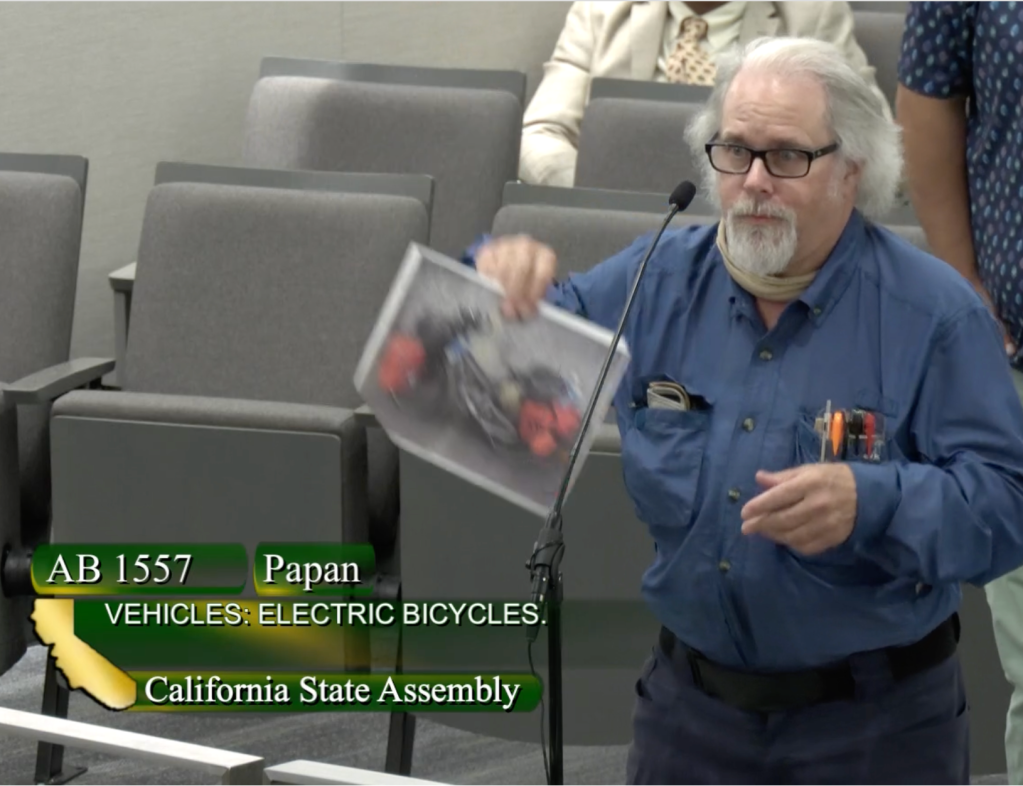
AB 1557, introduced by Assemblymember Diane Papan (D-San Mateo), also seeks to tighten and clarify California’s definition and regulation of electric bicycles in response to growing concerns about safety and misclassified devices. It passed 12-0, but has been more controversial.
The bill redefines an e-bike as having a motor that cannot exceed 750 watts of peak power and lowers the maximum assisted speed for Class 1 and Class 2 e-bikes from 20 miles per hour to 16 miles per hour. It also limits those classes to 250 watts of continuous power.
Class 3 requires riders to be 16+ and wear helmets, requires permanent labels and speedometers on the bikes, and restricts the bikes from certain bike paths where Classes 1 and 2 are allowed.
To address concerns about existing bikes, the legislation includes a grandfather clause allowing e-bikes manufactured before January 1, 2027, to retain their current classifications if they complied with prior law.
AB 1557 also targets manufacturers and retailers by prohibiting the sale or marketing of devices labeled as e-bikes if they exceed legal power or speed limits. Violations would carry significant civil penalties, enforceable by state and local authorities.
Supporters include a handful of cities and medical groups. Opponents include most bicycle advocacy groups and e-bike retailers.
One bike shop owner didn’t mince words during public testimonu: “This legislation will decimate the e-bike industry” because a bike limited to 250 watts of continuous power would not be able to push a rider up a steep hill…such as the ones found in cities such as San Francisco.
Instead, opponents urged that the Assembly focus on e-motos.
“The biggest problem on our roadways is illegal devices flooding the market, not legal e-bikes being used as intended,” continued Marc Vukcevich with Streets for All, quoting a report by the Mineta Institute for Transportation. “The picture Papan held earlier in the meeting is not a legal e-bike in California.”
Responding to testimony from other Assemblymembers, Papan vowed to continue to work with e-bike shop owners to limit any cost increases that could be caused by this legislation. In her testimony, she also said she would work with opponents to make sure they are not impeding the ability of adults to use the technology to address their own mobility needs.
AB 1557 still needs to be heard by the Judiciary and Appropriations Committees.
Assembly Bill 1569: Pupil safety: electric bicycle: safety and training program.
AB 1569 focuses on improving e-bike safety for students by tying campus access to basic safety education. Authored by Assemblymembers Laurie Davies (R-Oceanside) and Phillip Chen (R-Brea), the bill would require K-12 students to complete an approved electric bicycle safety training course before being allowed to park an e-bike on school grounds during the school day. AB 1569 was also unanimously passed.
If this legislation becomes law, starting in the 2027-28 school year, students riding Class 1, 2, or 3 e-bikes will need to participate in a safety program developed by the California Highway Patrol—or a comparable course approved by local law enforcement—and provide proof of completion to their school. The requirement is aimed at ensuring young riders understand traffic laws, safe riding behavior, and the risks associated with higher-speed e-bikes.
The bill also includes flexibility for schools: any campus that already has an e-bike safety policy in place before January 1, 2027 would be exempt from the new mandate.
Overall, AB 1569 takes an education-first approach to addressing rising concerns about youth e-bike safety, focusing on training and prevention rather than enforcement or new penalties.
Assembly Bill 2595: Vehicles: electric bicycles.
AB 2595, also introduced by Papan, creates a local pilot program in San Mateo County focused on improving electric bicycle safety among young riders. The bill allows the county, or cities within it, to adopt ordinances restricting children under 12 from operating Class 1 or Class 2 e-bikes. If adopted, those rules would begin with a 60-day warning period before transitioning to $25 infraction fines, with additional provisions allowing violations to be cleared if a safety training course is completed. The measure also makes parents or guardians jointly responsible for fines when minors violate the rules.
Counties that adopt the program must submit a detailed report to the Legislature by 2030, including the number of stops, citations, warnings, crash data, enforcement actions, and demographic information. The bill also requires a public education campaign before any local ordinance takes effect, ensuring residents are informed in advance.
Overall, AB 2595 is structured as a time-limited pilot program aimed at testing whether age-based restrictions, education requirements, and local enforcement tools can reduce injuries and improve safety outcomes related to youth e-bike use in high-traffic communities.
Streetsblog has migrated to a new comment system. New commenters can register directly in the comments section of any article. Returning commenters: your previous comments and display name have been preserved, but you'll need to reclaim your account by clicking "Forgot your password?" on the sign-in form, entering your email, and following the verification link to set a new password — this is required because passwords could not be carried over during the migration. For questions, contact tips@streetsblog.org.