OpEd: Separating Substance from False Solutions, E-bike and E-moto Activity in Sacramento

Bob Mittelstaedt is a retired lawyer, avid e-biker, and co-founder of E-Bike Access which is dedicated to expanding access for legal e-bikes and combatting illegal e-motos. He consults with state and local governments, school officials and law enforcement on how to address e-bikes and e-motos. He was featured in the NYT Magazine article on Marin County’s experience. Read more of his work at Streetsblog. Also, if you’re unfamiliar with e-bike legislation, Calbike authored this handy guide.)
Update, 4/15 – Bob wrote in with an update that can be found in italics at the end of the story.
With constituents clamoring for action, legislators in Sacramento are responding with a flurry of proposed bills. The bills run the gamut —from the good to the “what were they thinking?” Here’s a quick rundown, starting on a positive note.
Senate Bill 1167 (Blakespear, D-Encinitas) has received the most favorable press, including in this publication. It is based on the important understanding that our so-called e-bike problem is actually an e-moto problem. The ruckus, and ER visits, are not being caused by pedal-assist class 1 and 3 e-bikes. They result instead from the throttle devices that are supposed to cut off at 20 mph but most of them don’t. They are what we call e-motorcycles or e-motos for short.
As this publication explained, SB 1167 helps clarify and reinforce the differences between e-bikes and e-motos. Under existing law, it is fraud to sell a motorcycle as an e-bike. This bill would also make it a criminal violation of the Vehicle Code to do so.
As beneficial as SB 1167 will be, Assembly Bill 2284 (Dixon, R-Newport Beach) will be even more impactful, although it is getting much less press. It goes to the heart of the enforcement problem. Everyone agrees that throttle electric two wheelers that exceed the 750 watts/20mph requirements for e-bikes are illegal e-motos. But it’s difficult for resource-light police departments and schools to keep track of which brands cross the line and thus trigger licensing, registration, insurance and safety equipment requirements.
AB 2284 would direct the state Attorney General to consult with bicycle advocacy groups (like ours, I hope) to prepare a definitive list of which brands and models are being sold as e-bikes but exceed the legal limits. To date, the only such list of which we are aware is the partial list on our website, E-Bike Access. An official list, with the imprimatur of the State’s chief legal officer, would greatly assist consumers, schools, law enforcement and other public officials. This resource will help them get these illegal devices off our streets and out of our schools, and keep our youth safer.
We encourage the Legislature to go one better and direct the Attorney General not just to draw up a list of offenders but to investigate and prosecute them. As recommended by the recent Mineta Institute report commissioned by the Legislature, the Legislature should “direct the Attorney General to investigate whether manufacturers and retailers have been misleading buyers about devices marketed as electric bicycles that may be ridden on public streets and roads.” .
Turning to the bad and downright awful bills, SB 956 (Choi, R-Irvine) is particularly misguided. It would allow cities and counties to adopt a patchwork of registration, licensing, speed limits, minimum age, equipment and other requirements for e-bikes. Each city and county would decide who can ride what. How is anyone to keep track of the various requirements and comply with them as they cross from one town to another? That’s unworkable and would never be enforced.
It’s a classic “bike-lash”: ignoring the real problem and drowning the baby with the bath water. It’s ivory tower thinking, Sacramento-style: passing laws without considering how they will or won’t be enforced.
To be effective, any vehicle regulation should be at the state level for uniformity and enforcement. Punting to the cities and counties is an easy but ineffective approach.
Even worse, while we are on the topic of punting, is the federal bill introduced by Rep. Jared Huffman (D-Marin). To his credit, Huffman recognizes the problem of dangerous e-motos being misrepresented as e-bikes free of licensing and regulation and suitable for children. But instead of figuring out what if any further rules are needed or what they should be, Huffman’s bill would delegate that critical task to the Consumer Product Safety Commission — an agency that Trump has gutted and that has made clear it does not want to get involved.
Unexplained is why Huffman or the various sponsors think anything useful will come out of this. In our view, it’s just a diversion, designed to give the false appearance of action. Meanwhile, these e-motos mislabeled as e-bikes are flying off the shelves, with ER visits, fatalities and serious injuries continuing unabated.
What makes Huffman’s bill even worse is that a much more effective method exists to end this problem. It’s called enforcing existing laws, by the police and by investigations and prosecutions by the state Attorney General and the county DAs.
But back to the other bills in Sacramento. Assembly Bill 2346 (Wilson, D-Suisun City) would require speedometers and on class 1 and class 2 e-bikes. That just adds to the cost of e-bikes, and does not address the core problems. Nor does the added requirement that a bicycle’s packaging describe e-bike laws. The problem is not that youth riding throttle devices don’t realize how fast they are going. A speedometer will not slow them down in the slightest.
Assembly Bill 1557 (Papan, D-San Mateo) is a bill in search of substance. It started off as a bill to define motor size in terms of peak rather than sustained power. Its current version would reduce not just motor size but also top speeds for class 1 and class 2 e-bikes from 20 mph to 16 mph. That’s unworkable and unenforceable. The police already have difficulty enforcing the current laws that limit the motor size and speed capability of e-bikes. Reducing the speed capability of e-bikes by 4 mph will be no more enforceable — and is insignificant. Most notably, the bill does nothing to address the core problem: e-motos.
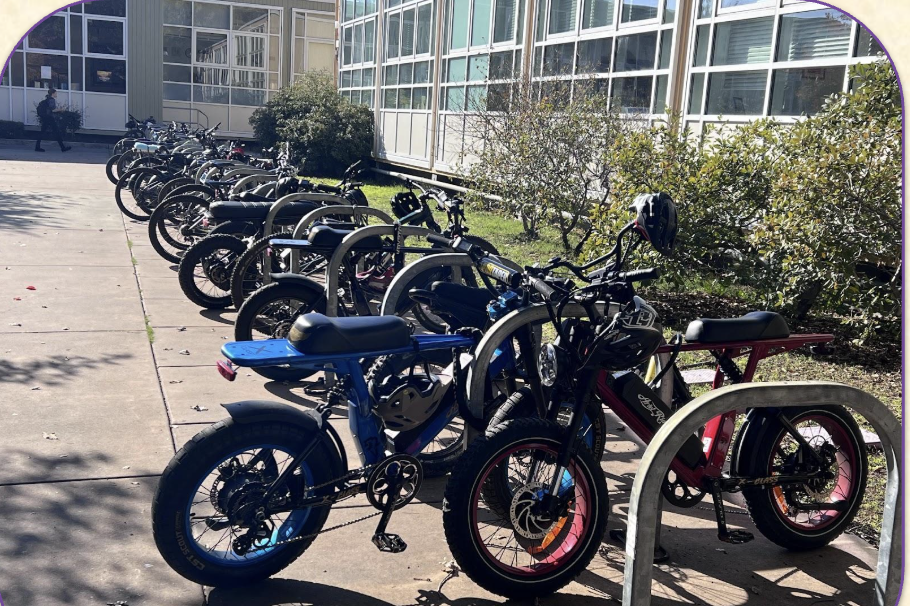
Assembly Bill 1569 (Chen, R-Brea and Davies, R-Oceanside) would require each school that allows pupils to park e-bikes on campus to require pupils to complete an e-bike safety program. While the bill is well-intentioned no doubt, we do not think schools should be burdened with this responsibility. And it would not cover the e-motos, which are the vast majority of electric devices that students ride to school based on our counts with Safe Routes to Schools in three Bay Area counties.
We end with Assembly Bill 1942 (Bauer-Kahan, D-San Ramon) — another classic and unfortunate example of bike lash. Rather than address the e-moto problem, the bill would require class 2 and class 3 electric bicycles to be registered with the DMV and to display a special license plate issued by the department. At a minimum, class 3 e-bikes should be excluded and this should be limited to anything sold as a class 2 e-bike. The same requirement should also apply to e-motos.
The benefit of requiring a license plate on class 2 e-bikes is that the police will have an additional reason to stop anyone riding a throttle device without determining whether it is a class 2 e-bike or an e-moto. If a class 2 e-bike, it must have a license plate under this bill. If it is an e-moto, it must have a license plate under existing law.
In this nuanced way, AB 1942 is similar to Assembly Bill 1778 (Connolly, D-San Rafael) which authorized a pilot program in Marin to require a minimum age of 16 for class 2 e-bikes. AB 1778 was triggered by a tragic brain injury suffered by a Marin high schooler who, as reported in the New York Times, was riding an e-moto, not an e-bike. Ariel Rider’s advertised top speed was 38 mph, almost double the limit for class 2 e-bikes.
Nonetheless, AB 1778 aided in enforcing existing laws against e-motos because now the police have reason to issue citations to any riders of throttle devices under 16. They are either violating the Marin ordinance if their vehicle is a Class 2 e-bike. Or they are violating existing laws requiring licensing and registration of e-motos.
AB 1942 may well have the same effect. But it should be limited to Class 2 e-bikes, not Class 3 which are not the problem.
Update from Bob, 4/15:
One late entrant that I didn’t mention in the April 13 op-ed: Assembly Bill 2595 (Papan, D-San Mateo). It would authorize San Mateo County and its municipalities, in their discretion, to impose a minimum age of 12 years for riders of Class 1 and Class 2 e-bikes. We have four problems with the bill.
First, it continues the sponsor’s focus on legal e-bikes and distracts attention from the main problem: illegal e-motos. To address that problem our politicians should be calling for more enforcement, and passing bills like AB 2284 that facilitate enforcement.
Second, given the present difficulty that schools, parents and police encounter in trying to tell which throttle devices are e-bikes v. e-motos, as a practical matter this bill would essentially condone kids as young as 12 years old riding devices that go 40 mph with the mere twist of a throttle.
Third, the “pilot” nature of the bill (like the previous San Diego and Marin counterparts) treats our youth as guinea pigs. The concept is “let’s have a minimum age of 16 in Marin and 12 in San Diego and San Mateo, and compare how many kids get killed or mained over three years, and then we will decide what the statewide minimum age should be.” A better approach is to recognize that throttle device manufacturers and retailers have cheated on the Class 2 category by selling e-motos as e-bikes, and it’s time to eliminate Class 2 entirely.
Fourth, the bill repeats the mistake of the previous Marin and San Diego bills by limiting the data collection to fatalities and “loss or permanent impairment of function of a bodily member or organ.” Broken limbs apparently don’t matter if they heal!

Streetsblog has migrated to a new comment system. New commenters can register directly in the comments section of any article. Returning commenters: your previous comments and display name have been preserved, but you'll need to reclaim your account by clicking "Forgot your password?" on the sign-in form, entering your email, and following the verification link to set a new password — this is required because passwords could not be carried over during the migration. For questions, contact tips@streetsblog.org.